

Iconic IWC Schaffhausen Collections – Engineering, History, Icons

Founded in 1868 in Schaffhausen by American Florentine Ariosto Jones, IWC has gone against the grain from the very beginning. Quite literally: energy from the Rhine powered precision machines, and Jones combined Swiss craftsmanship with American industrialization. The result? A brand that collectors call the “engineer of watchmaking.”
Why is IWC considered the “engineer of watchmaking”
It’s simple. Where other houses speak of luxury, IWC speaks of technical solutions. The iconic collections of this brand are not just about design—they offer specific functions and a story:
- Pilot’s Watches – aviation tools since the 1930s, now featuring ceramic and titanium materials
- Portugieser – chronometric precision in an elegant form (that distinctive large indicator)
- Portofino – Italian lightness with a Geneva heart
- Ingenieur – protection against magnetic fields, created for scientists
- Da Vinci – perpetual calendars and complications, where technique meets art
- Aquatimer – diving DNA with a Quick-Change system for straps
Each family has its own calling and a dedicated fan base. Interestingly, IWC has recently been focusing heavily on in-house calibers and experimenting with materials (ceramics, Ceratanium), especially in the aviation context. Outer space? That interests them too. But more on that in a moment.
History and Evolution of IWC
In 1868, the American watchmaker Florentine Ariosto Jones landed in Schaffhausen with a plan that sounded rather crazy: to combine Swiss craftsmanship with American mass production. Energy from the nearby Rhine was to power the machines, and pocket watches were mainly destined for the US market. That was when International Watch Company was born.
Already in 1885, IWC showed that it likes to be first. The Pallweber system with jumping numerals? A revelation for its time (and that’s why in 2018, for the 150th anniversary, the brand brought it back). But the true icons arrived in the 1930s and 1940s. In 1936, the “Spezialuhr für Flieger” made its debut—a legend in aviation. Three years later, in 1939, Portuguese importers managed to convince IWC to create something extraordinary: the Portugieser, with cases that were enormous for those days—about 41–43 mm—with a pocket watch caliber inside.
We owe much of the post-war development to Albert Pellaton. His caliber 89 and the Pellaton winding system are the foundations of the brand. Around 1948, the Mark XI was created for the RAF, a watch encased in soft iron to protect against magnetism. Simple, effective, iconic.

From Genty to the anniversary
The following decades saw the expansion of families: 1955 brought the Ingenieur, 1967 the Aquatimer, and 1969 the Da Vinci with the quartz Beta 21 (yes, IWC also experimented with quartz movements). Then came the quartz crisis and the response in the form of the Ingenieur SL designed by Gérald Genta from 1976. Resistance of 80,000 A/m, with only about 598 pieces produced in steel. Collectors today lament that they don’t own one.
In 1985, Kurt Klaus created the Da Vinci Perpetual Calendar operated exclusively by the crown, without correctors. The 1990s brought the Grande Complication, Il Destriero Scafusia, and in 1993 the Portugieser Jubilee ref. 5441. In 2000, IWC joined Richemont, which gave it financial stability for further experimentation. In 2017, Ceratanium® (a titanium and ceramic alloy) appeared, and a year later the brand celebrated its 150th anniversary. All these dates and names come together to form one truth: IWC has built its legend consistently, stone by stone.
Six IWC families
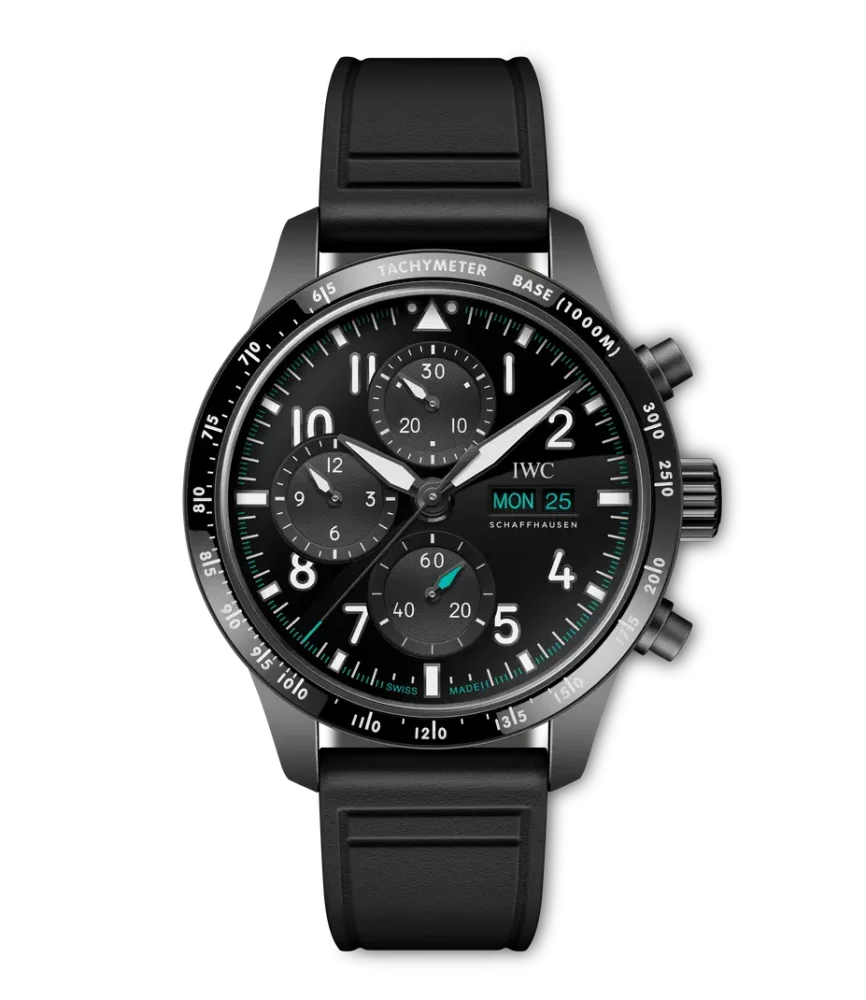
Each of the six IWC families has its own “personality,” stemming from its original purpose. Pilot’s Watches? Here, legibility is paramount: a large triangle at 12, contrasting hands, anti-magnetic protection (soft iron inside the case). Big Pilot with a 46 mm case and a power reserve of ~7 days (cal. 51110 or 82xx) is an icon of the genre, while the Mark XX at 40 mm (cal. 32111) is a more versatile, everyday version.
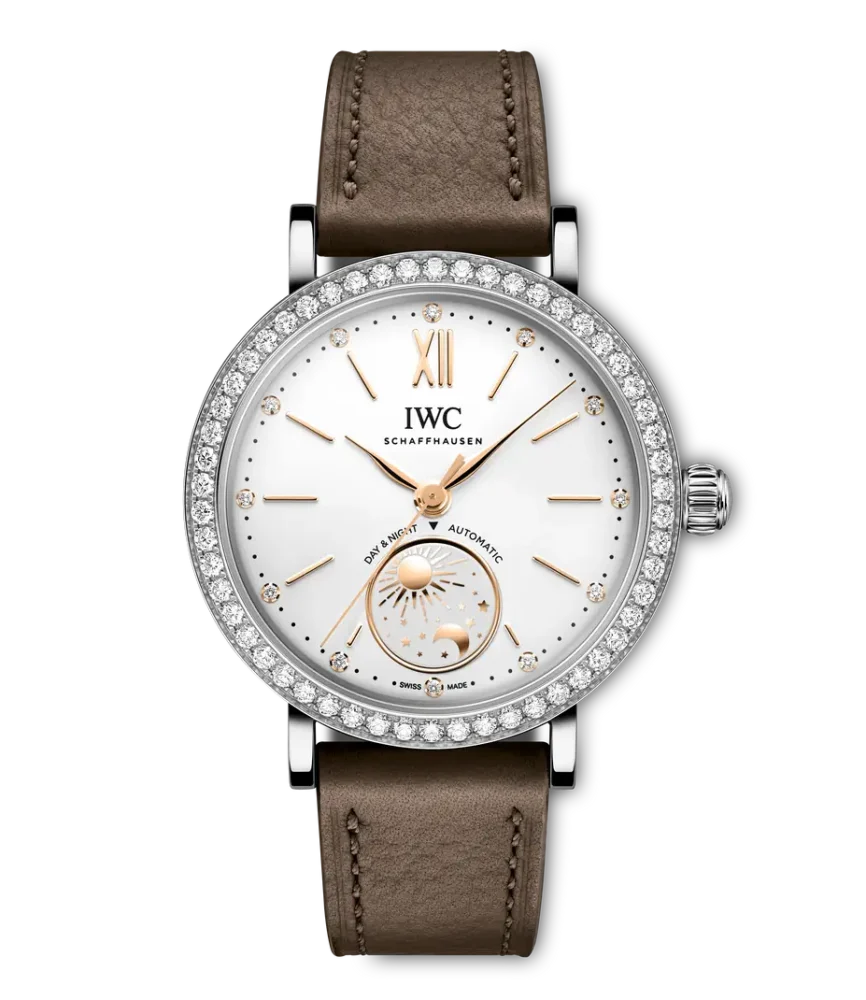
Portugieser targets lovers of classic watchmaking: large diameters (40-46+ mm), clear dials inspired by marine chronometers. Here you’ll find serious complications (perpetual calendar, rattrapante, tourbillon). Portofino goes the other way: elegant dress style, smaller sizes (34-37 mm), simplicity and versatility. Perfect under a cuff.
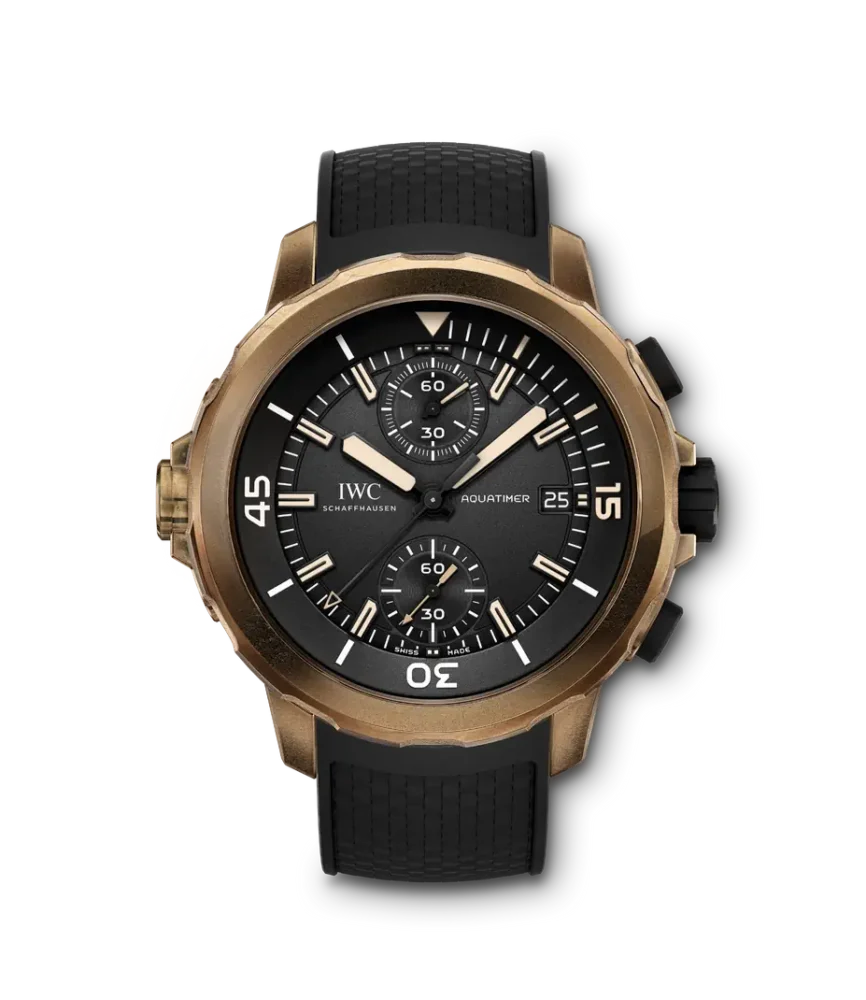
Ingenieur, a modern sports watch with an “integrated bracelet” in the Genta style, has antimagnetic roots and a distinctive “grid” on the dial in selected versions. Available in 35/40/42 mm, depending on wrist thickness. Da Vinci is the carrier of the most advanced movements (perpetual calendars, rattrapante chronographs), today mainly round. Aquatimer? A true tool diver, some references withstand up to 200 bar, rotating bezel systems, zero compromises underwater.
| Collection | Key features/usage |
|---|---|
| Pilot’s Watches | Legibility, anti-magnetism, 40-46 mm, aviation DNA |
| Portugieser | Large sizes, complications, dress elegance |
| Portofino | Minimalism |
| Engineer | Sporty integrated, grid dial, antimagnetism |
| Da Vinci | Advanced complications, round shape |
| Aquatimer | Diver up to 200 bar, bezel systems, tool |
Choice? It depends on whether you need readability in the cockpit, an elegant chronograph for a tuxedo, or perhaps a diving tool that will withstand anything.
Technical breakthroughs and materials
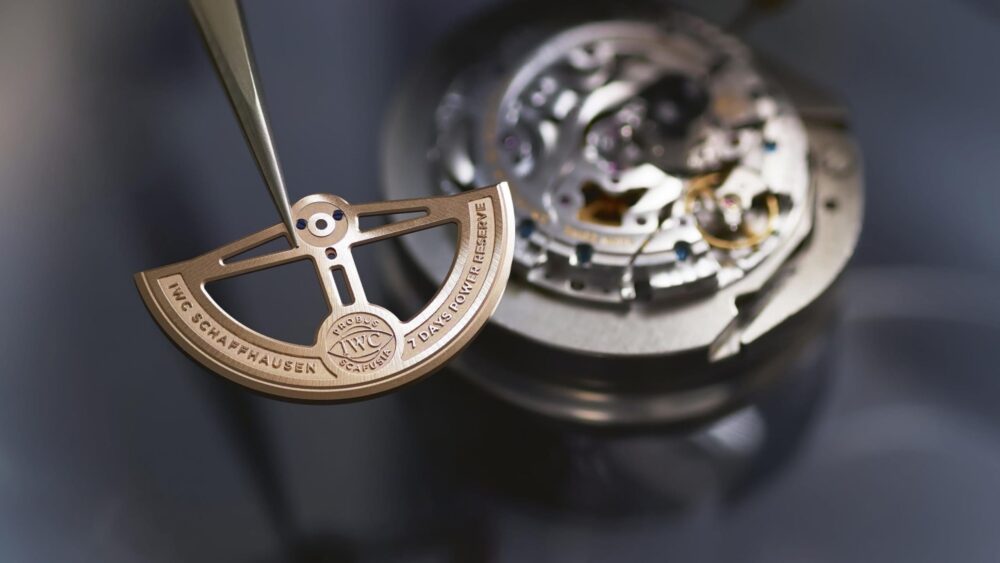
Caliber 89 is the post-war pillar of IWC, a precise movement that laid the foundation for dozens of subsequent calibers. But the real breakthrough is the Pellaton winding system, introduced in the 1950s and still in use today. Instead of a standard unidirectional rotor, it operates bidirectionally, which means greater efficiency with ordinary wrist movements. In practice? The watch winds faster and more evenly. It’s a simple mechanism that just works better.
The next step is the power reserve, which in the 5000, 51110, or 82xx families reaches around 168 hours. That’s 7 days without wearing. Take off your watch on Friday evening, and it will still be running on Monday morning the following week.
Materials and durability
Antimagnetism is a topic that IWC has taken seriously since the 1940s. The soft iron in the Mark XI cage (RAF, circa 1948) was just the beginning. The real record came in 1976 with the Ingenieur SL: 80,000 A/m, resistance comparable to that of an MRI magnetic field.
Materials? This is where it gets interesting:
- Titanium and ceramic – used for years, lightweight and durable
- Ceratanium® (2017) – the lightness of titanium combined with the hardness of ceramic, all hardened in black
- Ceralume® – luminous ceramics in limited editions (it really glows!)
And then there’s Kurt Klaus’s perpetual calendar from 1985, which you operate solely with the crown, no correctors needed. A practical complication that doesn’t require a 20-page manual. Simple, clever, it just works.
Premieres 2025-2026 and the IWC. Curated. program.
IWC has shown a clear direction in recent seasons. The Ingenieur returns with new strength: three sizes (35, 40, 42 mm), including fully ceramic versions and a “Grid” variant in green, inspired by the F1 movie. In addition, the Pilot’s Watch Performance Chronograph 41, also draws inspiration from racing motorsport. For fans of complex mechanisms, there’s the Portugieser Eternal Calendar, which understands the Gregorian calendar for several hundred years, and the Big Pilot’s Perpetual Calendar Ceralume® with full luminescence (limited edition). Of course, the Le Petit Prince editions are back, because some icons simply need to be maintained.
In 2026, something unusual will appear: the Pilot’s Venturer Vertical Drive, a crownless watch designed in collaboration with Vast for space missions to the Haven-1 station. Adjustment is done via the ring and bezel. Really. This is intended to be a tool for everyday work in orbit, not a collector’s gadget.
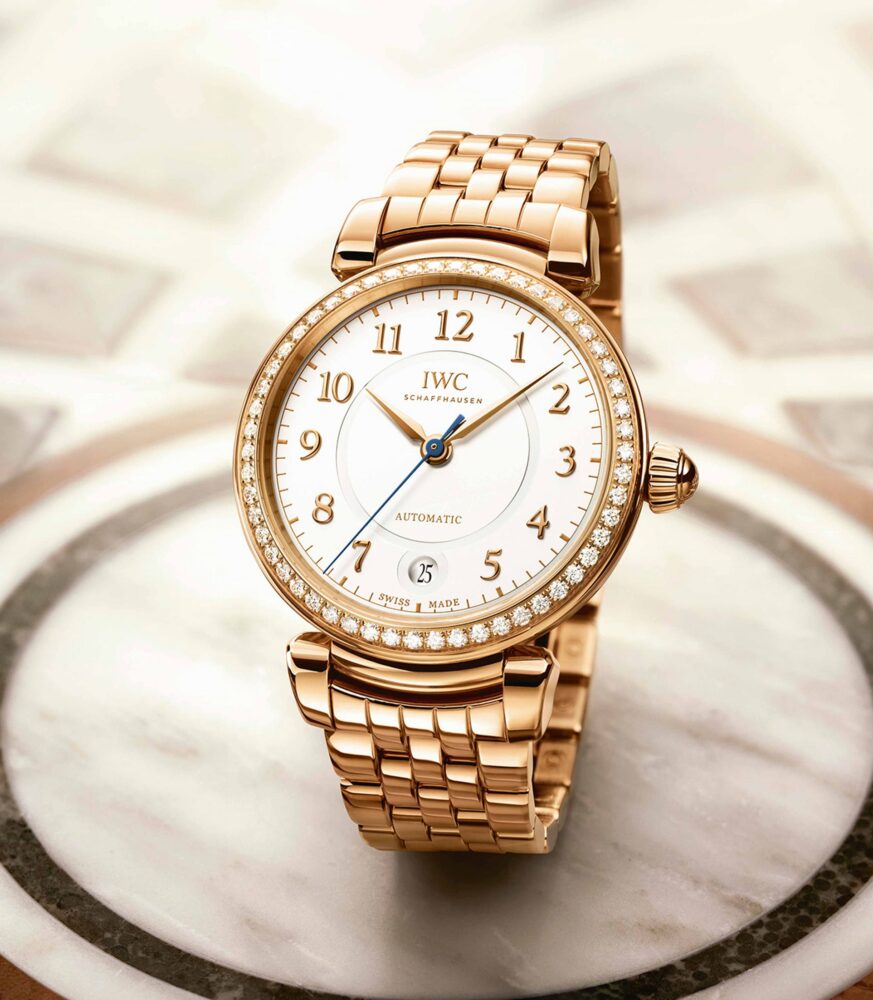
IWC. Curated.
The IWC. Curated. program (starting around 2025) is an attempt to bring order to the vintage market. Experts select key models from the past, such as the Ingenieur SL Ref. 1832, Da Vinci PC Ref. 3750, or the iconic Mark 11, offering museum-level verification. This gives collectors a guarantee of authenticity and provenance, which can often be a significant issue on the secondary market. It will be interesting to see how it fares in the long run, but the direction seems reasonable.
Buckle closure
IWC is a place where everything comes together: the precision of Swiss craftsmanship, the American pragmatism from the brand’s origins, and that persistent belief that a watch can be both a tool and a work of art. Pilot’s Watch for someone who flies. Portugieser for someone seeking elegant simplicity. Aquatimer for the diver. Ingenieur for the engineer. Sounds logical, right? And yet, it’s precisely this kind of logic that makes IWC still make sense in a world where most watches will never see a cockpit or the ocean floor.

Because ultimately, it’s about something simpler. You wear a piece of history on your wrist that works exactly as it should. No fanfare, no unnecessary complications. And somehow, that’s enough.
Hans
Luxury Blog editorial team





Leave a Comment