

What is Bespoke Tailoring?
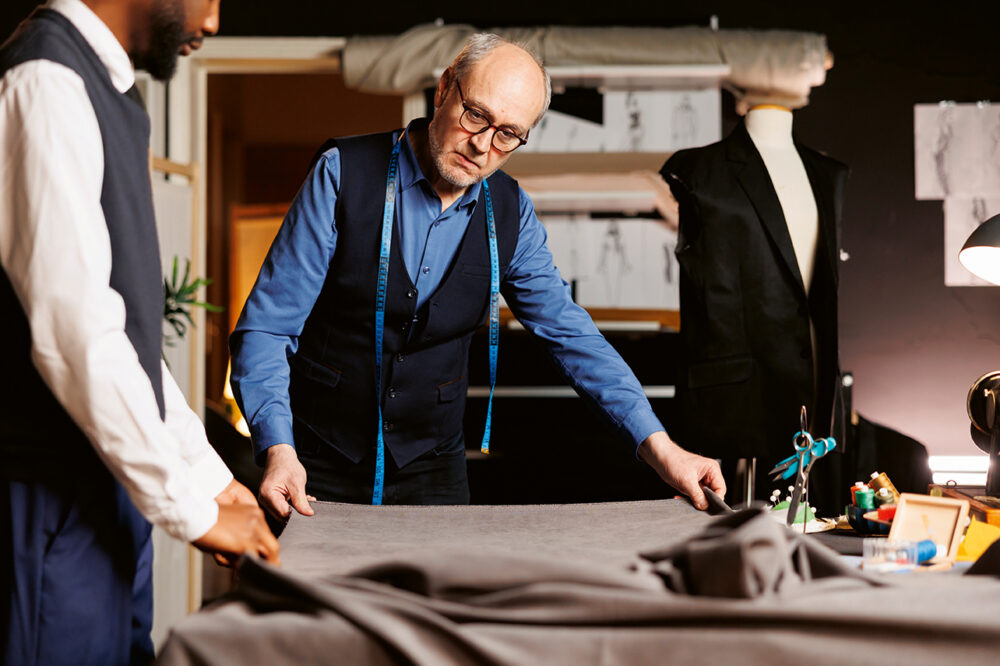
A fully bespoke suit requires at least 50 hours of handwork. That’s about two weeks of work for one person, dedicated solely to your garment. Sounds like a relic of the past? Yet in 2024, Savile Row has seen a marked resurgence in demand, especially among clients under forty.
What is Bespoke Tailoring and why is it making a comeback?
The pandemic changed more than we thought. People stopped buying suits just for show and started looking for things that truly fit, things you can wear for years. Personalization stopped being a whim and became a necessity. There’s something else, too: craftsmanship and manual skills suddenly matter again in a world where everything can be generated with a single click.
In this article, I will break down what bespoke tailoring truly is. You’ll get precise definitions (because bespoke is not just ” made to measure “), learn about the process from the first meeting to collection, see the historical context, and understand why a good suit costs what it does. We’ll also go through the differences between bespoke, made-to-measure, and off-the-rack, so you know exactly what you’re buying.
Definition and differences
I often hear that bespoke simply means “made to measure,” but that’s not precise enough. Here is a definition worth remembering:
“Bespoke tailoring (or custom tailoring) is the creation of clothing made to an individual buyer’s exact specifications by a tailor, resulting in garments that are completely unique and crafted without using any pre-existing pattern.”
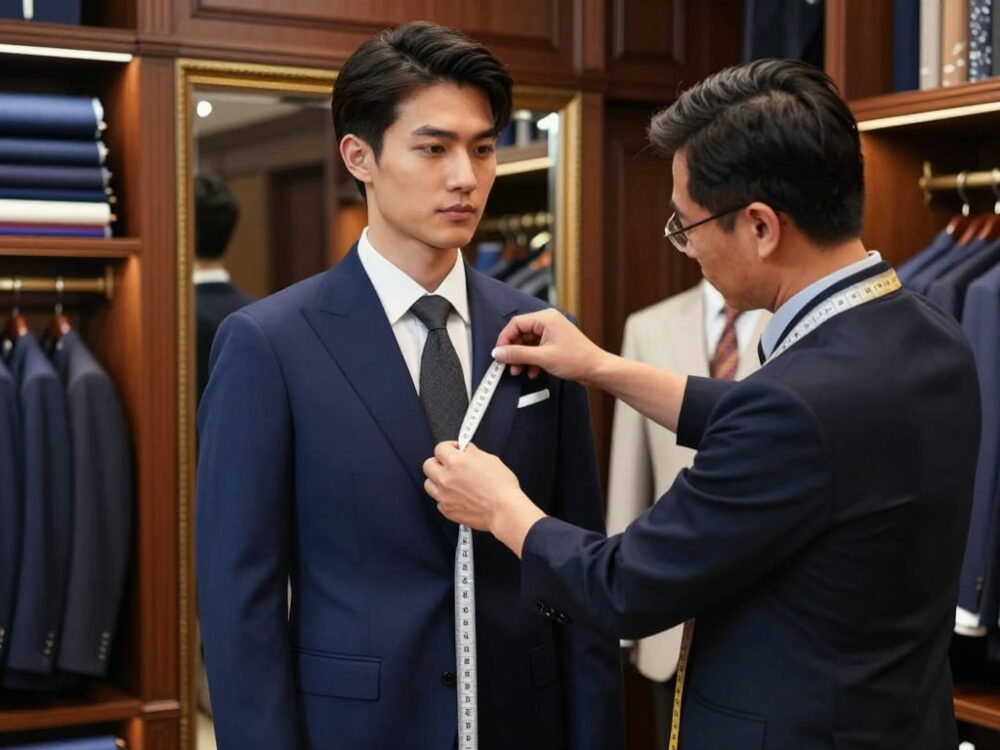
The key difference? The pattern is created entirely from scratch, tailored to a specific person. The tailor takes 20-30+ measurements (not just chest circumference and sleeve length), taking into account body asymmetry, posture, and shoulder slope. Then come the famous “basted fittings,” meaning 2-3 fittings with basting (white thread), during which the suit can still be modified. The SRBA standard is clear: bespoke means at least 50 hours of handwork for a two-piece suit.
MTM and RTW
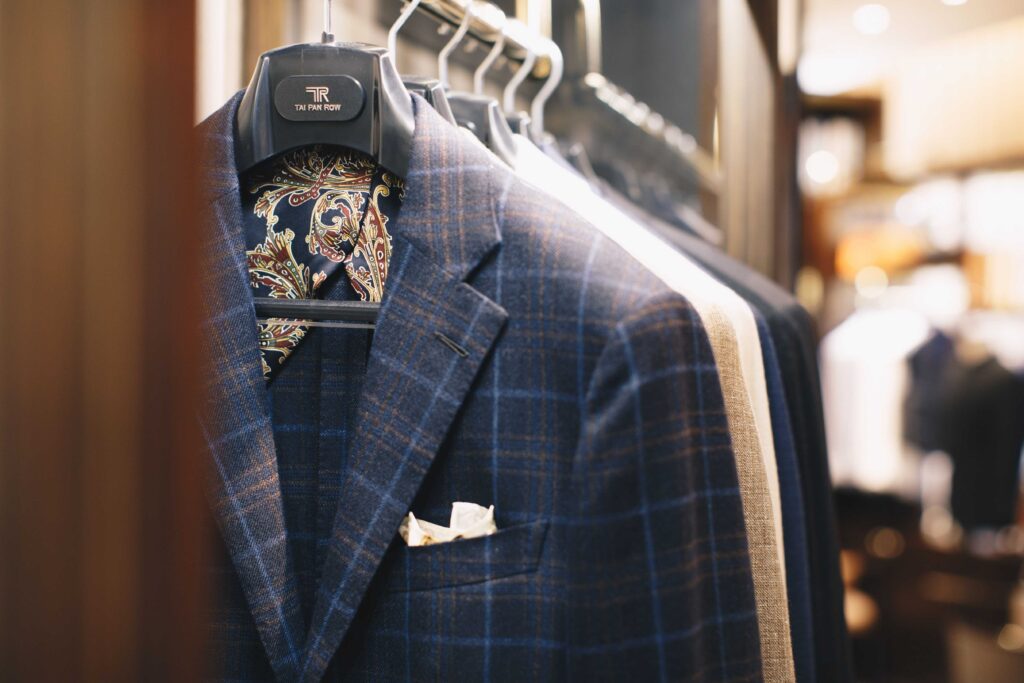
Made-to-measure starts from a ready-made base pattern, which the tailor digitally modifies to your measurements. Faster, cheaper, but you have fewer or no fittings. Works well for typical body types, but handles complicated asymmetries less effectively (one shoulder lower, forward-leaning front).
RTW (ready-to-wear) is classic mass production in sizes S, M, L, etc. You buy it in a store, and at most, you might have the pants hemmed by a tailor.
| Feature | Bespoke | MTM | RTW |
|---|---|---|---|
| Pattern | from scratch | base + adjustments | standard |
| Fittings | 2-3 | 0-1 | none |
| Lead time | 8-12 weeks | 3-6 weeks | available immediately |
| Handmade work | high (≥50h) | low/medium | none |
| Fit | perfect | good | approximate |
In practice: bespoke delivers an effect you simply won’t achieve in other categories. You can feel the difference even when getting into a car or in your gestures.
How is a bespoke suit made?
The bespoke creation process is much more than just sewing. It is craftsmanship, where every step matters and every detail is refined by hand over the course of months.
Stages from consultation to completion
The whole adventure begins with a detailed consultation, during which the tailor takes 20-30 measurement points, and sometimes even more. Next:
- Pattern construction – an individual design is drawn by hand on paper, taking into account body posture and asymmetries
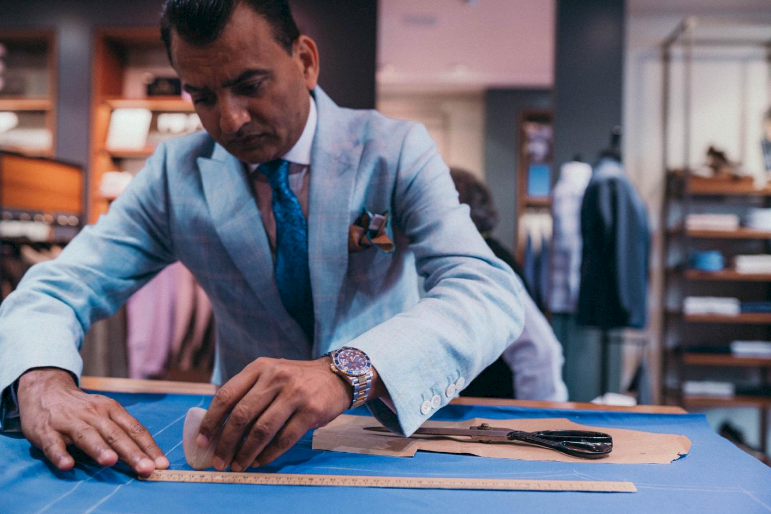
- Cutting the fabric – the tailor uses scissors and chalk, without machine templates
- Basting – temporary stitching with white thread before fitting
- Fittings – usually 2-3 sessions, where everything can still be adjusted
- Final stitching – this is where all the magic of handcrafting happens
- Finishing and ironing – precise ironing according to body shape
The entire process takes about 2-3 months.
What is a basted fitting?
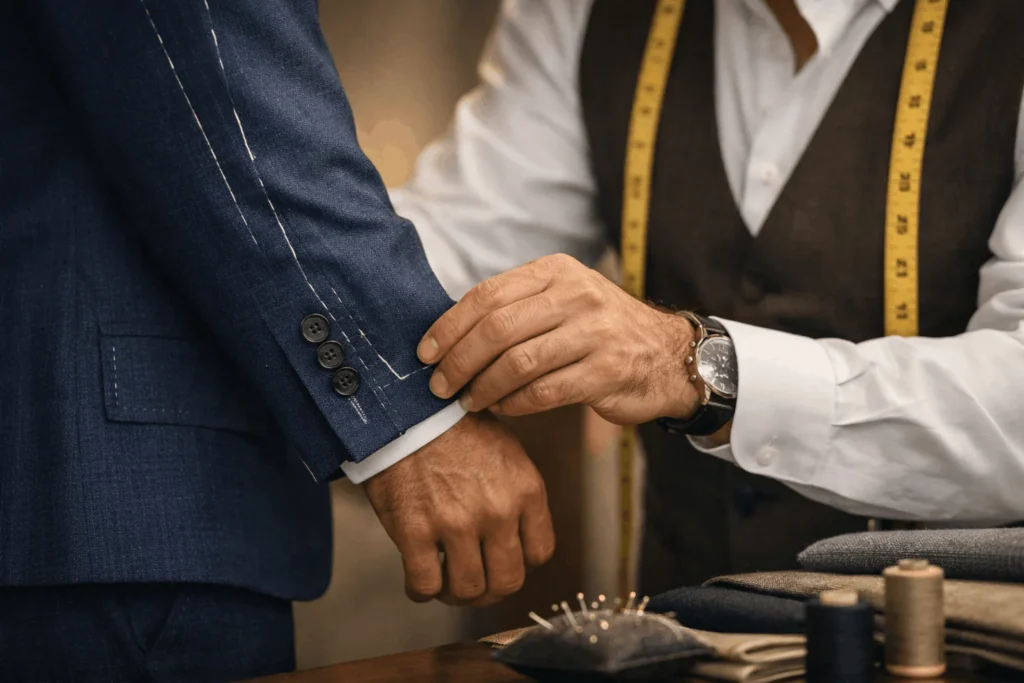
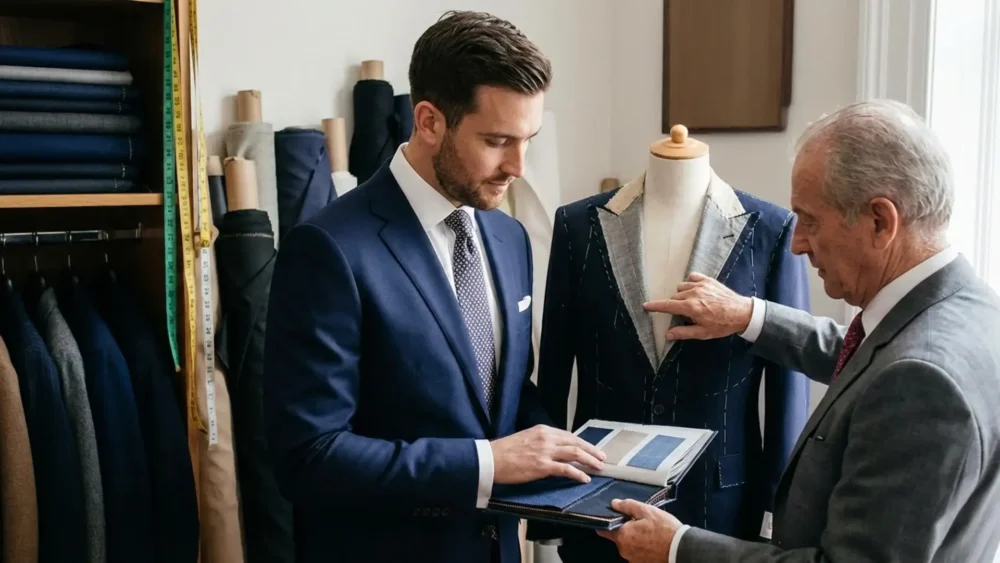
This is the moment when the suit is loosely basted with white thread, not yet permanently sewn. This allows the tailor to see how the fabric fits your body in motion. He can adjust the shoulder line, tailor the waist, correct the sleeve length. It’s like a “draft version” of the suit, only three-dimensional.
Handcrafted details that make a difference
According to SRBA, true bespoke requires a minimum of 50 hours of handwork. What does this actually mean? A hand-sewn canvas interlining that allows the suit to “breathe” and adapt to the body shape. Hand-stitched buttonholes. Hand-sewn linings. Quilted lapels.
Your individual pattern is archived, so for your next order the tailor has a base that can be further refined. As a result, each subsequent suit is better than the previous one.
History and Evolution
The word “bespoke” comes from the verb “bespeak,” meaning to order in advance. In the 18th century, a client would visit a London tailor, select a bolt of fabric that was set aside for him, and then have it made into clothing. It all began around Piccadilly, in the area of the Burlington Estate, where what is now Savile Row gradually took shape.
A few dates that really matter in this story:
- 1806 – Henry Poole & Co opens for business, becoming one of the oldest tailoring houses
- 1846 – Poole moves to Savile Row, establishing the street as the destination for bespoke
- 1860–1890 – the Industrial Revolution accelerates RTW, bespoke retreats to the elite, but workshops are abuzz with union strikes
- 1969 – Tommy Nutter opens Nutters of Savile Row and blends elegance with rock rebellion
- The 1990s. – Richard James, Ozwald Boateng, Timothy Everest return with new cuts and colors, adapting tradition to today’s bodies
Institutions that protect craftsmanship
In 2004, the Savile Row Bespoke Association (SRBA) was established to ensure that nothing is called bespoke unless it truly is bespoke. In 2016, Westminster introduced a Special Policy Area to protect the street from developers eager to build office blocks there. And it works—2024 saw a rebound in sales after COVID, as clients returned for suits tailored for them, not for the masses.
Craftsmanship endures because it adapts, without denying itself.
Market and trends
The global bespoke tailoring market is currently experiencing an interesting moment. On one hand, there are traditional tailoring houses that stick to proven methods; on the other, quite a few new players are emerging, combining craftsmanship with modern solutions. It is precisely this tension between the old and the new that shapes today’s market.
How much is the bespoke market worth
The numbers are quite specific:
- Global value: ~USD 3.2 billion (2024) → forecast USD 5.8 billion (2033)
- Growth rate: CAGR of approximately 6.8% per year
- Male participation: ~58%+ of market value
- Offline channels: still ~70% of sales, although online is growing
- Geography: North America and Europe hold the largest shares, but APAC is accelerating the fastest
Savile Row itself (still a symbol of the market) consists of around 19 houses, about 400 tailors, and approximately £40 million in annual revenue before the pandemic. After COVID, the numbers bounced back, though not evenly everywhere. Clients? HNWIs, executives, celebrities, but also simply people who want a perfectly tailored suit.
Technology that supports craftsmanship
Bespoke no longer means just a tailor with a measuring tape. More and more houses are reaching for tools that speed up measurement and refine the cut, without taking away handcraft where it matters:
- 3D body scanning replaces some traditional measurements
- Virtual fittings help remote customers see the result
- AI suggests cuts and fabrics based on your figure and preferences
- Digital patterns allow you to grade details without losing quality
Sustainability and development directions
Here the market is truly changing. Made-to-order production naturally limits overproduction, and the longevity of a bespoke suit is an argument in itself. In addition, eco-friendly fabrics are emerging: organic cotton, recycled fibers, Tencel. Not everyone is doing this, but the trend is there.
Directions for the coming years? Hybrid models (tech + final manual work), greater inclusivity of body types and genders,
When does bespoke make sense?
For a suit tailored on Savile Row, you’ll typically pay £4,000–£6,000, and with more complex fabrics or finishes, the price goes up. Globally? From several thousand to several tens of thousands of zlotys, depending on where you order and how extravagant you get. The difference compared to mass fashion isn’t just in the material. In bespoke, the production cost is about 33% of the final price, while in RTW it’s only 13–20%. The rest? That’s the tailor’s time, who hand-shapes the garment over 2–3 months. You’re paying for hours of fittings, adjustments made directly on your body, and details that machines simply can’t replicate.
Bespoke, MTM or RTW?
When is it worth choosing bespoke:
- You have an unusual body shape or noticeable asymmetries: ready-to-wear sizes don’t fit, MTM offers too few adjustments
- You work in a position where a suit says more than the title on your business card (diplomacy, corporate leadership)
- Are you looking for a suit or wedding dress designed to last for years and carry your personal signature
- Do you want something truly extraordinary: custom details, a pattern tailored to your figure
When MTM or RTW is enough:
- You have a standard figure and you quickly need clothes
- The budget doesn’t allow for several thousand for a single suit
- Do you prefer a compromise between price and fit (MTM will deliver 80% of the effect for 40% of the price)
Bespoke is an investment in something that will serve you for ten years. But only if you truly need it.
The measure that stays for a lifetime
In the world of fast fashion and trends that change every season, bespoke is something fundamentally different. It’s an investment in understanding your own body, which (well, with perhaps a few minor exceptions) remains relatively constant over the years. When a tailor creates a full set of measurements tailored to your silhouette, you receive something like a personal template that can be used for future orders. And here’s the crux: this knowledge of proportions, asymmetries, and preferences remains relevant.
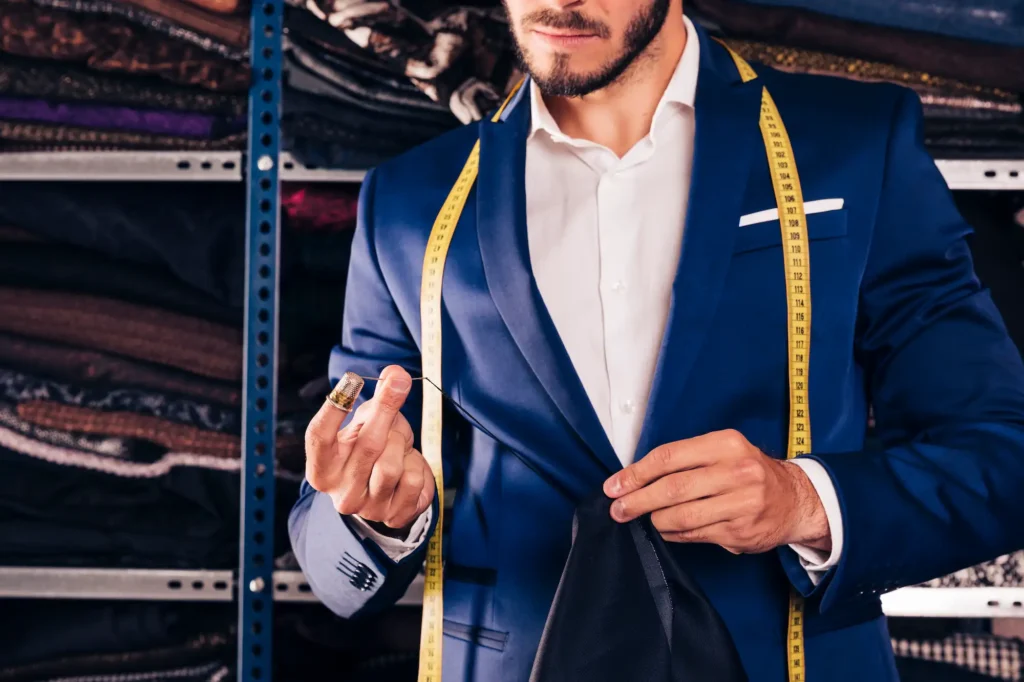
In retrospect, I see that bespoke teaches you more than just how to wear well-tailored clothes. It teaches you awareness of your own physique, an understanding of what works and what doesn’t. After a few sessions with a tailor, you start to better understand why standard sizes never fit perfectly. This knowledge stays with you much longer than the suit itself.
That’s why people who try true bespoke even once rarely go back to anything else. Because it’s not just clothing—it’s a relationship with your own proportions.
Rony


Leave a Comment