

Tailoring a suit to measure without secrets

You may not know this, but the term “bespoke” has a precise definition in the British tailoring association SRBA: a minimum of 50 hours of handwork and a unique, individually drafted pattern. In practice, many ateliers misuse this word for marketing purposes, selling a service closer to MTM, or made-to-measure, as “bespoke.” But these are completely different levels of personalization and craftsmanship.
Why does it matter today?
“Custom” is an umbrella term that covers various things. MTM (sometimes called “fitted tailoring” in Poland) involves adjusting a ready-made pattern to your figure, modifying the measurements and details. Bespoke means creating a garment from scratch, where the tailor designs a pattern specifically for you and everything is made by hand. The difference? Time, number of fittings, cost, and the final result. MTM is popular for business and wedding suits, as it offers a good balance between price and quality.
In the following sections, you will learn specifically: how long you have to wait for MTM and for bespoke, what stages both processes involve, and what affects the delivery times. No marketing myths, just a factual comparison.
How long is the wait for MTM and bespoke?
Are you planning a suit and wondering when you’ll be able to pick it up? This is a crucial question, as the timelines for MTM and bespoke differ significantly.
Estimated completion dates
MTM usually takes 4-8 weeks from order to pickup. Some ateliers offer express service in 10 days to 6 weeks, but for an extra fee and depending on fabric availability. Bespoke? Here, patience is key: 8-16 weeks is standard, though it can take longer—sometimes even 20+ weeks at renowned ateliers. The difference is mainly because bespoke requires more fittings (3-5 instead of 1-2 in MTM) and is entirely handcrafted on site.
What has the greatest impact on time?
Several factors can extend the deadlines, regardless of the chosen standard:
- Seasonality and fabric availability – if you want Loro Piana or another top-quality wool, the factory may experience delivery delays
- Place of sewing – a factory in Eastern Europe operates differently than a local workshop in the center of Warsaw
- Peak wedding season (April–June, September) – that’s when the queues get longer
- Body complexity – asymmetries, non-standard posture, significant adjustments require more time
- Revision policy after delivery – some studios include them in the deadline, others add extra days
Sample MTM schedule: order and measurement (week 0) → production in the factory (week 1-4) → fitting and possible alterations (week 5-6) → pickup (week 6-8).
Sample bespoke schedule: measurement and fabric selection (week 0) → pattern cutting and first fitting (week 3-4) → subsequent fittings and adjustments (week 6, 9, 12) → hand finishing (week 13-15) → collection (week 16+).
Always verify the deadline directly with the selected atelier, as practices vary between brands.

What does the process and fitting look like?
To make an informed choice between MTM and bespoke, it’s worth knowing what happens from the initial consultation to the moment you pick up your finished garment. The names of fittings, their number, and the roles of the people conducting them can vary significantly.
MTM – step by step process
The made-to-measure process is usually divided into four stages:
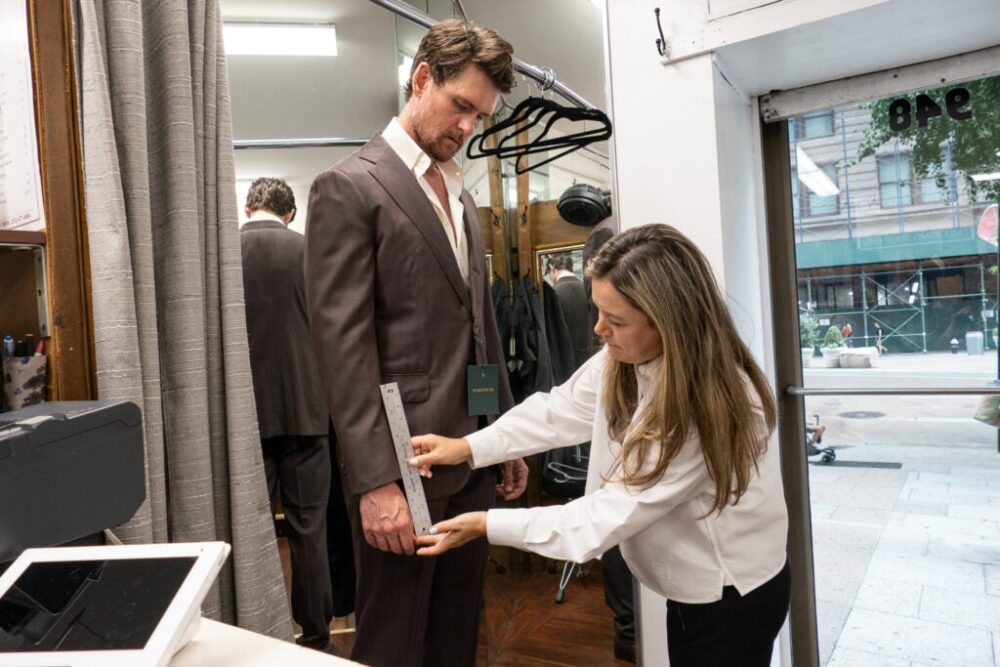
- Consultation and measurements – the tailor or consultant takes 10-20 measurements (chest, waist, hip circumferences, sleeve length, etc.), together you choose the fabric, lapel styles, and number of buttons.
- Modification of the base pattern – the studio or factory adjusts an existing pattern to your measurements.
- Production – the suit is made in a workshop or a larger factory (depending on the level of the offer).
- Final fitting and adjustments – you meet to check the fit; minor alterations (shortening the trouser leg, narrowing the sleeve) are done on the spot.
In better MTM offers, there is sometimes an additional “in-progress” fitting, but this is not standard.
Bespoke
True bespoke is five appointments:
- Consultation – 25-30 measurements plus posture analysis (shoulder asymmetries, pelvic tilt).
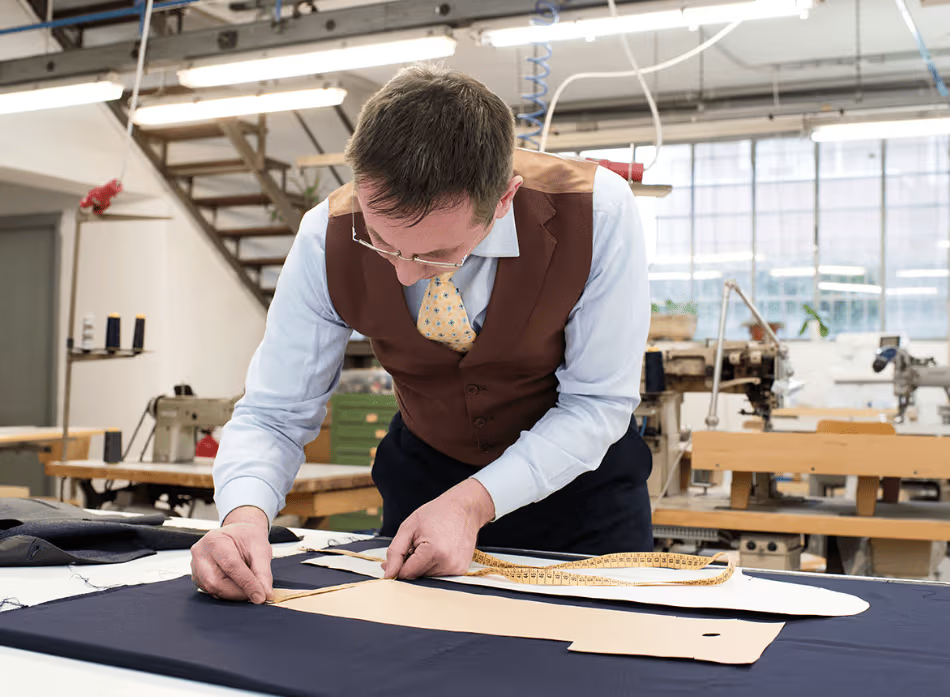
- Drawing a unique paper pattern – the cutter creates the design from scratch.
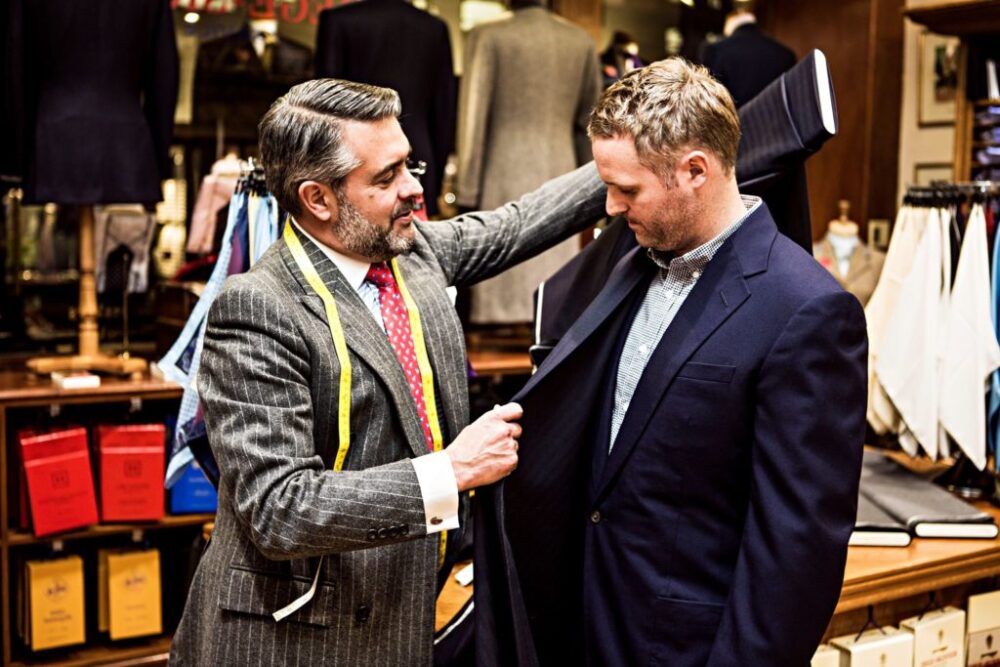
- “Baste fitting” ( first fitting) – a loose framework sewn from canvas, with adjustments made using chalk and pins. A crucial moment, as this is where the entire structure takes shape.
- “Forward/finish fittings” ( subsequent fittings) – the suit is almost ready, final adjustments to the shoulder line and length.
- Final acceptance – finishing touches and possible minor adjustments (depending on the studio’s policy).
Usually, 2-3 weeks pass between fittings. The cutter meets with you to make adjustments on the spot. He is responsible for the pattern and fit, not just the seamstress at the machine.
Minor adjustments after collection (e.g., after a few weeks of wearing) are sometimes part of the service, but the policies vary between studios.

What is the difference between MTM and bespoke?
MTM takes a ready-made corporate pattern (the so-called block) and adjusts it to your measurements. It can alter the sleeve length, hip width, or collar height, but works within the limits of the template. Bespoke starts from a blank sheet of paper, where the cutter creates your unique pattern, able to modify the shoulder line, pocket shape, or vent placement according to the character of your silhouette. The construction freedom is incomparably broader, including the atelier’s signature house cut.
Construction and durability
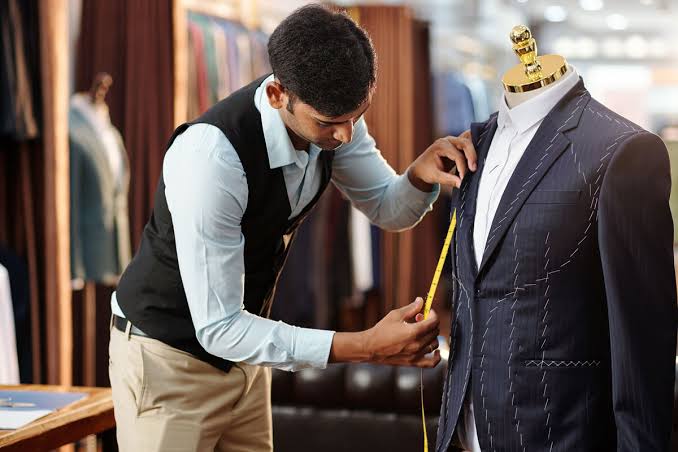
Most MTM suits receive a half-canvas construction (canvas only in the front part) or a fused (glued) one. It serves its purpose, but shapes less well. Bespoke usually goes for full canvas with the horsehair canvas hand-stitched to the outer wool, often also with a hand-sewn lining . This work takes 50-100+ hours of pure time, but the jacket molds with your body’s movement and becomes more beautiful over the years.
Price and purpose
In Europe, you often see the label £3,500 / $3,000+. The difference comes from the number of hand movements involved.
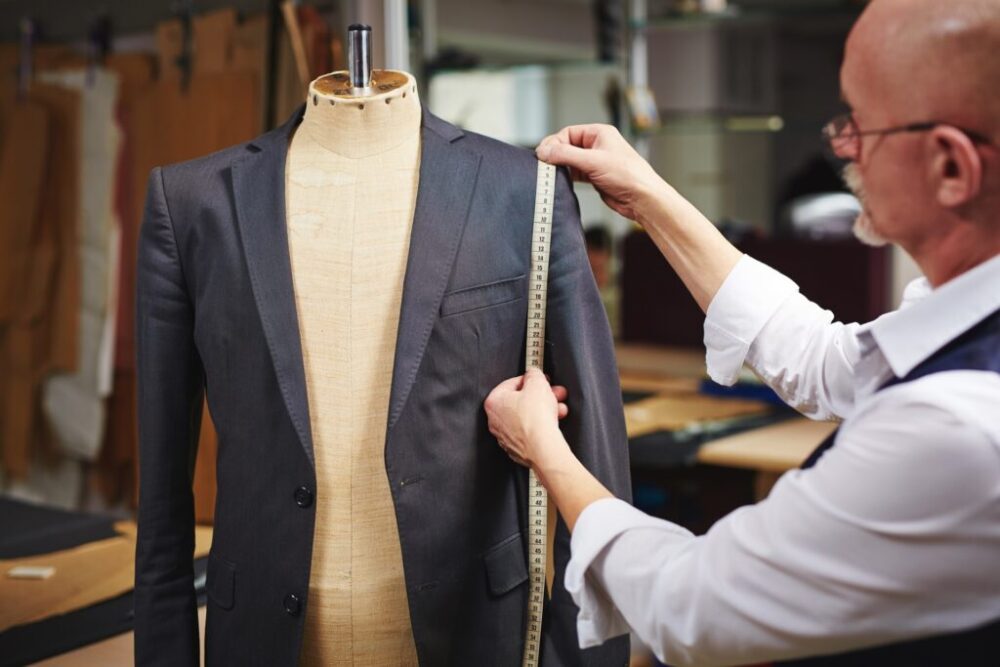
Note: many sellers misuse the word “bespoke” to refer to enhanced MTM. The British Savile Row Bespoke Association (SRBA) has clear standards: two fittings on you, hand cutting.
For whom? MTM, when your body shape is closer to the standard, you expect about a month of waiting, and you have a reasonable budget. Bespoke, when your posture is unusual ( asymmetry, sloping shoulders) or you need a landmark garment: for a wedding, an anniversary, something that lasts.
From choosing to the perfect suit
The difference between MTM and bespoke is not just a matter of time or price. It’s about the certainty that what you get truly fits you. With MTM, you know what to expect because you’re working within proven patterns. With bespoke? Here, you’re building something from scratch, but you have to trust the process and your tailor.
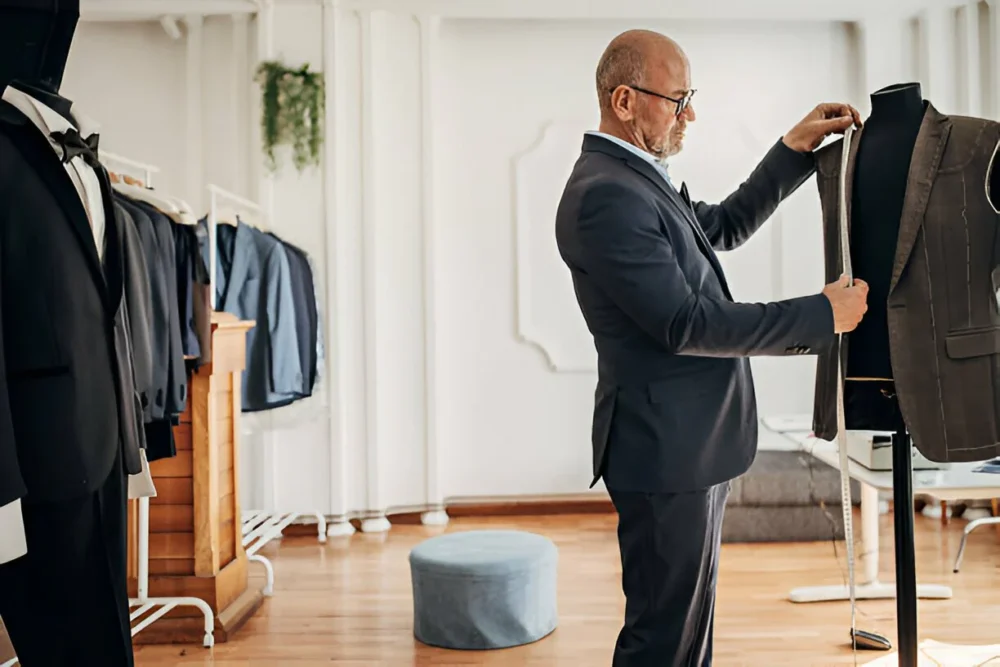
Both paths lead to a suit that fits better than anything off the rack. The question is: how much control do you want to have, and how much are you willing to invest in the process itself? Because it’s not just about money—it’s also your time and commitment.
At the end of the day (well, maybe after a few weeks), you come out with something that truly belongs to you. And that’s what it’s all about.
Toony U.
editorial fashion
Luxury Blog




Leave a Comment