

History of Saint Laurent
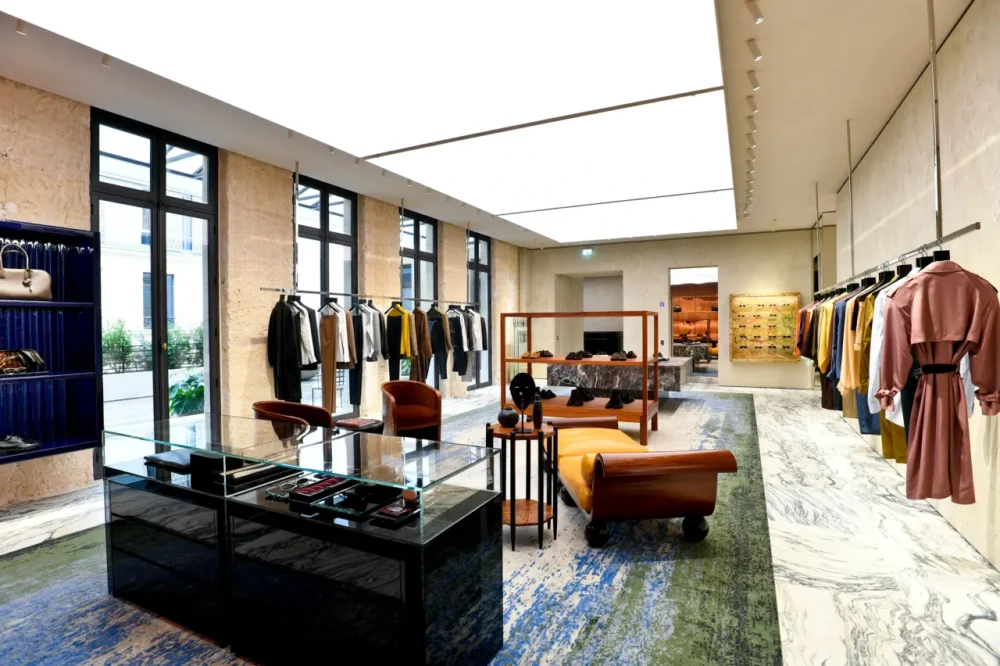
In 1966, Yves Saint Laurent designed “Le Smoking,” the first women’s tuxedo, which gave women the right to wear trousers in an elegant restaurant. Sounds trivial? Back then, it was a revolution. A woman in a men’s suit meant more than just fashion: it meant choice, autonomy, the ability to decide for herself.
Today, Saint Laurent is not just archival designs in museums. The brand still thrives as a synonym of cultural boldness, modernity, and a dialogue between art and what we wear every day. YSL was the first living designer to have a solo exhibition at the Metropolitan Museum (1983), which brought haute couture into galleries on equal footing with painting and sculpture. Fashion ceased to be just clothing; it became a language.
The contemporary brand, now simplified to “Saint Laurent,” produces films, draws inspiration from cinema and pop culture, but its foundations remain the same: freedom, modernism, and the courage to break boundaries. In this article, we will explore the designer’s origins, his debut at Dior, the creation of his own fashion house, and the journey to the brand’s current significance under the direction of Anthony Vaccarello. Because this is a story that continues to be rewritten.
History of Saint Laurent
Yves Mathieu-Saint-Laurent was born on August 1, 1936, in Oran, an Algerian port city. As a teenager, he was already winning design competitions organized by the International Wool Secretariat: in 1953, he took third place, and the following year, he won both first and third place simultaneously. Michel de Brunhoff from “Vogue” noticed him while he was studying at the Chambre Syndicale in Paris. In 1955, at just nineteen years old, Saint Laurent landed a position at the house of Christian Dior.
The real test came after Dior’s sudden death in 1957. YSL, at just twenty-one, took over as head designer and saved the company with the Trapeze collection for spring 1958. The press went wild with praise, but in 1960, military conscription brutally interrupted his career. A nervous breakdown, dismissal from Dior (which, to be honest, wasn’t entirely voluntary), and the prospect of an ending. That’s when Pierre Bergé, his life partner since 1958, stepped in and secured funding from J. Mack Robinson.
1961-1966
The Yves Saint Laurent fashion house launched in 1961 at 30 bis Rue Spontini. The first haute couture show took place on January 29, 1962. The success was immediate. In 1963, Adolphe Mouron Cassandre designed the iconic ” YSL ” logo, three letters intertwined in perfect geometry.
But the real breakthrough? That was 1966 and Rive Gauche, the first luxury prêt-à-porter line bearing the couturier’s name. The boutique at 21 Rue de Tournon brought haute couture to the street. The expansion was rapid: New York in 1968, London a year later. Saint Laurent understood that the future was not just salons for the chosen few, but freedom within reach of more women.
Stylistic revolutions
For twelve years, Saint Laurent transformed fashion into a field of experimentation. It wasn’t just about pretty dresses, truly. It was an attempt to answer the question: what can fashion borrow from art, and what can it give to women besides beauty?
Art on the dress
Autumn/Winter 1965 brought something no one expected. A simple trapeze dress in geometric color blocks of Piet Mondrian, as if someone had taken a canvas from a museum and turned it into clothing. It wasn’t a quotation, but rather a conversation between fashion and contemporary art. From 1966, Saint Laurent went further, reaching for Pop Art: Tom Wesselmann’s portrait on a dress, vibrant colors worthy of Andy Warhol. Haute couture entered the galleries, and the gallery stepped onto the runway.
The tuxedo that changed the evening
“Le Smoking” from 1966 is already a legend. A women’s tuxedo, black, sharply tailored, with satin lapels. Sounds simple? It was a scandal. Elegant restaurants refused entry to women in trousers, even those designed by Saint Laurent. But that was exactly what mattered most: the tuxedo became a symbol of emancipation, a refusal to play by the rules of traditional femininity. Power dressing of the 1980s started here.
Safari jacket (1968), tight trousers, high musketeer boots are further chapters of the same story. An androgynous look that said: a woman can wear whatever she wants.
Scents and scandals: from “Y” to “Opium”
Saint Laurent understood that scent is a language just as important as cut. “Y” (1964, created by Jean Amic) was only a prologue. The real breakthrough? “Pour Homme” (1971) with a nude campaign featuring the designer himself, “Rive Gauche” (1971) in a metal can like a hairspray. And then “Opium” in 1977, oriental, addictive, commercially brilliant. The very name triggered bans in some countries (an echo returned in the Sophie Dahl campaign in 2000).
The 1971 collection, called a ” Libération ” and a scandal by critic Michael Quarante, referenced the occupation-era aesthetics of France. Some of the press attacked the designer mercilessly. Saint Laurent learned then that provocation sells, but it comes at a price.
From couture to a global brand
When Yves Saint Laurent took his house public on the Paris stock exchange in 1989, it was no longer just a couturier’s atelier—it was a brand with structure, ambitions, and market pressure. A decade later, in 1999, it was acquired by the French group Pinault‑Printemps‑Redoute (now Kering). And this is where the real game begins: how to preserve the spirit of YSL in a world where business strategy matters just as much as creative vision.
Ownership structures
The acquisition by PPR provided the brand with capital for expansion, but it also raised the question: who would lead the creative direction after the founder’s departure? Yves designed until 2002, after which the reins were taken over in turn by Alber Elbaz, Tom Ford (who ignited the sexy aesthetic of the ’90s), and Stefano Pilati. Each brought something of their own. Ford established a recognizable glamour, Pilati aimed for sophistication, but it was Hedi Slimane who truly changed the game.
Rebranding 2012: why “Saint Laurent”
In 2012, Slimane shortened the name to Saint Laurent, sometimes adding Paris. He wanted slim silhouettes, rock energy, and a younger audience. Fans were outraged (remember the slogan ” Ain’t Laurent Without Yves ” on T-shirts?), but sales started to climb. Controversy attracts attention—and wallets.
Vaccarello and the continuity of vision
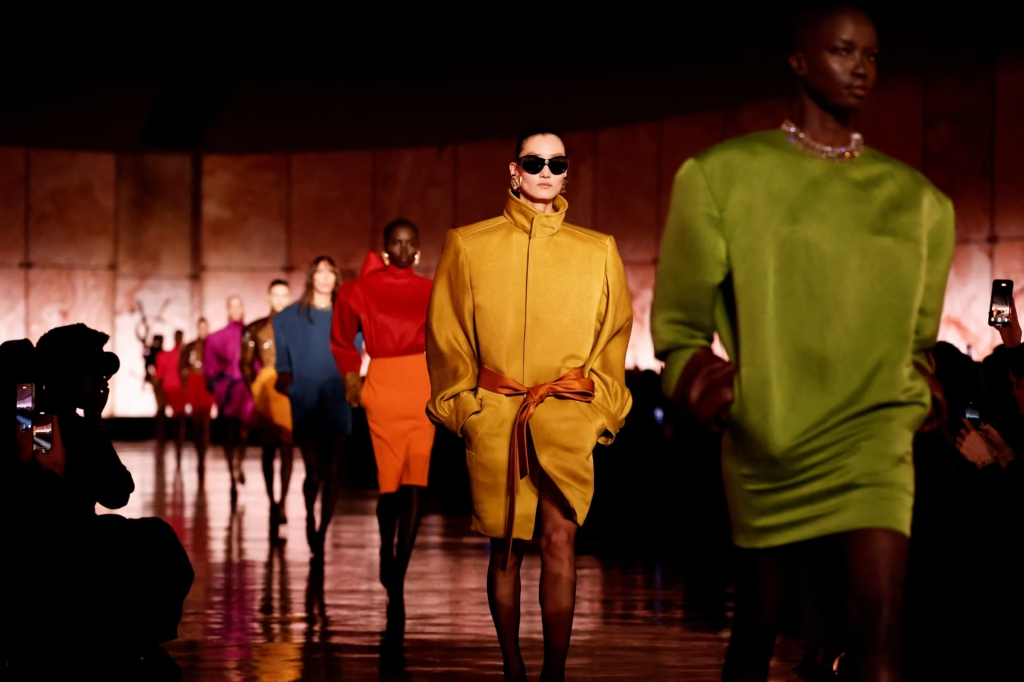
Anthony Vaccarello took over creative direction in 2016. He returned to strong femininity, leather, and structural cuts. He also develops cinematic narratives, building the brand’s image beyond the runway. Since November 2024, Cédric Charbit has been CEO (after Francesca Bellettini), but within Kering, the strategy remains consistent. So where does the brand stand today?
Saint Laurent today
What do the latest data say about the brand’s condition? The year 2025 closed with revenues of approximately €2.643 billion, an 8% decrease on a reported basis (about 6% compared to €2.881 billion in 2024). Operating profit amounted to €529 million, with the margin stabilizing at 20%. It may sound like a slowdown, but the fourth quarter showed sequential improvement, mainly thanks to new footwear and women’s ready-to-wear collections, as well as growth in North America and better cost efficiency. It’s clear that Vaccarello’s direction is holding strong, even though the luxury market has its fluctuations.
Boutique network and flagship locations
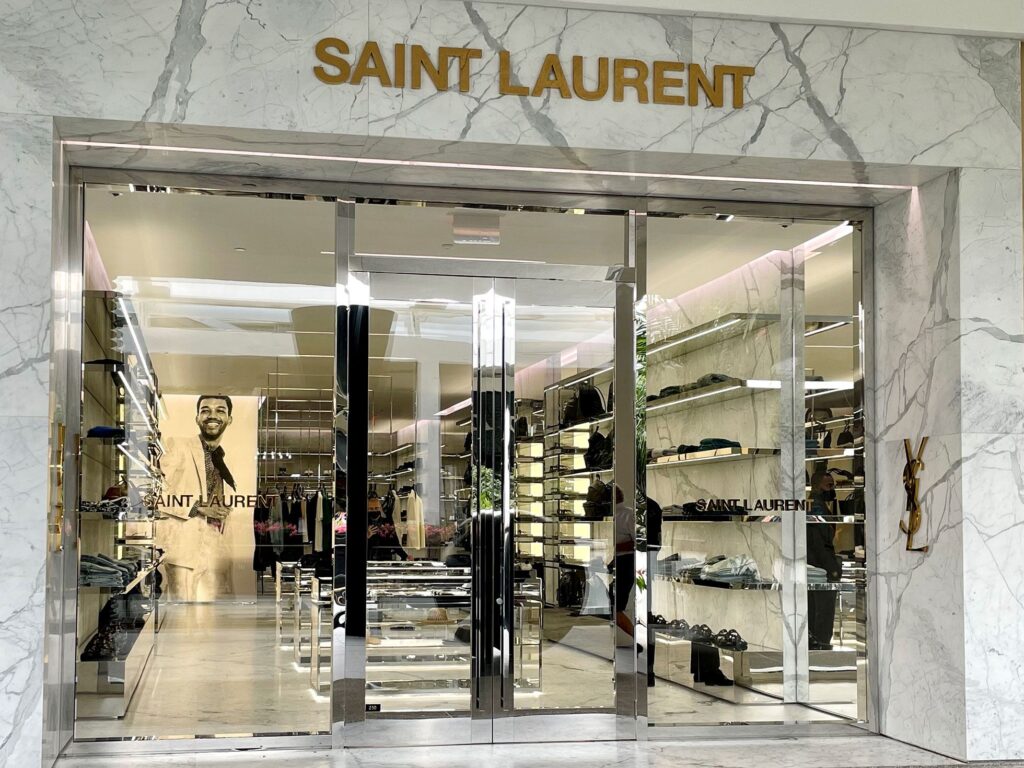
Saint Laurent operates through approximately 282-312 boutiques in over 48 countries (sources provide different numbers for early 2026, retail data always has such discrepancies). Estimated:
- Western Europe: approx. 72 stores
- USA: approx. 57 locations
- Flagships: Avenue Montaigne in Paris (November 2025) and Champs-Élysées (2023)
In addition, there are museums, the Musée Yves Saint Laurent in Paris (5 Avenue Marceau) and in Marrakesh (both opened in 2017), which safeguard the brand’s archives and heritage.
Saint Laurent Productions
Since around 2023, the brand has been running its own film platform, Saint Laurent Productions. Vaccarello is involved in costume design, and the list of creators is impressive: Pedro Almodóvar (“Strange Way of Life”, 2023), Paolo Sorrentino (“Parthenope”), David Cronenberg (“The Shrouds”), Jacques Audiard (“Emilia Pérez”, Cannes 2024). This is not sponsorship; it is about building a cultural narrative through cinema.
Lyst Index 2025 recognized the brand as the “hottest brand,” confirming that Saint Laurent still has cultural momentum.
Freedom, modernism, memory
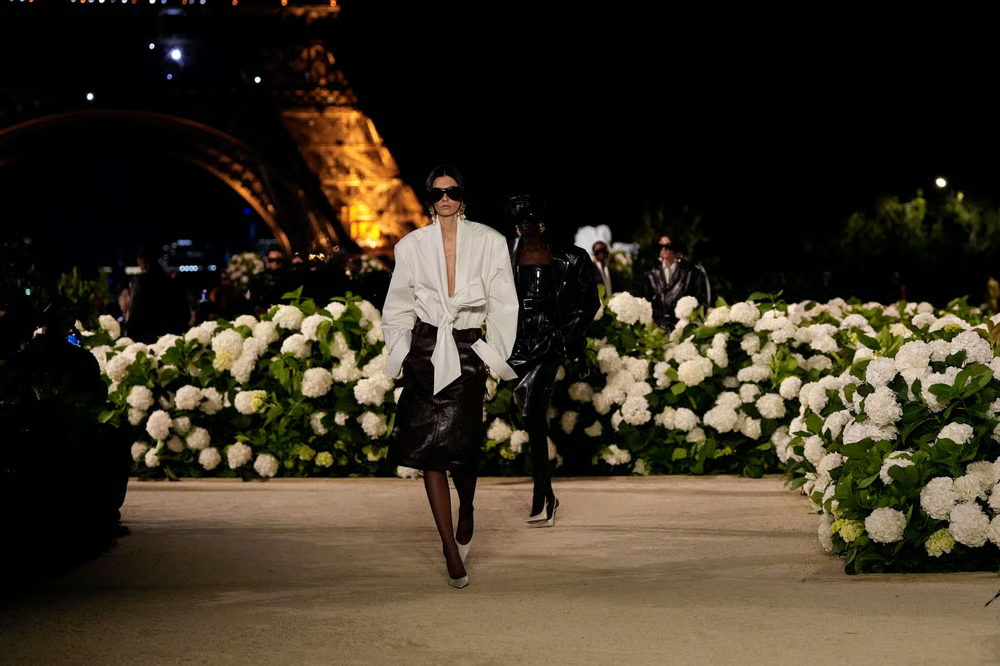
Saint Laurent not only dressed women in trousers. He showed that freedom doesn’t need a manifesto—a well-tailored blazer is enough. Here, formal courage met business intuition, and the memory of Le Smoking became more than just nostalgia. It’s proof that the brand knows how to balance heritage and the present, without losing its identity through changes in owners or creative directors.
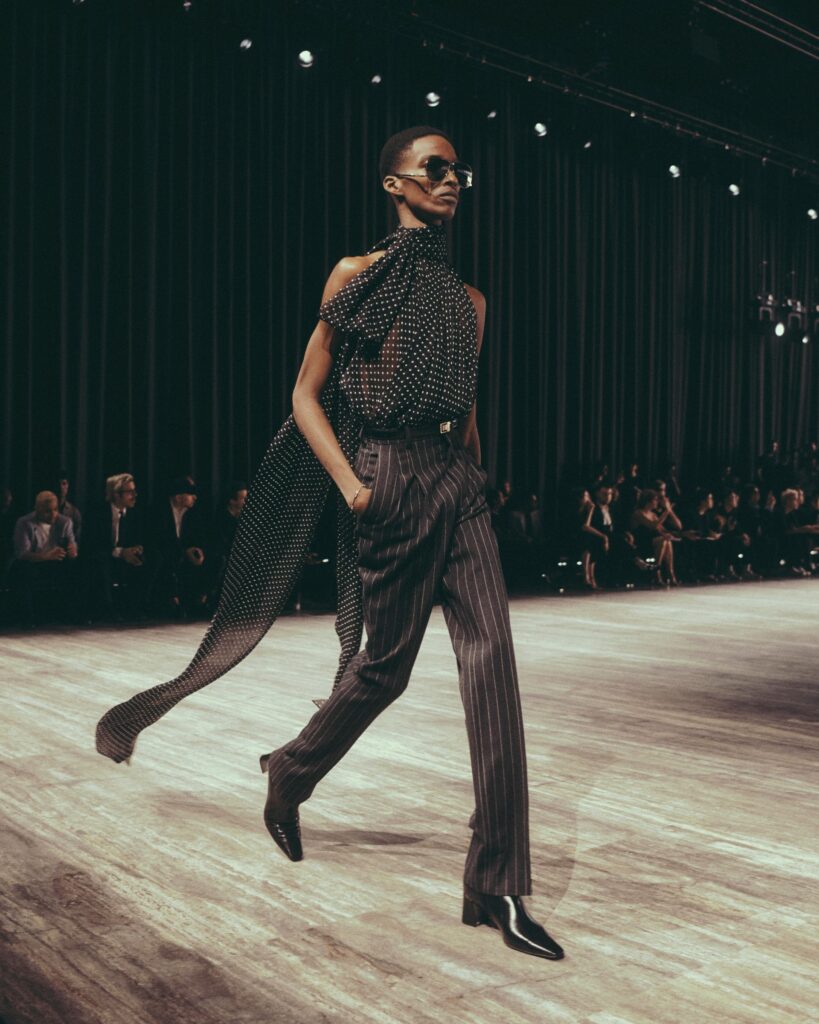
Interestingly, the strength of Saint Laurent lies precisely in this tension. On one hand, archival tuxedo silhouettes return every season; on the other, the brand continues to seek new definitions of contemporary female empowerment. Not always without missteps, but with remarkable consistency.
And that’s exactly why the YSL logo on a black blazer still works. Because it recalls the moment when fashion stopped being just decoration and started to mean something.
Laura 99
editorial fashion
Luxury Blog




Leave a Comment