

Will the climate kill the winter business? – the future of ski resorts after 2030
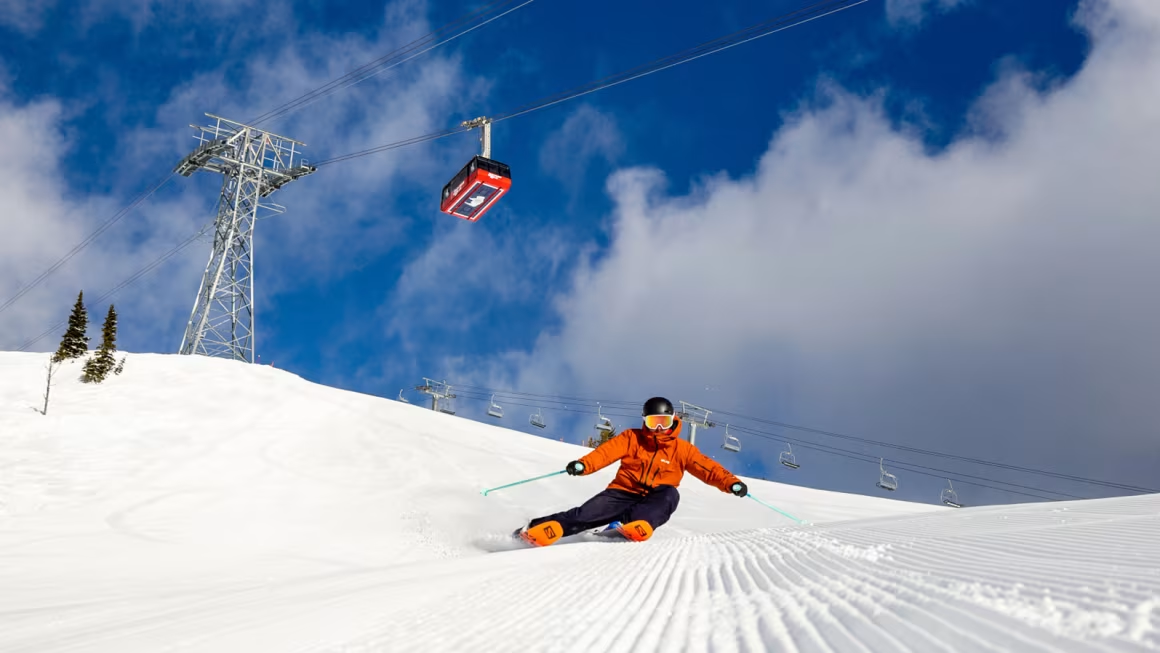
Does anyone remember that weekend in February when Zakopane was warmer than Barcelona? The slopes were as green as in spring, the ski lifts stood still, and tourists wandered along Krupówki in T-shirts. These are no longer weather anomalies—this is the new reality.
“In the past 30 years, the ski season in the Alps has shortened by an average of 38 days, and in the Polish mountains by 28 days. By 2030, losses could reach up to 50% of the traditional season length.”
The ski industry is facing the greatest challenge in its history. It’s no longer just about a few bad winters or strange weather. This is a systematic change affecting everyone—from lift operators to instructors, from equipment manufacturers to entire towns that rely on winter tourism.
The future of ski resorts after 2030 – winter business under the scrutiny of climate change
The year 2030 wasn’t chosen at random. It marks the end of the first decade since the Paris Agreement—a point when the effects of global warming will become irreversible. At the same time, it’s when the current ski infrastructure will require a complete overhaul or… closure.
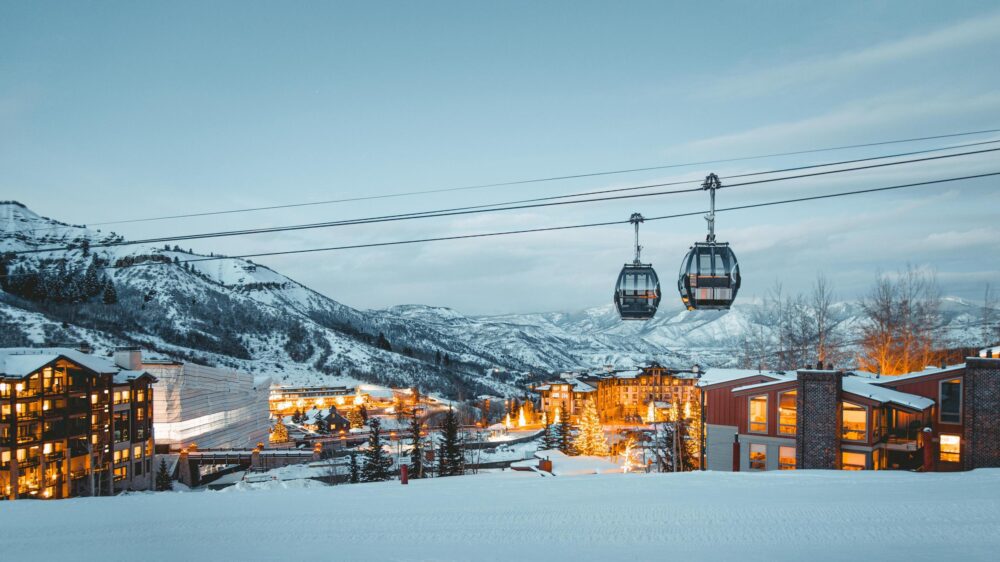
photo: inspirato.com
In Poland, the problem affects not only the Tatra Mountains. The Sudetes, the Beskids, even small resorts in the Masurian region—everywhere, owners are questioning the future. Some are already shifting their focus to summer attractions.
To grasp the scale of these changes, it’s worth looking at four key areas. First, precise climate forecasts—what can we really expect by 2050? Next, the economic side—what losses will resorts face, and how are they trying to adapt? The third element is technology—from artificial snow to entirely new business models. Finally, the social debate—will skiing survive as a mass sport?
There are no simple answers to these questions, but ignoring them means condemning the entire industry to a slow decline.
Climate forecasts until 2050 – what does the future hold for snow?
IPCC climate models give us concrete numbers—and frankly, they’re not very optimistic for fans of powdery snow. Scientists analyze various scenarios, but the two main ones are RCP 4.5 (moderate) and RCP 8.5 (pessimistic). The difference between them? In the first case, the average winter temperature will rise by about 1.8°C by 2050; in the second, by as much as 3.2°C.
That might not sound like much, but the devil is in the details. Every degree Celsius pushes the permanent snow line 150 meters higher. Sounds abstract? Imagine that today’s snow line at 1,200 meters will be at 1,350–1,650 meters in 30 years, depending on which scenario comes true.
The RCP 4.5 scenario assumes relatively controlled CO2 emissions. Here, forecasts predict the snow season will be 30–45 days shorter by 2050 at mid-elevations. In the Alps, this means snow will fall mainly from January to March instead of December to April. Snow cover will decrease by about 25–40%.
In the pessimistic RCP 8.5 scenario, the numbers become truly alarming. The season could be shorter by as much as 60–80 days. In some regions of the Carpathians, snow may not persist at all below 1,500 meters.
| Scenario | 2030 | 2050 | 2100 | Snow depth change |
|---|---|---|---|---|
| RCP 4.5 | +1.2°C | +1.8°C | +2.4°C | +180-360m |
| RCP 8.5 | +1.7°C | +3.2°C | +4.8°C | +255-720m |
Lake Tahoe in California is a perfect example of what lies ahead. Research shows that by 2050, the snow line there will rise from the current 1,800 to 2,100 meters in a moderate scenario, and up to 2,300 meters in a pessimistic one. By 2100, it could reach as high as 2,600 meters.
The situation in the Alps is similar, though somewhat milder due to their greater elevation. The French Alps are expected to lose about 30% of their snow cover below 2,000 meters by 2050. In the Austrian Alps, the season is projected to shorten by 5–7 weeks at elevations of 1,000–1,500 meters.
Unfortunately, our Carpathians will be in the worst position. Due to their relatively low altitude, they could lose up to 60% of snow days below 1,200 meters. The situation in the Tatras will be better, but still serious.
Interestingly—or perhaps sadly—these changes are already forcing ski resorts to extend the artificial snowmaking season. Where a month of snowmaking used to suffice, now two or even three months are needed. The problem is that artificial snow requires temperatures below -2°C, and such days will become increasingly rare.
Regional models are even more detailed. They show that changes will be highly uneven—northern slopes will retain snow longer than southern ones, and higher mountain areas will become a kind of refuge for skiing.
These figures are the foundation for all further economic and social analyses. Without them, it would be difficult to estimate the costs of adaptation or the losses in mountain tourism.
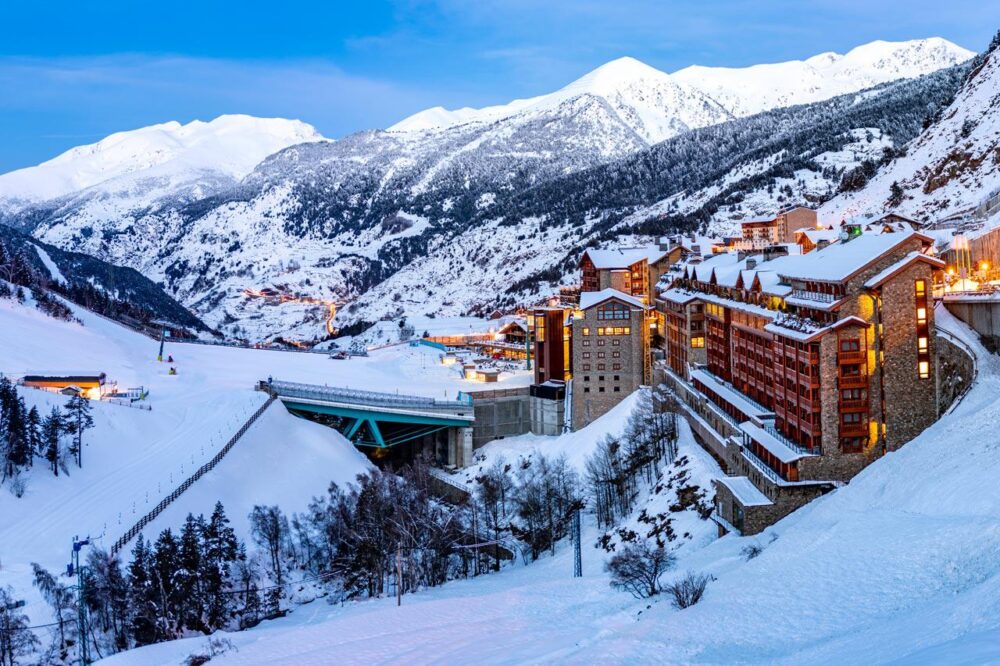
photo: leotrippi.com
Impact on the economy of mountain regions
The global ski market is a business worth around 45 billion euros a year. That might sound like an abstract figure, but in practice, it means entire towns whose livelihoods depend on winter sports.
Alpine regions in Europe have made their economies so dependent on the white powder that, just 20 years ago, it seemed like a reasonable bet. Now, it’s not so obvious. In some places, winter tourism accounts for as much as 40% of the local GDP. That means when the snow doesn’t come, the whole community feels the pain.
The projected annual loss of $268 million for the Lake Tahoe region in California shows the scale of the problem. That’s the equivalent of over a billion zlotys simply disappearing from the local economy. Tahoe is one of the wealthiest ski resorts in the US, so their struggles are a warning sign of something bigger.
Similar stories are heard across Europe. Between 2010 and 2020, 45 European ski resorts closed down. Not all due to climate, but most struggled with unreliable snowfall. Every closure means dozens, sometimes hundreds, of lost jobs.
In small Alpine towns, a single ski resort often employs half the residents. Instructors, rental shops, hotels, restaurants—all depend on the same snow. When it’s gone for two seasons in a row, people simply move away.
| Region | Average revenue (EUR million) | Season length | Lost jobs |
|---|---|---|---|
| French Alps | 2,800 | 120 → 85 days | -15% since 2015 |
| Dolomites | 1,200 | 110 → 75 days | -22% since 2010 |
| Polish Tatras | 150 | 90 → 30 days | -35% since 2018 |
Poland is a completely different story, but just as painful. Our mountains have never had the snow guarantee of the Alps. Now, the season often lasts only 4 weeks instead of three months. Equipment rental shops in Zakopane or Szczyrk openly admit—it’s no longer a business you can plan for.
A friend of mine runs a rental shop in the Beskids. Just a few years ago, he earned enough during winter to afford a vacation. Now, he barely covers the cost of storing equipment all year round. Sales have dropped by 60% compared to 2015.
The problem is also that tourists are simply stopping coming. Not just because there’s no snow in a particular week. They’re losing trust in our mountains as a winter holiday destination. They’d rather travel farther but have certainty.
The hotel industry in mountain regions feels this especially hard. Winter bookings have dropped by an average of 25% over the past five years. Hotels that focused on winter tourism now have to radically change their business models or go bankrupt.
Jobs are disappearing not just directly on the slopes. The entire network of services—from snowcat mechanics to salespeople in sports shops—is shrinking in proportion to the shortening season.
The worst part is that investments in ski infrastructure are amortized over decades. Lifts that cost millions now stand idle for most of the winter. These are massive capital losses for owners, but also for municipalities, which were often co-investors.
The trend is clear and worrying. Mountain regions must find new sources of income, as the traditional ones are becoming less and less reliable. The next step will be to see what technologies can help them do this.
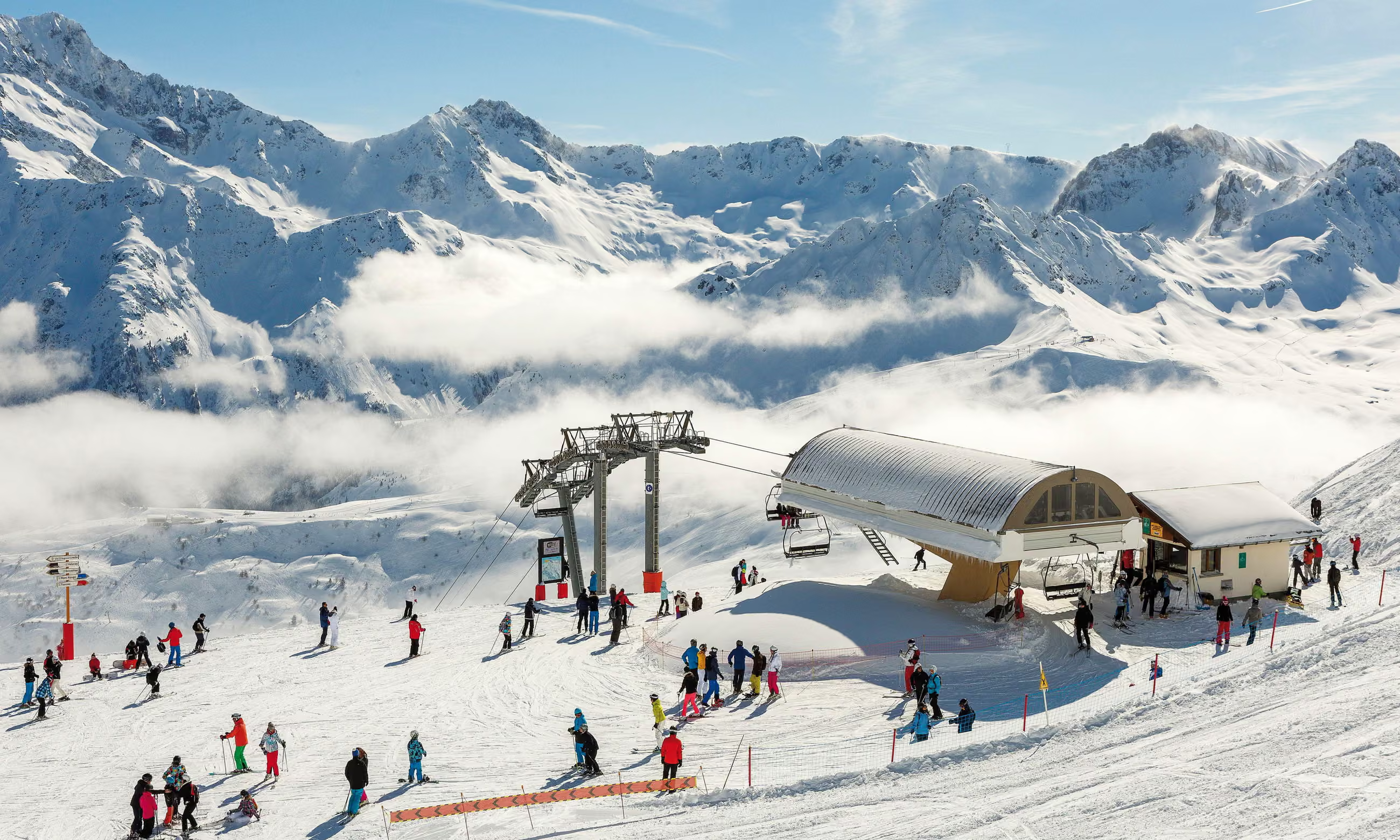
photo: theguardian.com
Technologies and innovations saving the season
Winter temperatures are no longer as predictable as they once were. Ski resorts are facing increasingly shorter seasons, but technology is lending a helping hand.
Artificial snowmaking is essential for survival. A snow cannon mixes water with compressed air—it sounds simple, but the devil is in the details. The temperature must drop below -2°C for the water droplets to freeze before hitting the ground. Any warmer, and you get slush instead of snow.
A single snow cannon uses about 100 liters of water per minute. That’s a lot—the average resort needs several million liters per season. Some places build their own retention reservoirs, others tap into local sources. The water doesn’t disappear; it just changes form.
AI algorithms are starting to help optimize the entire process.
Systems are learning to predict the perfect moments to turn on the snow cannons. They analyze weather forecasts, humidity, wind direction. This can save up to 15% in energy—no need to start the equipment too early or too late.
Permafrost tunnels are even more intriguing. Sweden is opening its first such facility in 2025 —an underground ski trail carved into frozen ground. The temperature stays constant year-round, regardless of the weather above. It’s more engineering than artificial snowmaking.
Case study: The Swedish tunnel in Torsby uses natural permafrost reinforced with a cooling system. The 1.2 km-long trail operates 365 days a year. The construction cost was enormous, but it pays off thanks to year-round use.
Indoor centers are already a proven technology. Halls with real snow, slopes angled between 15 and 25 degrees. Dubai has had its own indoor ski slope for years. Similar projects are now appearing in Poland as well.
Every technology has its limitations. Snowmaking requires subzero temperatures. AI helps, but still needs basic weather conditions. Tunnels are expensive to build. Indoor halls work, but it’s hard to recreate the feeling of a real mountain.
These solutions buy time. They allow resorts to operate despite climate change, but that’s not all. It’s also important to think about offerings beyond just skiing.
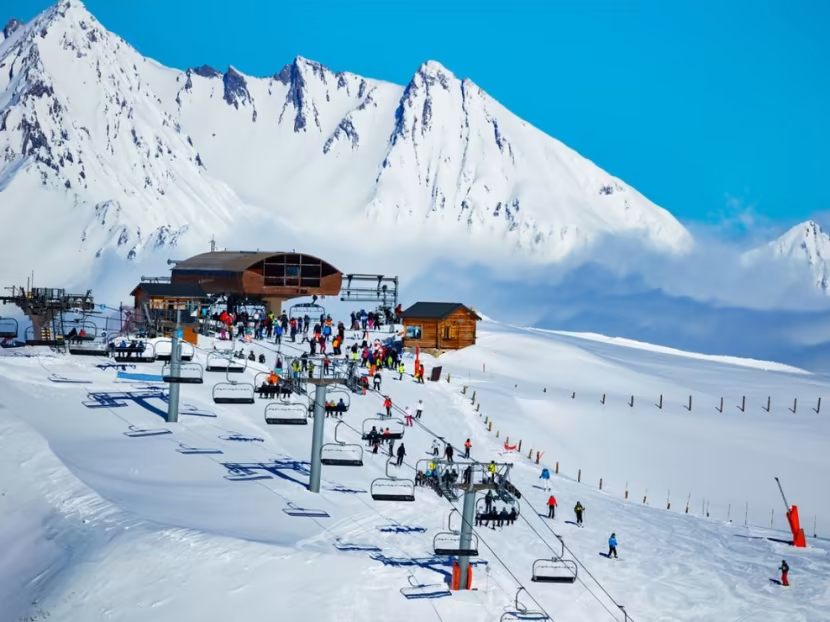
photo: cnaluxury.channelnewsasia.com
Diversifying the offer: life beyond skiing
Ski resorts in the Alps realized long ago that snow is just one of many ways to make money. In Poland, we still think in terms of winter, but over there, they already operate as year-round entertainment centers.
Zermatt has launched the “Summer 365” program and now makes a fortune from trekking. People pay for cable car rides to reach the trails. Mountain bike rentals are booming, and mountaintop restaurants run non-stop. This is no coincidence—it’s a well-thought-out strategy.
| Winter season | All-season model |
|---|---|
| ? 120 days of operation | ?️ 365 days of adventure |
| ❄️ Weather dependency | ☀️ Seasonal independence |
| ? One revenue stream | ? Multichannel earning |
Vail Resorts is the best example of this. In 2024, 30% of their revenue came from outside the winter season. Bike parks, zip lines, music festivals. There’s something happening every weekend.
I’ve looked into the profitability of such projects. A zip line pays for itself in 3-4 years, a bike park in 5-6 years. Music festivals are a different story—one successful weekend can cover the costs for the whole summer. Of course, you need an audience, but the mountains themselves are a draw.
Polish resorts can copy this model, but they need to think on a smaller scale. Not every resort has to be Zermatt. One lift is enough, a few bike trails, maybe a local festival. Parking is key—people need a place to leave their cars.
I’ve seen Szczyrk trying this approach. In summer, they organize mountain runs and open-air concerts. Not everything works out, but the direction is right. The problem is, Poles still associate the mountains with winter.
The profitability of such a venture depends on location. Mountains close to big cities have an advantage—people come for the weekend. Those farther away have to rely on holiday tourists. But even small resorts can find their niche.
The most important thing is to stop thinking of yourself as a ski resort. It’s a mountain recreation center. The difference may seem cosmetic, but it changes the whole business approach.
Industry voices and controversies: public debate
I recently checked what’s happening in the media regarding the whole future of skiing debate. And honestly, it’s complete chaos—everyone says something different.
The Guardian wrote bluntly in 2024: “The era of abundant snow is over.” That sounds like a death sentence for the entire industry. On the other hand, Steve Milloy claimed in 2025 that there’s no real evidence of CO₂ affecting mountain snow. Completely different worlds.
The most interesting thing is what’s happening online—the hashtag [infographic color] #EndOfSkiing [/color] shows just how heated the arguments have become.
Climate experts talk about disaster. They see the temperature data, look at the glaciers, and predict the end of resorts below 1,500 meters. Environmentalists aren’t far behind—Protect Our Winters is running campaigns designed to awaken skiers’ consciences. Their message is simple: either we change our lifestyle, or we’ll be left without snow.
Entrepreneurs see things differently. They’ve long stopped relying solely on natural snow. Their narrative is: we’ll adapt, invest, and survive. Some even claim that climate change is an opportunity to modernize the industry.
Skeptics have their own arguments. They point to natural fluctuations, question climate models, and remind us of winters that were exceptionally snowy. Steve Milloy isn’t the only voice—there’s a whole community of people who consider the climate alarm to be exaggerated.
| Group | Position | Main argument |
|---|---|---|
| Environmentalists | Alarmist | Inevitable disaster |
| Entrepreneurs | Adaptive | Technology will save us |
| Skeptics | Questioning | No evidence of a crisis |
Social media only deepen this divide. Under the hashtag [kolor infografiki] #EndOfSkiing [/kolor] you’ll find everything—from dramatic photos of green slopes to ironic comments about “yet another climate panic.”
All of this shapes how people perceive skiing. Some are already planning their last trips, while others buy passes as if nothing is happening. Parents wonder whether it even makes sense to teach their children how to ski.
This debate isn’t just academic. It shapes the decisions of millions and influences the strategies of the entire industry.
The way forward – strategic insights for ski resorts
Ski resorts are facing a pivotal moment—the next fifteen years will determine which of them survive the climate and social changes ahead. It’s time for concrete action.
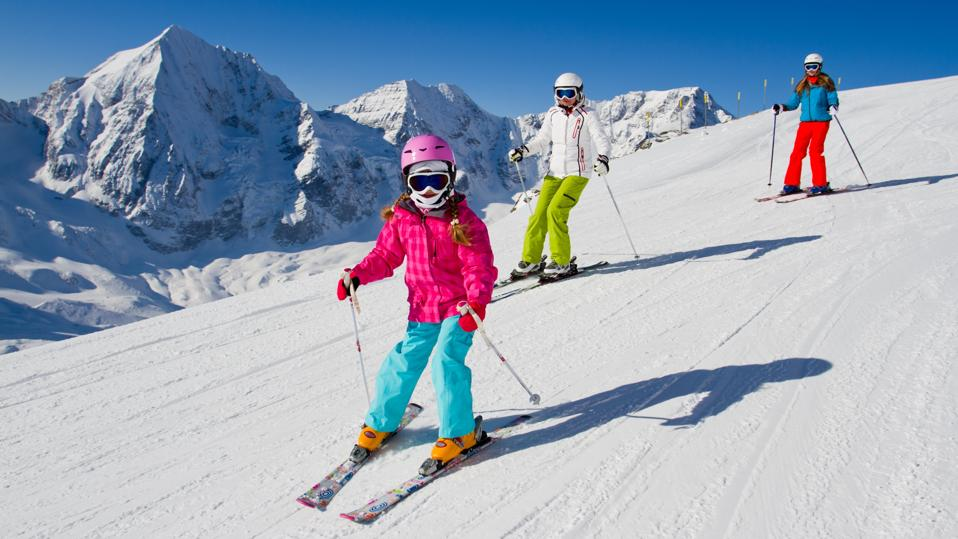
photo: forbes.com
The main conclusions point to the need to build resilience based on three pillars. It may sound like another catchphrase, but it works in practice.
- Reducing CO2 emissions must become an operational priority, not just a marketing slogan. Switching to renewable energy sources for lifts and artificial snowmaking is essential.
- Technological innovations in snow management and energy efficiency provide a tangible competitive advantage. Weather monitoring systems and predictive water resource management are already determining the profitability of the season.
- Diversifying revenue streams by expanding summer offerings—from mountain biking to corporate events. Some resorts are already generating 40% of their income outside the winter season.
- Building local partnerships with hotels, restaurants, and tourist attractions enhances the financial stability of the entire region.
- Investing in employee skills, especially in snow technology and customer service across different seasons.
The 2025-2030 plan aims for a 50% emissions reduction. Key actions include an energy audit by the end of 2025, replacing lighting with LED, and installing solar panels on service buildings. At the same time, development of summer offerings—bike trails, zip lines, rope parks.
Quick actions for the 2026/27 season include a review of energy systems, establishing partnerships with summer event organizers, and staff training on new technologies. This doesn’t require major investments but delivers fast results.
The 2030-2040 plan targets full carbon neutrality. Replacing the vehicle fleet with electric models, implementing energy storage systems, and advanced water recycling technologies. This stage will require greater funding.
Financing? EU funds for energy transformation, green bonds, support programs for small and medium-sized enterprises. Many resorts are unaware of available opportunities—it’s worth investing time to explore the options.
The ski industry still has a chance for a successful transformation. But the window of opportunity is closing faster than a gondola at 4:30 PM. Those who act now will have an advantage for decades to come.
Michael
lifestyle editor
Luxury Blog





Leave a Comment