

Victoria’s Secret Fantasy Bra – myth, luxury, and controversy
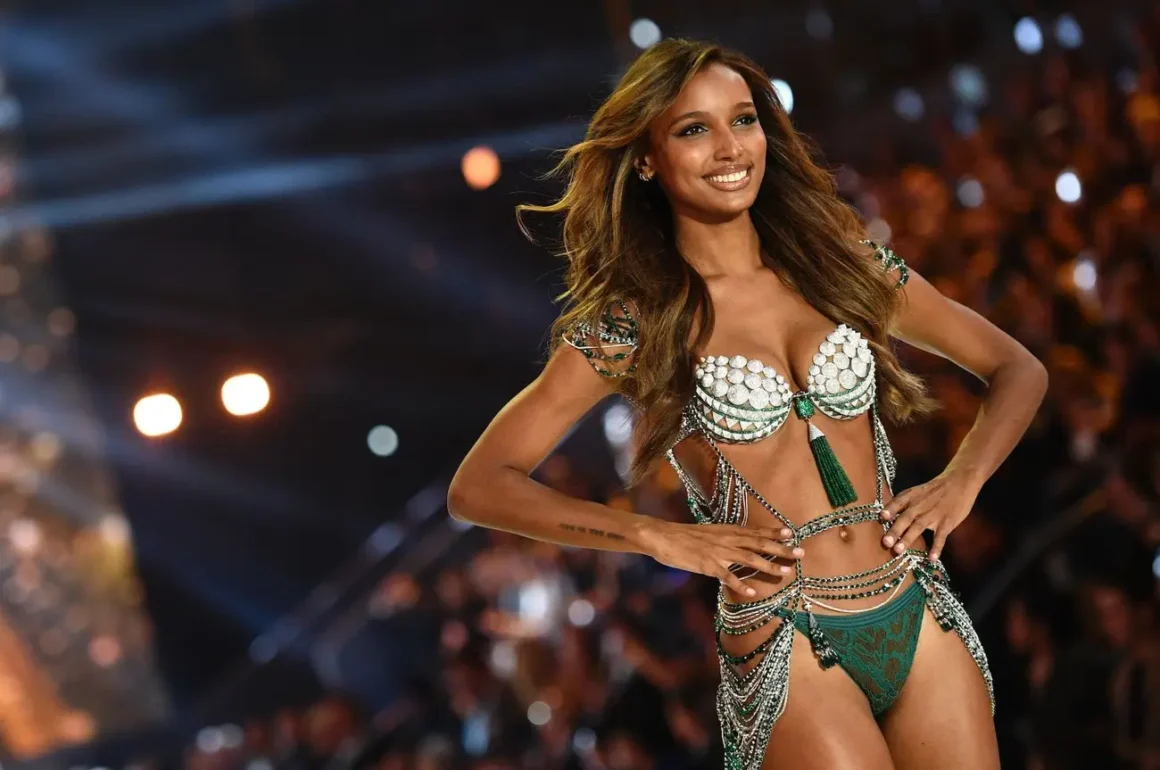
Imagine slipping on a bra insured for 10 million dollars. No, this isn’t a joke. Such a thing really exists. An ordinary bra might cost around 100 zlotys, sometimes less. But what I’m about to tell you is about creations valued higher than a luxury apartment in the heart of Warsaw. Sounds absurd? That’s exactly the point.
The Fantasy Bra—this is the “crown jewel” in the world of lingerie —is a handmade, one-of-a-kind bra encrusted with real gemstones. Not crystals. Diamonds, sapphires, rubies. Each piece took years to make, with budgets ranging from $1,000,000 to over $15,000,000. It might seem strange that something as intimate as lingerie can also be an extravagant piece of jewelry worth a fortune. And it’s precisely this contradiction that has sparked so much excitement.
Victoria’s Secret Fantasy Bra – where lingerie becomes million-dollar jewelry
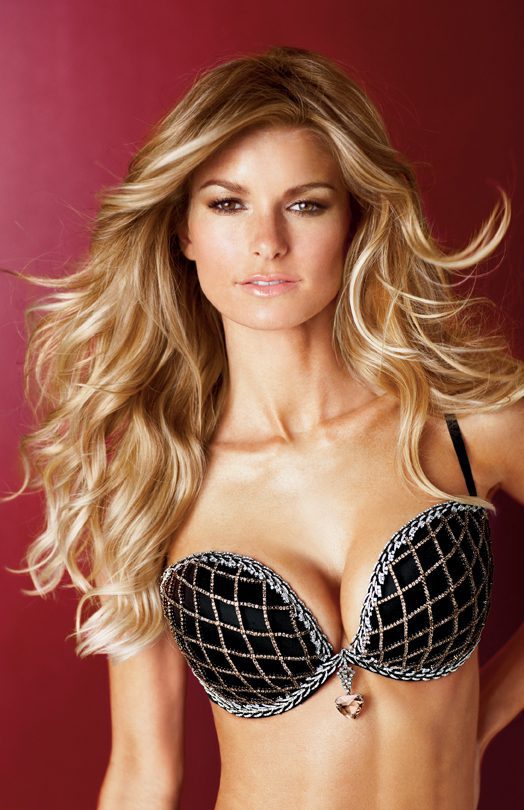
photo: kobiecaintuicja.com
Victoria’s Secret showcased these creations at its iconic fashion shows. Today, in 2025, the brand is making a comeback with a new show after years of hiatus, and suddenly everyone is talking about those times again. But this nostalgia is complicated—on one hand, we miss the glamour and extravagance, but on the other, we know that ideal of beauty was toxic. The old Fantasy Bras were worn only by Angels who met very specific standards, while today we talk about body acceptance and diversity. That’s exactly why the topic returns as a cultural paradox.
Why were we so fascinated by these bras in the first place? A few reasons are immediately obvious:
- Value – no other item of clothing has ever been so absurdly expensive while being so utterly useless
- Show – a fashion parade as a theater of dreams, where lingerie ceased to be functional and became art
- Pop culture – those shows were watched by millions, models were stars, and every new Fantasy Bra made headlines
- Tension – the contrast between the intimacy of lingerie and its public display stirred something within us
In the following sections, we’ll explore the history of these creations, step into the world of master jewelers and designers, take a look at the business figures behind the entire venture, and reflect on what the Fantasy Bra reveals about us as a society. We’ll also look ahead—is this concept still relevant?
You can view the Fantasy Bra with awe or with criticism. Or perhaps with both at once—because that’s exactly how the complex culture of luxury works.
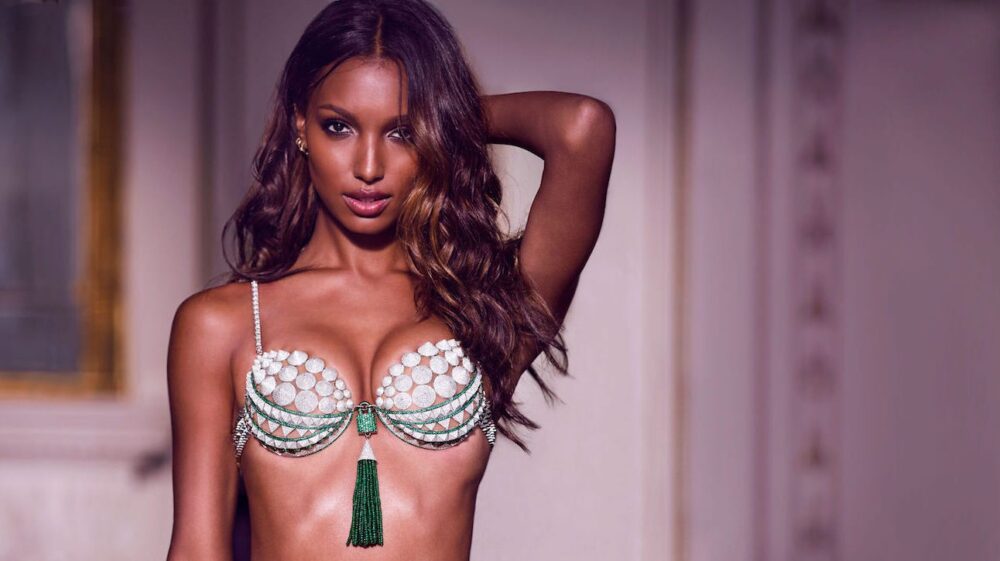
photo: themilliardaire.com
From 1970s boutiques to a multimillion-dollar spectacle – the story of the Fantasy Bra
In 1977, a guy from California opened a small lingerie boutique for men who felt embarrassed buying underwear for their wives in regular department stores. No one imagined it would turn into a global empire. And certainly, no one was thinking about diamond-encrusted bras worth millions of dollars.
Roy Raymond founded Victoria’s Secret for a simple reason—he wanted a place where men wouldn’t feel awkward among lace. The mall store was meant to be elegant, nothing more. The problem was, the business was barely surviving, so in 1982, entrepreneur Les Wexner took over the whole thing for a mere half a million. And that’s when things started to happen.
Wexner understood something important—lingerie isn’t just about function. It’s about fantasy. He dreamed of a brand that spoke to desire and luxury, not practicality. Throughout the ’80s and ’90s, Victoria’s Secret grew rapidly, opening hundreds of stores in malls across the United States. In 1995, someone came up with the idea of doing a televised fashion show. It was quite modest at the time, streamed online and watched by only a handful of people—the servers even crashed.
The golden era 1996–2005
A year later, in 1996, everything changed. Claudia Schiffer appeared on the runway wearing what was called the “Million Dollar Miracle Bra.” A bra worth a million dollars. Sounds crazy? Maybe, but it worked. People went wild—newspapers wrote about it, TV stations showed it, everyone wanted to know who, what, and how.
That was the turning point. Victoria’s Secret stopped being just a chain of stores. It became a show. A spectacle.
In 1997 came the Millennium Bra—10 million dollars, brilliants, sapphires, diamonds. Model Tyra Banks strutted in it against a backdrop of a balloon marked 2000. In 1998, there were controversial reports about a bra worth 20 million (though that figure was never officially confirmed and many considered it a marketing exaggeration). Gisele Bündchen, Heidi Klum—these women wore treasures as expensive as Manhattan apartments.
Everything kept getting bigger. Jewelers like Mouawad got involved—a company known for royal jewelry. These were no longer just stones glued to lace. These were works of art. Intricate, delicate, requiring months of work.
Budgets soared. The show’s viewership swelled—over 10 million viewers at its peak in the early 2000s. Victoria’s Secret was cool, it was glamorous, it was everywhere.
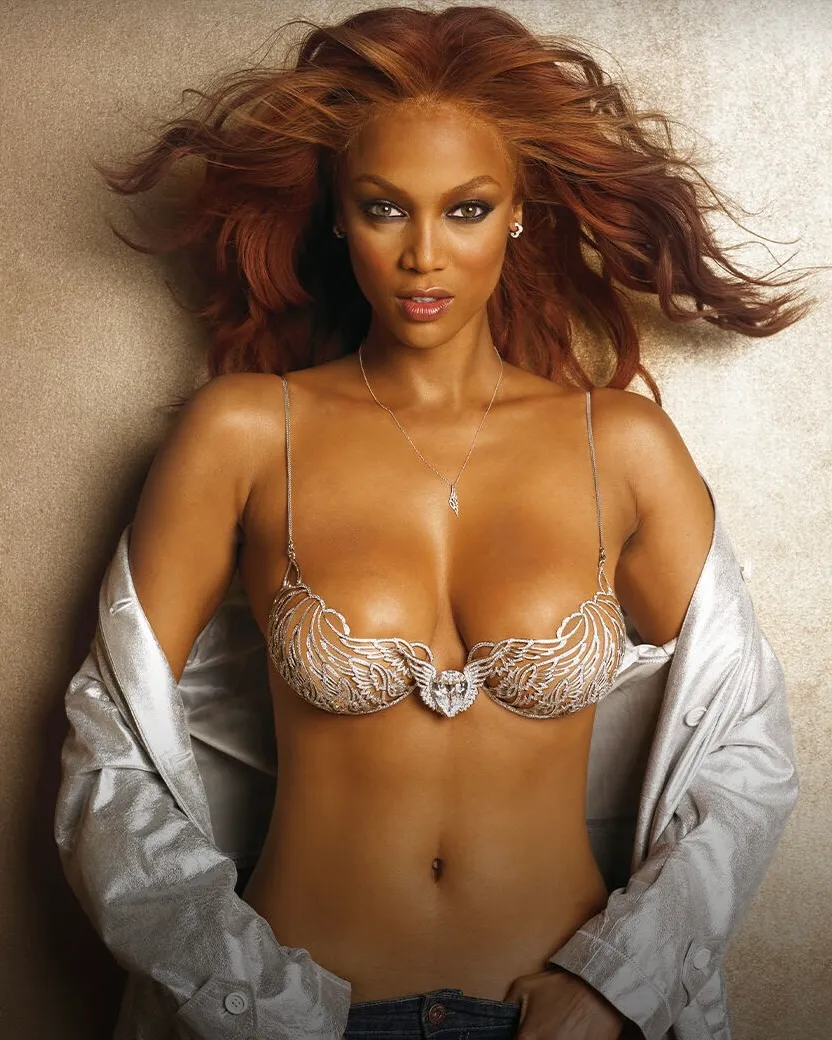
photo: naturaldiamonds.com
Stabilization and the First Cracks
Roughly between 2006 and 2015, the tradition became firmly established. Every year—a new Fantasy Bra. In 2014, they even came up with the idea of double models for two Angels at once. The marketing worked like a machine. But it started to feel a bit repetitive, didn’t it?
The value of the bra itself stopped being shocking. Twelve or fourteen million—how long can you keep relying on the same trick? That’s when they started focusing more on storytelling. Gems from specific mines, designs inspired by ancient cultures, collaborations with designers who had real names. The emphasis shifted—it was now also about craftsmanship, storytelling, narrative.
But the audience still began to drift away. Viewership of the show dropped to around 6 million in 2018. People said it just wasn’t their vibe anymore. Too commercial, too superficial, too one-dimensional. A wave of crit
The anatomy of luxury – how the Fantasy Bra is really made
An ordinary bra from the Victoria’s Secret line leaves the factory after just a few hours. The Fantasy Bra? That can mean up to a year of preparation and hundreds of hours of meticulous jewelry work. This scale is exactly what sets it apart from regular lingerie—it’s something that needs to be guarded like a national treasure.
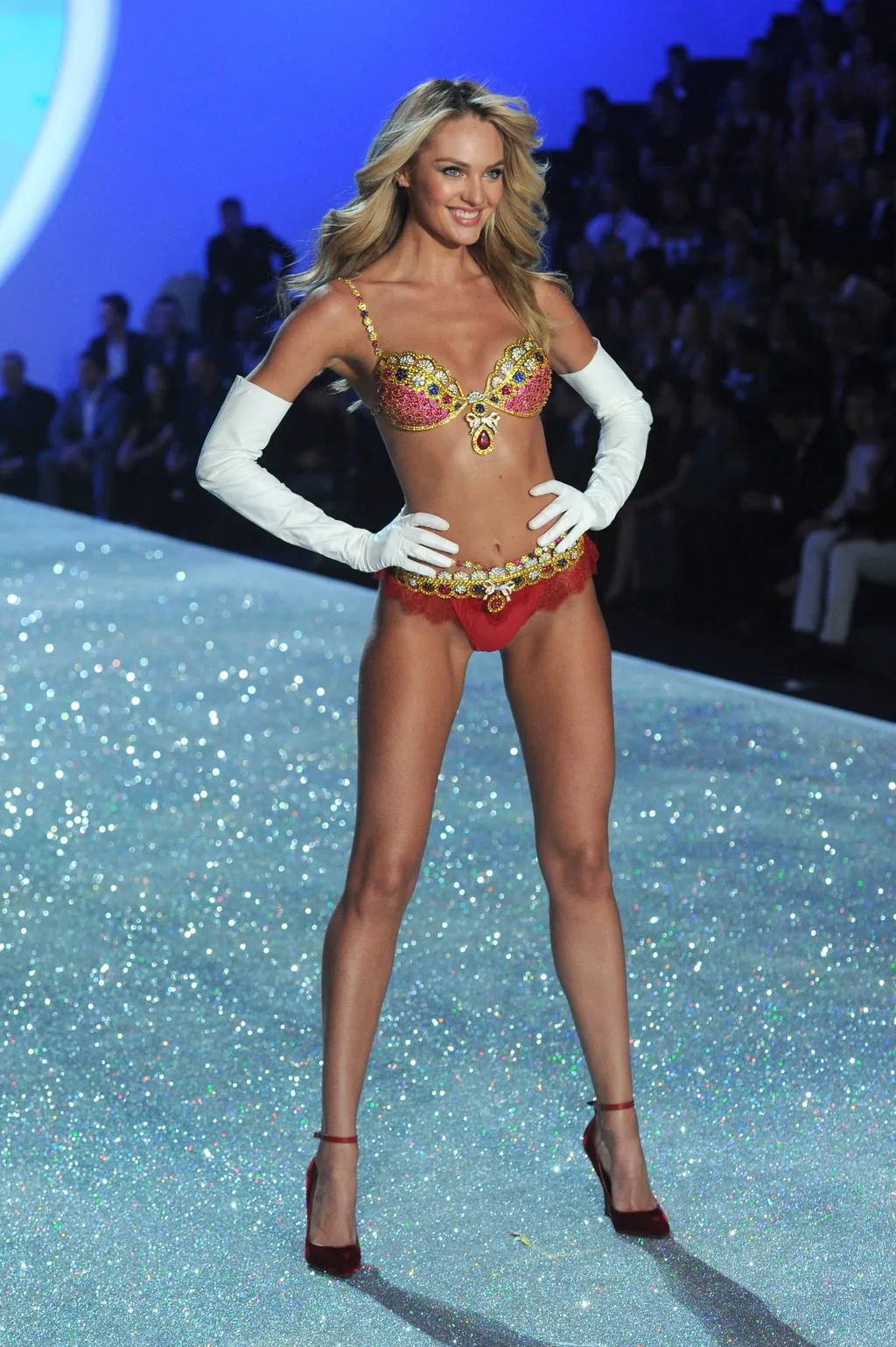
photo: teenvogue.com
The base design itself isn’t all that exotic. Most often, it’s a tried-and-true style from the brand’s collection—a balconette or push-up from the Very Sexy or Dream Angels lines. Underwires, full finishing, sometimes silicone straps to keep everything in place under the weight. Because that’s the first challenge designers had to solve: how to make a structure that supports not just a few dozen grams of fabric, but several kilograms of stones and metal. And it all had to fit the body of a specific model, since each piece was custom-made. Candice had different measurements than Jasmine, so there were no universal sizes here.
Then comes the jewelry layer, and that’s where the numbers start to sound unbelievable. Let’s take three iconic examples:
| Year | Model | Number of stones | Total weight | Opening hours |
|---|---|---|---|---|
| 2013 | Candice Swanepoel | ~4,200 | over 3,000 ct | ~1,350 h |
| 2014 | Adriana + Alessandra | over 16,000 | no data | ~1,380 h |
| 2016 | Jasmine Tookes | over 3,000 | 67 ct (including 18k gold) | ~700 h |
The very process of setting is a masterpiece of microscopic precision. Diamonds are mounted using the pave technique, sometimes micropave—which means that each stone must have its own individual nest lined with precious metal. Jewelers from Mouawad or Atelier Swarovski worked under lamps with magnifiers, arranging row after row of stones so that none would fall off during movement on the runway. After all, the model has to walk, turn, perform all those gestures—and the construction should shine evenly, without any “blind” spots.
One of the craftsmen reportedly said: if I dropped this part on the floor, it would take us a week to find all the diamonds.
The challenge also lies in combining something rigid (metal chains, stone settings) with flexible fabric. To make it work, special hinges were used, flexible bases under the settings, and sometimes even separate segments that could move slightly relative to each other. This isn’t ordinary jewelry—it’s a hybrid of furniture, clothing, and a jeweler’s masterpiece.
And then there’s the weight. The 2013 Fantasy Bra weighed almost as much as a newborn—over 4 kilograms. The model could wear it for maybe a dozen minutes without needing medical support for her spine. That’s why it’s mainly a “runway only” creation—one walk, photos, done. Not counting the security detail that accompanied the model at the side of the stage.
In the next part, you’ll see how much all this cost and why those numbers went down in marketing history.
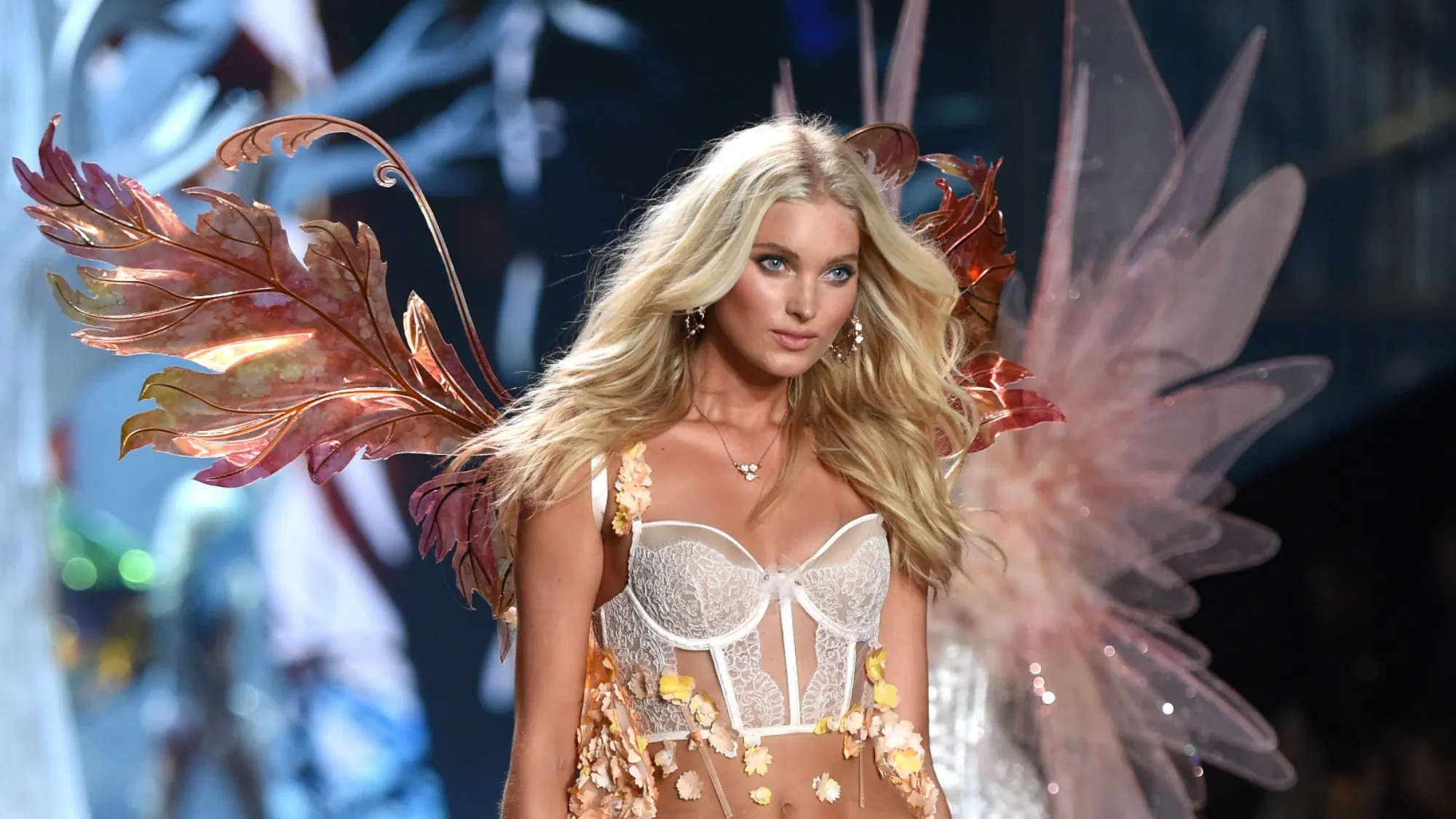
photo: teenvogue.com
Millions on the runway – the economics and marketing of the Fantasy Bra
A million-dollar bra that no one will buy. Sounds like a failure, right? And yet, Victoria’s Secret made a fortune for years precisely because no one bought the Fantasy Bra.
It was pure marketing at its finest. Every Fantasy Bra generated hundreds of press articles—from tabloids to “Forbes.” Social media went wild over the photos. And Victoria’s Secret? They only paid for the stones and the jewelers’ work. The rest was done for free by the media. That earned media effect was the key. One bra worth $10 million brought media coverage worth many times more.
Imagine a chart of VS revenue from 2000 to 2024. The first half is almost a straight line upward. In 2016, the brand hit $7.4 billion in revenue. At its peak, Victoria’s Secret controlled about 45 percent of the American lingerie market. The shows? Over 10 million women watched them every year, and in the best years, even 12 million.
Crucially, after every show, sales jumped by 10–20 percent in the next quarter. A regular $50 bra sold better because the customer had just seen the million-dollar one. The halo effect was relentless. You bought something ordinary, but felt like you were touching the same world of luxury.
The Fantasy Bra also fueled global expansion. The brand opened over 1,000 stores worldwide. In the US, Victoria’s Secret was the default choice—if you were looking for lingerie, you went there. Period.
But after 2016, the numbers started to fall. New competition emerged: Aerie with a natural approach, Savage X Fenty with diversity. Show viewership dropped to around 6 million. Market share? From 45 down to about 25 percent. The brand tried to save itself—in 2018, they even released a Fantasy Bra replica for $250. Monetizing the dream for a wider audience. It sold, but didn’t save the day.
Rebranding brought some improvement. In 2024, revenue reached $6.2 billion—a roughly 5 percent increase. And then the show returned in 2025. Nostalgic vibe, streaming, retrospectives. Fourth-quarter sales rose by 10 percent. People missed it, so they came back.
That’s the numbers. But the question remains—what was the real cost of this entire strategy?
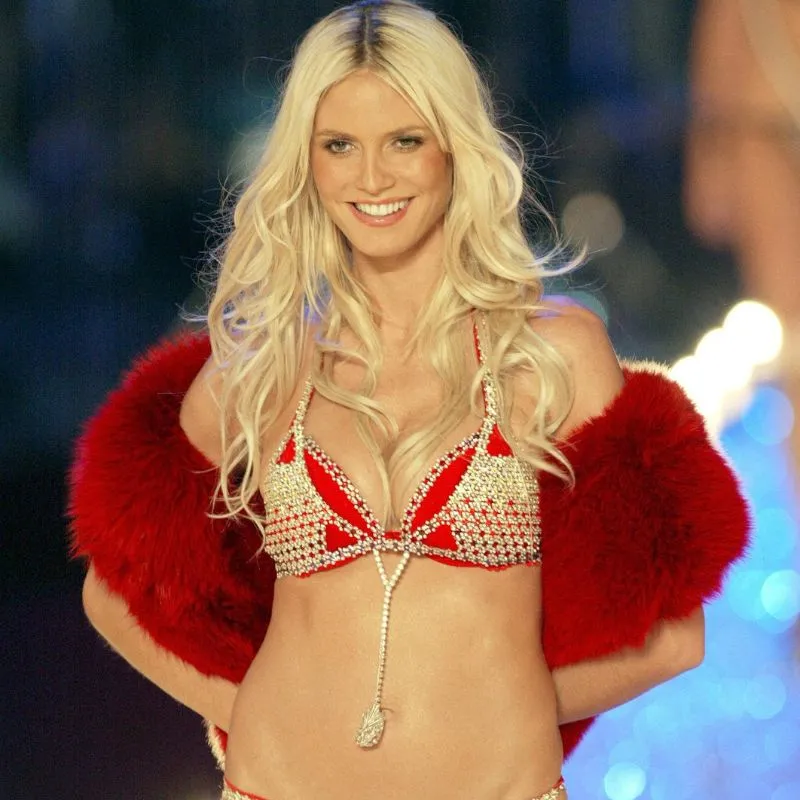
photo: lifestyleasia.com
Between Dream and Bodily Pressure – The Cultural Dimension of the Fantasy Bra
I remember being sixteen, sitting in front of the TV with my friend, watching the Victoria’s Secret show. Those wings, those bodies, that glow. Back then, we thought they were simply perfect. It never crossed our minds to ask—whose dream was this, really? And why didn’t any of those girls look like us, like our mothers, like most women we saw on the street?
For two decades, the Fantasy Bra and the entire Victoria’s Secret show created a single, specific image of the female body—very slim, mostly white, cisgender models in sizes around 0-2. These “Angels” were meant to embody a fantasy. But the harsh truth is: it was someone else’s fantasy, not ours. Cultural researchers have been saying for years that the whole spectacle served men a ready-made image of a sexy woman, while giving women an unattainable standard to chase. In reality, it was symbolic violence, even if dressed up in a million dollars’ worth of Swarovski crystals.
Over the years, the accusations piled up. Second- and third-wave feminism criticized VS for objectification. Models in outfits that were just an excuse to showcase their bodies. No space for plus-size women, trans women, even ethnic diversity was just for show. The statistics speak for themselves—ninety percent of the girls on that runway were white, cis women with a specific body type. Where were the rest of us?
“The Victoria’s Secret show wasn’t selling lingerie, but a very narrow definition of what it means to be a desirable woman—tall, thin, young, white. Everything else was invisible.”
Then came #MeToo. Suddenly, it turned out that the backstage of this fairy-tale world was far less glamorous. Ed Razek, the longtime creative director responsible for the show, publicly stated in an interview that trans and plus-size models would not appear because it was a “fantasy” and the vision had to be preserved. This comment sparked an uproar. Companies began pulling their sponsorships. At the same time, a scandal erupted around Les Wexner, the founder of L Brands (owner of VS), and his ties to Jeffrey Epstein. Suddenly, it became clear that behind the glitz, something deeply toxic was lurking. People stopped buying into the story.
In 2021, Victoria’s Secret issued an official apology. They admitted to promoting an “unhealthy” image of femininity. A new campaign was announced, and the VS Collective was formed—a group of ambassadors from diverse backgrounds. The lineup included Priyanka Chopra, Megan Rapinoe, Eileen Gu, Paloma Elsesser. The brand started talking about comfort, inclusivity, and women’s agency. They moved away from hyper-sexualized language. But you know what? Many people called it woke-washing—a superficial show of social responsibility, a marketing ploy to cover up declining sales.
Some researchers write that, paradoxically, it was the VS model that helped the body positive movement grow. Because people started to rebel. Brands like Savage X Fenty by Rihanna or Aerie emerged, championing diversity from the start. They showed stretch marks, cellulite, women over fifty, non-binary people. They filled the void that VS itself had created.
Today, as an adult woman, I look at old photos from the shows and feel something strange. On one hand, nostalgia—it was a piece of pop culture. On the other, disappointment—how much harm those images might have done to young girls.
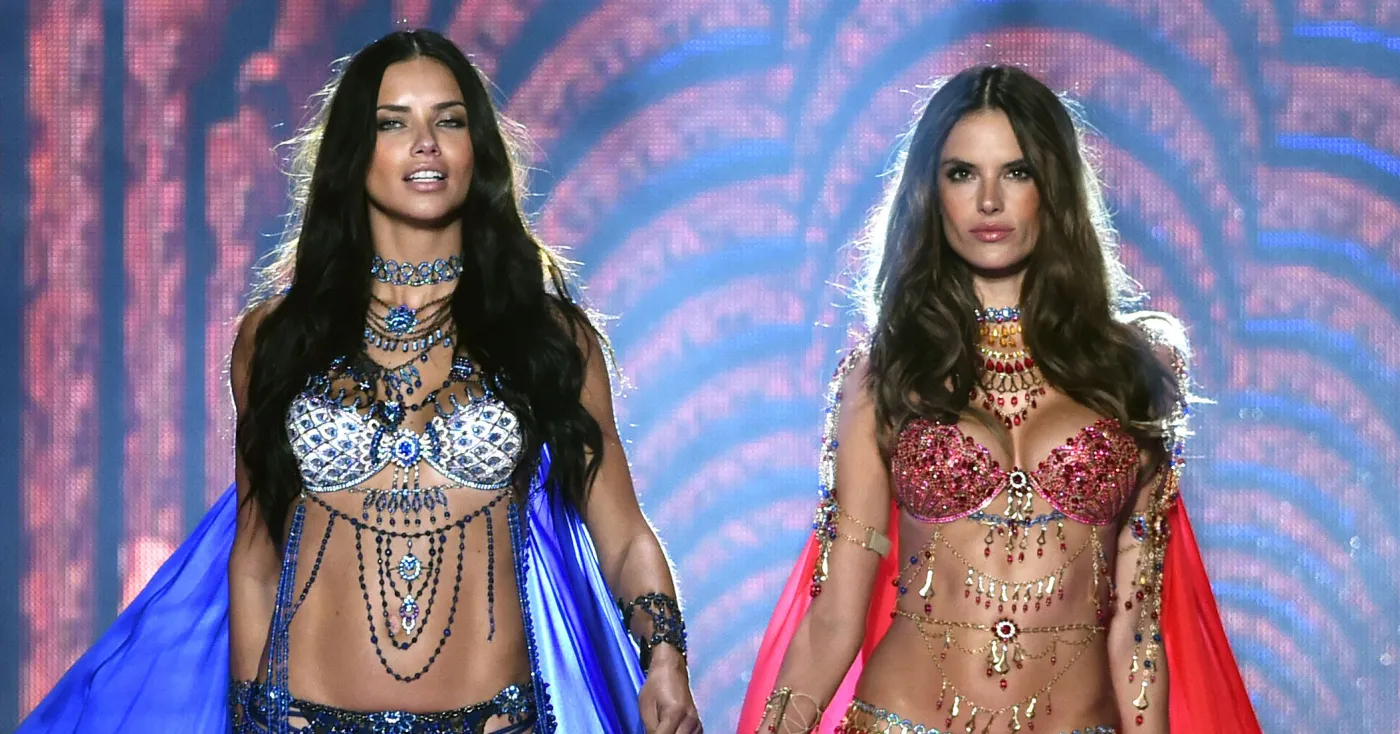
photo: usmagazine.com
The most iconic Fantasy Bras and their Angels
You’re at a Victoria’s Secret show, and suddenly every camera turns toward one model. Why? Because she’s wearing the Fantasy Bra—more than just lingerie. It’s a symbol. Like a queen’s coronation in the fashion world.
Being chosen to wear this bra is, let’s be honest, the highest honor an Angel can get. Not everyone gets it, not even the really famous ones. This is the moment that says: this girl just reached the top.
“Million Dollar Miracle Bra” 1996 – Claudia Schiffer
The very first time in the brand’s history. Claudia on the runway in a million-dollar bra—it was wild back then. 1,188 Brazilian gemstones, totaling 72 carats. Designed by Alan Necke for Harry Winston. Claudia was already a superstar, but this moment cemented her as a 90s glamour icon. I remember the photos from that show—she looked like a living jewel under the spotlights. This was the start of the whole Fantasy Bra tradition.
“Red Hot Fantasy Bra” 2013 – Candice Swanepoel
Now we jump to a record-breaking sum. 10 million dollars. Over 4,200 stones, including rubies, diamonds, and yellow sapphires. More than 3,000 carats in total. Mouawad designed it again, and this time they really went all out. Candice was already well-known, but wearing this bra made her the face of the entire 2013 show. She later said in interviews that she felt enormous pressure—after all, she was wearing the value of a luxury apartment.
“Dream Angels Fantasy Bras” 2014 – Adriana Lima and Alessandra Ambrosio
Twin designs, a first for the brand. Together, 16,000 stones, 1,380 hours of craftsmanship. Each worth about 2 million. It was the crowning moment of both Brazilians’ long careers at Victoria’s Secret—Adriana was already a veteran, Alessandra had also worked with the brand for years. It felt like a symbolic farewell to an era, since both knew their peak was behind them.
“Dream Angels Fantasy Bra” 2018 – Elsa Hosk
Here you see a paradigm shift. Instead of real diamonds, mostly Swarovski crystals. Valued at about 1 million—so back to the roots, but with a different philosophy. It wasn’t about record-breaking sums anymore, but about accessibility. Fans could buy replicas and feel part of the show. Elsa was surprised to be chosen, since she wasn’t one of the oldest Angels. But that was the idea—freshness.
These few models make up the entire Fantasy Bra myth. Each one shows something different—record value, emotional meaning for the model, changes in the brand’s strategy.
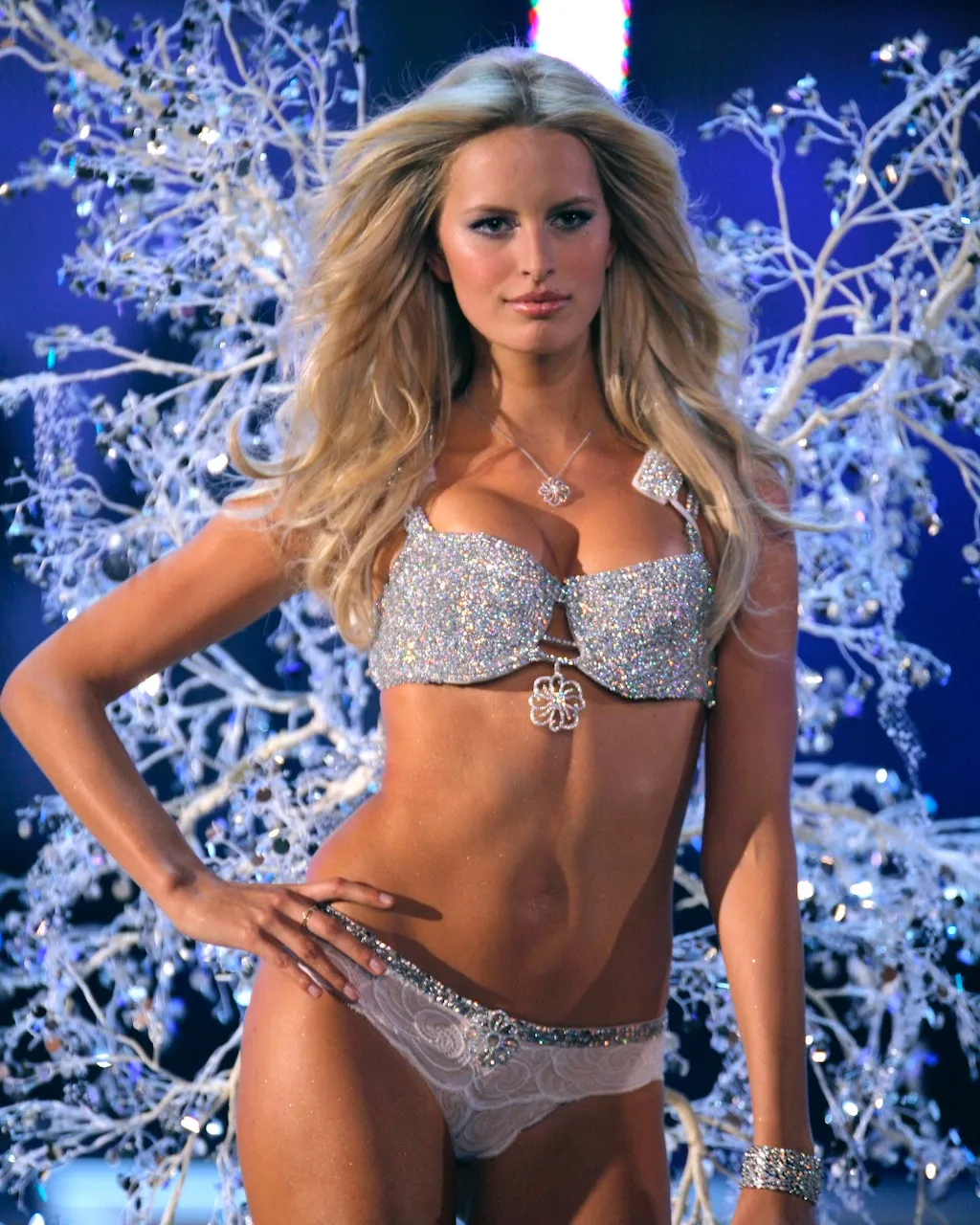
photo: naturaldiamonds.com
After the diamond era – what remains of the Fantasy Bra today
Diamond bras are back. But they’ve returned to display cases, not to real life.
In 2025, Victoria’s Secret held a streamed show—and what appeared there? The historic Fantasy Bras, those from the brand’s glory days. They stood like museum pieces, evoking a time when a million-dollar bra was the most important event in the lingerie world. Now, it’s more of a nostalgic journey than an actual offering. No new Fantasy Bra has been created since 2019—and it’s unlikely we’ll see one in the old format again.
The brand itself is trying something completely different now. Victoria’s Secret wants to be inclusive, comfortable, accessible. You can see it in products like the VS Bare Infinity Flex —a bra designed to fit different body types and provide comfort. The language has changed, too. No more “sexy” and “fantasy”—now it’s about how you feel, comfort, confidence. It’s a big challenge: how do you reconcile the legacy of diamond-studded creations with offering functional bras?
The market has changed a lot, too. The global lingerie market is expected to grow to around $100 billion by 2030. Victoria’s Secret wants to reclaim its position—it currently holds about 25% of the US market, aiming for maybe 30%. The problem is, competition is ruthless. Brands like Savage X Fenty and ThirdLove have focused on diversity from the start. They don’t have to convince anyone—they’re already where VS is only trying to go.
I see an opportunity for something in between. Maybe capsule collections inspired by “fantasy,” but at accessible prices? Where fantasy is about the customer’s individuality, not a single model imposed on everyone. Or collaborations with artists and designers whose vision can also be “fantasy”—just more diverse.
For us, as consumers, it’s an interesting moment. You can enjoy the aesthetic—because glamour and beauty have a right to exist—but at the same time choose transparent brands. Check if they care about ethical production, if their campaigns show different bodies and faces. You don’t have to give up luxury. You just need to be aware of what you’re buying and why. Fantasy can exist, as long as it doesn’t force a single standard.
Ultimately, diamond bras haven’t disappeared completely. They’ve just stopped being the center of the universe.
Your own fantasy – how to look at the Fantasy Bra wisely
Do you remember that first image—a simple bra for twenty zlotys versus a creation worth more than a luxury apartment? Today, after this whole journey through the history of the Fantasy Bra, you probably see it differently. Because this isn’t just a story about jewelry sewn into lingerie. It’s really several different stories at once.
First—there’s true craftsmanship at play here. Goldsmiths, jewelers, designers spent hundreds of hours creating something that was never meant to be everyday lingerie. It’s more a miniature sculpture than a bra. Second—the aggressive marketing that built an entire machine around a single product, designed to spark imagination and convince you that by buying regular panties with a Victoria’s Secret tag, you’re buying a piece of that magic. Third—a very specific, narrow ideal of femininity that for decades left no room for other bodies, other fantasies. And fourth—today, it’s more of an artifact. Something that exists in the archive of culture, but no longer at the center of events.
The future of “fantasy” in lingerie is something we can create ourselves—not as an object of desire constructed by marketers, but as a space where every body can feel luxurious. That takes conscious choices and a bit of courage.
Practically speaking—start curating your social media. Follow accounts that showcase diverse bodies. Look for lingerie that makes you feel good, regardless of whether it has a prestigious label. Read reviews about brands, not just their campaigns. And remember, what you see on the runway or in a campaign often has nothing to do with what will actually be comfortable and beautiful on your body.
Fantasy doesn’t have to disappear. It can change—from a fantasy about one perfect body to a fantasy about a world where each of us can feel like a million dollars in our own skin. Even if our bra cost thirty zlotys.
Kate Z
fashion & lifestyle editorial
Luxury Blog

Leave a Comment