

Supreme, the iconic American streetwear brand under the microscope
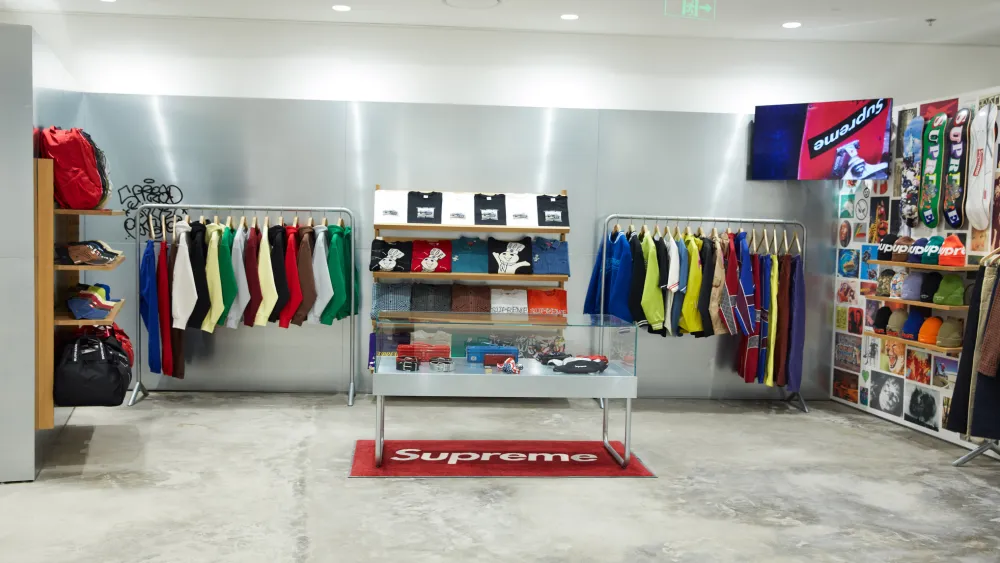
Founded by James Jebbia in 1994 on Lafayette Street in New York, Supreme grew from a single shop serving skaters. Today? 17 locations worldwide, $538 million in revenue (fiscal year 2024), and an owner in the form of powerhouse EssilorLuxottica (acquisition completed in October 2024). Not bad for a skateboard boutique.
Supreme is the red logo and the Thursday ritual
What makes Supreme evoke such strong emotions? The “drop model,” that is:
- Limited releases every week on Thursdays at 11:00 AM Eastern Time
- Artificially limited supply (a T-shirt? Maybe 500 pieces worldwide)
- Queues in front of stores and reselling at 300% of the price
This is not an ordinary sale. It’s a ritual where you’re not just buying a product, but taking part in an event. Products sell out within minutes, sometimes seconds. What didn’t make it to the cart? It ends up on the secondary market for the price of an apartment.
In the next section, you’ll see how the brand went from a single store to a global empire and why every collaboration (yes, Nike SB Dunk too) sends the internet into a frenzy.
History and Evolution
Before James Jebbia opened Supreme, he first had to understand New York. He moved there in 1982, worked at Union NYC (1989), then at the New York branch of Stüssy (1991). It was there that he learned what skateboarding really needs, at least when it comes to clothing.
Key milestones
| Year | Event |
|---|---|
| 1994 | Opening of the first store on Lafayette Street in SoHo |
| 1996 | Formation of the skate team |
| 1998 | Expansion into Japan, 3 stores |
| 2002 | Nike SB Dunk, the first major collaboration |
| 2011 | Store in London |
| 2012 | Collection with Comme des Garçons |
| 2017 | Louis Vuitton, CFDA award, Carlyle acquires 50% for 500 million USD (valuation: 1 billion USD) |
| 2020 | VF Corp acquires for USD 2.1 billion |
| 2022-2023 | Tremaine Emory as creative director, then resignation |
| 10.2024 | EssilorLuxottica finalizes $1.5 billion acquisition |
It is worth mentioning that the distinctive red box logo is clearly inspired by the works of artist Barbara Kruger (white and red inscriptions set against images). The debate about the ethics of this appropriation continues to this day.
From skater culture to high fashion
A small retail space with concrete ramps evolved into a global streetwear-luxury hybrid. Collaboration with Louis Vuitton in 2017 ended the debate about whether Supreme is “real fashion” — nobody cared anymore, as the brand gained acceptance everywhere.
How does the drop model work?
Supreme has elevated its drop system to cult status. Every Thursday, precisely at 11:00 a.m. New York time, a new collection goes on sale. Limited quantities, no pre-sales, no announcements about how many pieces are available. This artificial scarcity is a deliberate strategy that fuels resale on the secondary market. Products regularly fetch prices from 2 up to even 10 times higher than retail. Although there has been a recent cooling, Supreme’s share on StockX has dropped from around 36% in 2020 to about 16% now. The hype, however, is still alive.
| Channel | Principle | Example |
|---|---|---|
| supreme.com | Digital-first premiere, Thursday 11:00 AM EST | Main selling point |
| Physical stores | 17 locations worldwide | 4 USA, 4 Europe, 9 Asia |
| Dover Street Market | The only external wholesale point | Collaboration with Rei Kawakubo |
Quality, logo, and things no one expects
Supreme T-shirts are made from 220-240 g/m² cotton, sweatshirts feature reinforced seams, and chinos get bar-tack stitching at critical points. Box logo? Futura Heavy Oblique, white on a red background, dimensions about 4.5×3 inches. The same for years.
And then there are the accessories. Supreme sold a brick with its own logo. A Maglite flashlight. A Buck 120 knife. Marketing relies entirely on word-of-mouth and ambassadors like A$AP Rocky or Tyler, the Creator. Zero traditional advertising. Today, the brand is targeting China and Korea, and after being acquired by EssilorLuxottica, we’ll probably see more eyewear (Ray-Ban, Oakley).
Between the street and the salon
Supreme operates on the border of two worlds, and that is precisely where its strength lies. On one hand, it remains true to the street, its skate DNA, and the culture that gave birth to it. On the other, it enters galleries, appears in art collectors’ collections, and costs as much as works by renowned artists. This duality is no accident—it’s a strategy that has made the brand more than just clothing.
Actually, you’re not buying a T-shirt. You’re buying a piece of cultural history that you can wear or hang on your wall. And that’s what fascinates, whether you’re on a skateboard or at an art opening.
Noahii U90
editorial fashion & lifestyle
Luxury


Leave a Comment