

Ferrari 12Cilindri – a modern ode to the naturally aspirated V12
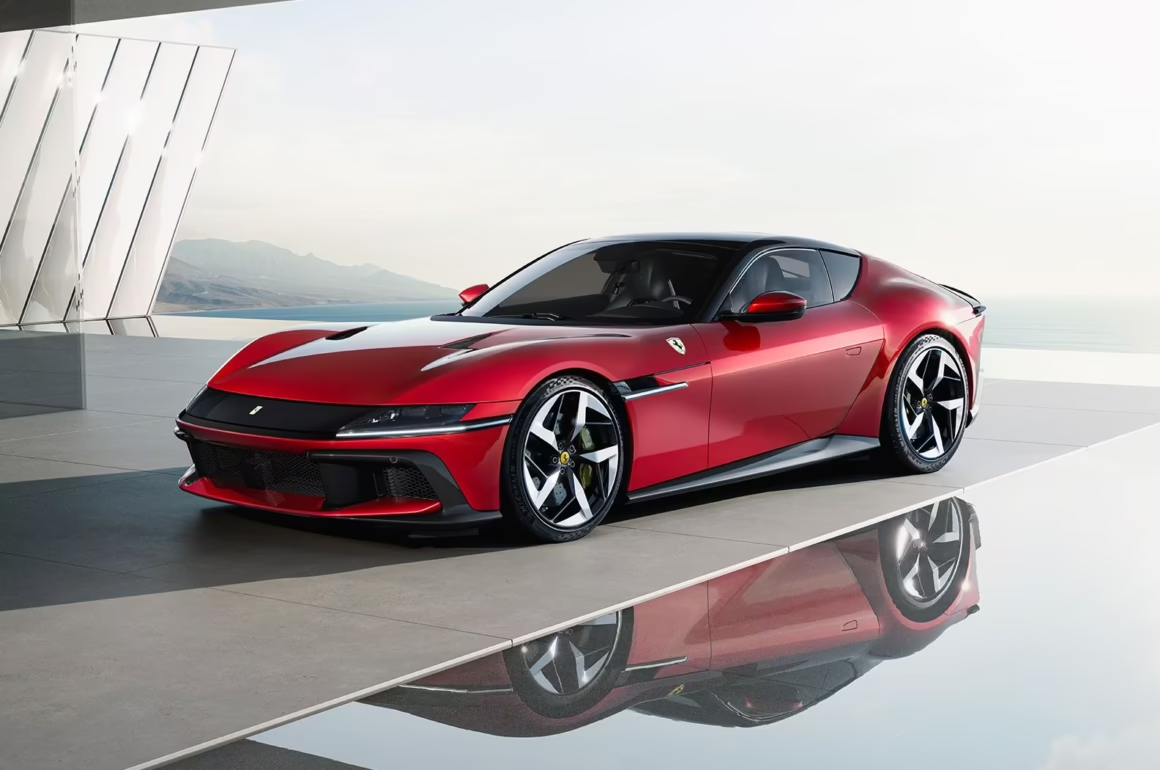
Is there still room for a classic, naturally aspirated V12 in the era of electrification and turbochargers? Ferrari proves there is, unveiling the 12Cilindri —a modern take on the legendary grand tourers.
Ferrari 12Cilindri: a powerful debut for the V12 legend
On May 3, 2024, under the tropical lights of Miami Beach, Ferrari celebrated its 70th anniversary on the American market by unveiling the 12Cilindri. Surrounded by select guests, against a backdrop of ocean and palm trees, the car was presented in Bianco Artico. It immediately drew attention with its elegance and modern design.
Beneath the hood of the 12Cilindri lies a 6.5-liter V12 engine delivering 830 hp, reaching 9,500 rpm and generating 718 Nm of torque. These impressive figures enable acceleration from 0 to 100 km/h in just 2.9 seconds, as well as a top speed exceeding 340 km/h.
In 2025, the 12Cilindri was honored with the prestigious Compasso d’Oro award, considered one of the most important distinctions in industrial design. This confirms that Ferrari not only continues its tradition, but also sets new standards in sports car design.
In this article, we’ll explore the legacy of V12 engines and the aerodynamic innovations featured in the 12Cilindri, as well as the future of naturally aspirated power units in the context of contemporary automotive trends.
“If you can dream it, you can build it.”
The Ferrari 12Cilindri proves that the dream of the perfect sports car can still become reality.
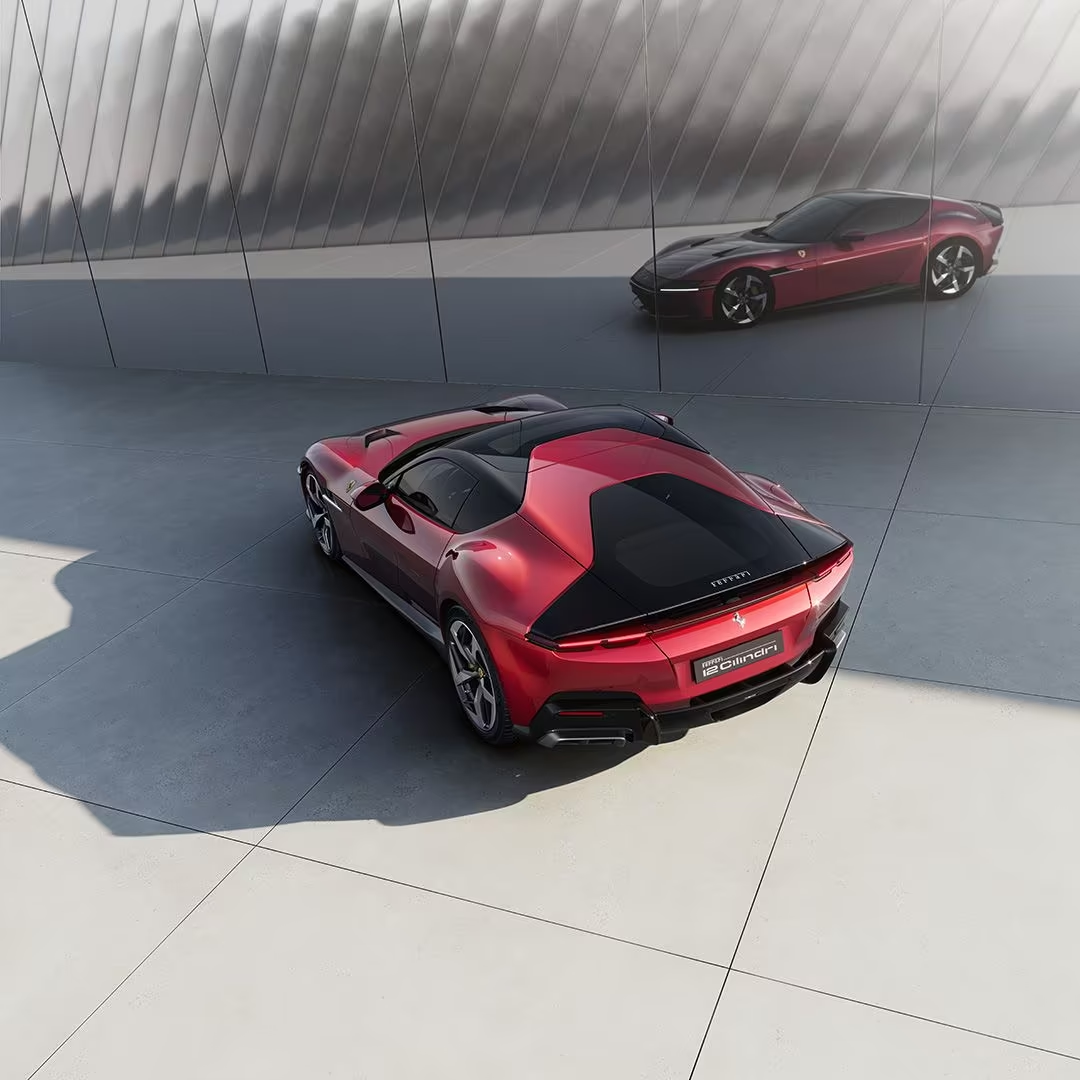
photo: ferrari.com
V12 Legacy: 80 Years of Passion and Innovation
Enzo Ferrari, the founder of the legendary brand, believed from the very beginning in the potential of the V12 engine as the heart of his cars. His first creation, the Ferrari 125 S from 1947, was equipped with a 1.5-liter V12 engine designed by Gioacchino Colombo. This compact yet powerful engine became the foundation for Ferrari’s future innovations.
The evolution of Ferrari V12 engines: from 125 S to 12Cilindri
- 1947: Ferrari 125 S
- The first Ferrari car, the 125 S, debuted with a 1.5-liter Colombo V12 engine delivering 118 hp. Despite its small displacement, this engine set the standard for future Ferrari designs.
- 1968: Ferrari 365 GTB4 Daytona
- Introduced in 1968, the Daytona model was powered by a 4.4-liter V12 engine producing 352 hp. It was the first Ferrari model with four camshafts, which significantly improved efficiency and performance.
- 1995: Ferrari F50
- The 1995 F50 featured a 4.7-liter V12 engine directly based on a Formula 1 power unit. This engine delivered 520 hp, and its carbon fiber construction and suspension technology came straight from the racetrack.
- 2013: Ferrari LaFerrari
- The 2013 LaFerrari introduced a hybrid powertrain, combining a 6.3-liter V12 engine with 789 hp and a KERS system. Together, this delivered a total of 950 hp. It was Ferrari’s first hybrid model, showcasing the blend of traditional V12 power with cutting-edge electric technology.
- 2024: Ferrari 12Cilindri
- The latest model, 12Cilindri, debuted in 2024 with a 6.5-liter V12 engine delivering 830 hp. It pays tribute to classic Ferrari models, combining traditional values with modern design and technology.
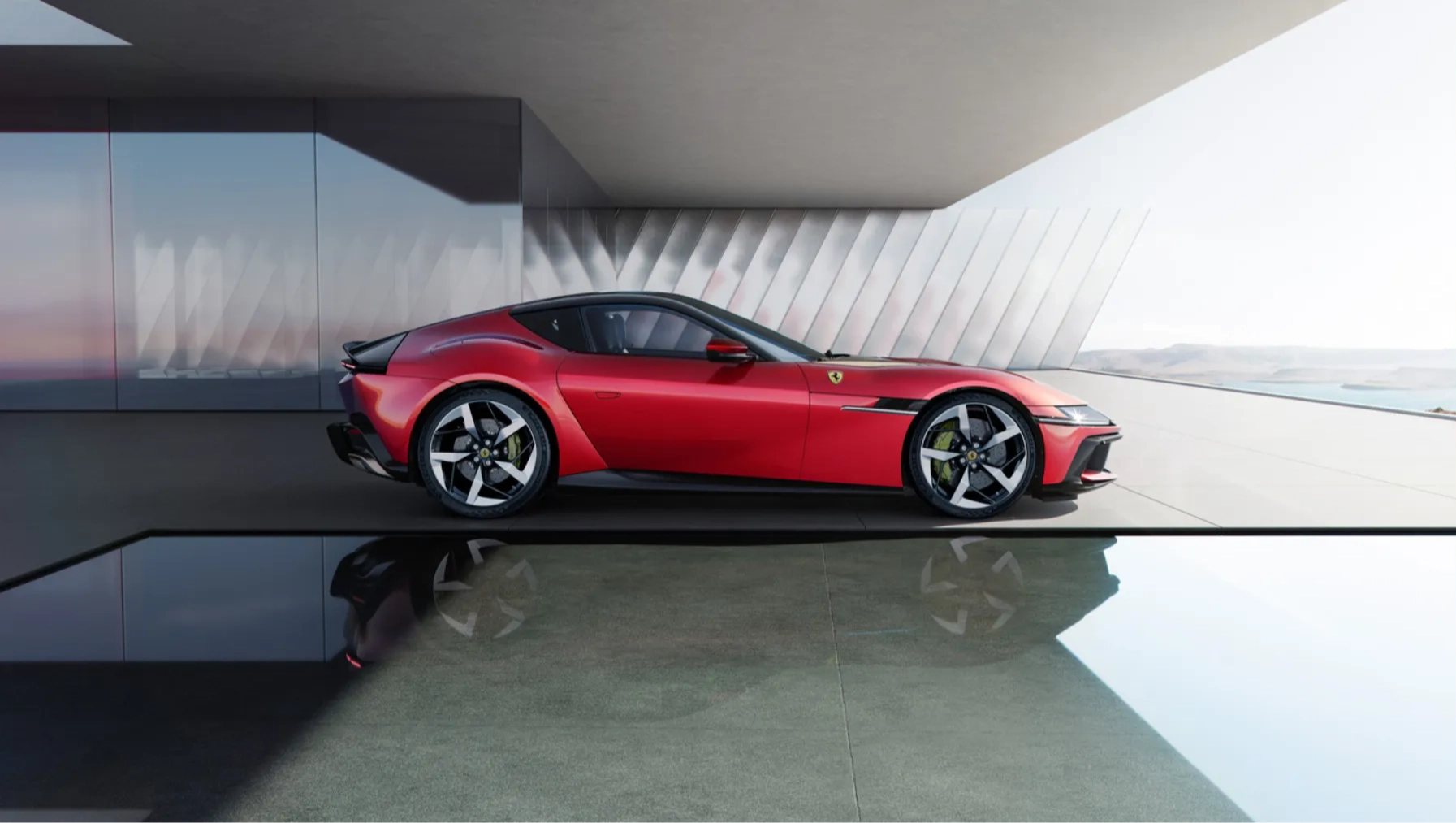
photo: f1rstmotors.com
The impact of Formula 1 experience on road cars
Ferrari has been transferring racing technology to its road cars for years. A prime example is the F50, whose V12 engine was directly based on a Formula 1 power unit, delivering outstanding performance and dynamics. Similarly, LaFerrari adopted the KERS system, known from F1, to boost power and efficiency. These innovations demonstrate how racing experience drives technological advancement in production vehicles.
“The evolution of Ferrari’s V12 engines is not just a story of power, but also of innovation and passion that have defined the brand for over 80 years.”
For decades, Ferrari has continuously refined its V12 engines, blending tradition with modernity. From the very first 125 S to the latest 12Cilindri, each model stands as a testament to the brand’s commitment to engineering excellence and a passion for automotive innovation.
Sculpture in Metal and Air: Design and Aerodynamics
At the Centro Stile Ferrari studio, under the direction of Flavio Manzoni, the 12Cilindri was born—a modern interpretation of the classic grand tourer with a naturally aspirated V12 engine. This design blends traditional GT proportions with advanced aerodynamics, creating a harmonious synthesis of form and function.
Key body lines
12Cilindri is distinguished primarily by its long, flat front and a cabin set further back, evoking classic Ferrari models such as the 365 GTB/4 “Daytona.” Manzoni emphasizes that this design moves away from anthropomorphic features like eye-shaped headlights or mouth-like grilles, opting instead for clean, futuristic lines inspired by science fiction aesthetics.
Operation of active aerodynamic flaps
To ensure optimal aerodynamics, the 12Cilindri is equipped with active flaps integrated into the rear window. These elements remain hidden during normal driving, preserving the purity of the design, and are activated in two modes:
- High downforce mode: At high speeds, the flaps lift to generate additional downforce, enhancing the vehicle’s stability.
- Aerodynamic braking mode: During heavy braking, the flaps rise, increasing air resistance and assisting the braking process.
This solution enables dynamic adjustment of aerodynamics to current driving conditions.
Aluminum frame and reduced weight
The 12Cilindri is built on a new aluminum frame, which is 0.8 inches shorter in wheelbase and offers 15% greater torsional rigidity compared to its predecessor, the 812 Competizione. Thanks to the use of lightweight materials, the vehicle’s weight has been significantly reduced, resulting in improved performance and fuel efficiency.
- Component Material Weight (kg) Frame Aluminum 85 Body Aluminum 120 V12 Engine Steel 220 Compasso d’Oro Award 2025
In 2025, the Ferrari 12Cilindri won the prestigious Compasso d’Oro award in the production car category. The jury praised the design for its “inseparable connection to tradition while looking to the future,” highlighting the design team’s ability to seamlessly blend sporty character with elegance.
By combining classic proportions with modern aerodynamic solutions and a lightweight structure, the Ferrari 12Cilindri offers a contemporary take on the grand tourer, delivering both outstanding performance and unmatched elegance.
Numbers that make your heart race: performance and specifications
Ferrari 12Cilindri is a modern ode to the naturally aspirated V12 engine, delivering impressive performance and cutting-edge technology. Before we dive into the details, it’s worth asking: how much horsepower does it take to get your pulse racing?
Performance comparison: Ferrari 12Cilindri, Aston Martin DB12 and Bentley Continental GT
The table below presents the key specifications of three luxury grand tourers:
Parameter Ferrari 12Cilindri Aston Martin DB12 Bentley Continental GT Power 819 hp 671 hp 659 hp Torque 678 Nm 800 Nm 900 Nm 0-100 km/h 2.9 s 3.6 s 3.6 s Top speed >340 km/h 325 km/h 335 km/h
https://www.youtube.com/watch?v=9LIfbLelKuQ
Chassis and braking system analysis
The Ferrari 12Cilindri features 21-inch wheels and an advanced braking system with 398 mm discs at the front and 360 mm at the rear. The brake-by-wire system, which uses electronic brake control, offers the following benefits:
- Precise braking force control: Electronic management enables more accurate adjustment of braking force to the conditions on the road.
- Faster system response: Eliminating mechanical delays results in an immediate reaction to pressing the brake pedal.
- Integration with support systems: Easier connectivity with other systems, such as traction control or ABS, enhancing overall safety.
Thanks to these solutions, the 12Cilindri offers outstanding vehicle control both on the track and during everyday driving.
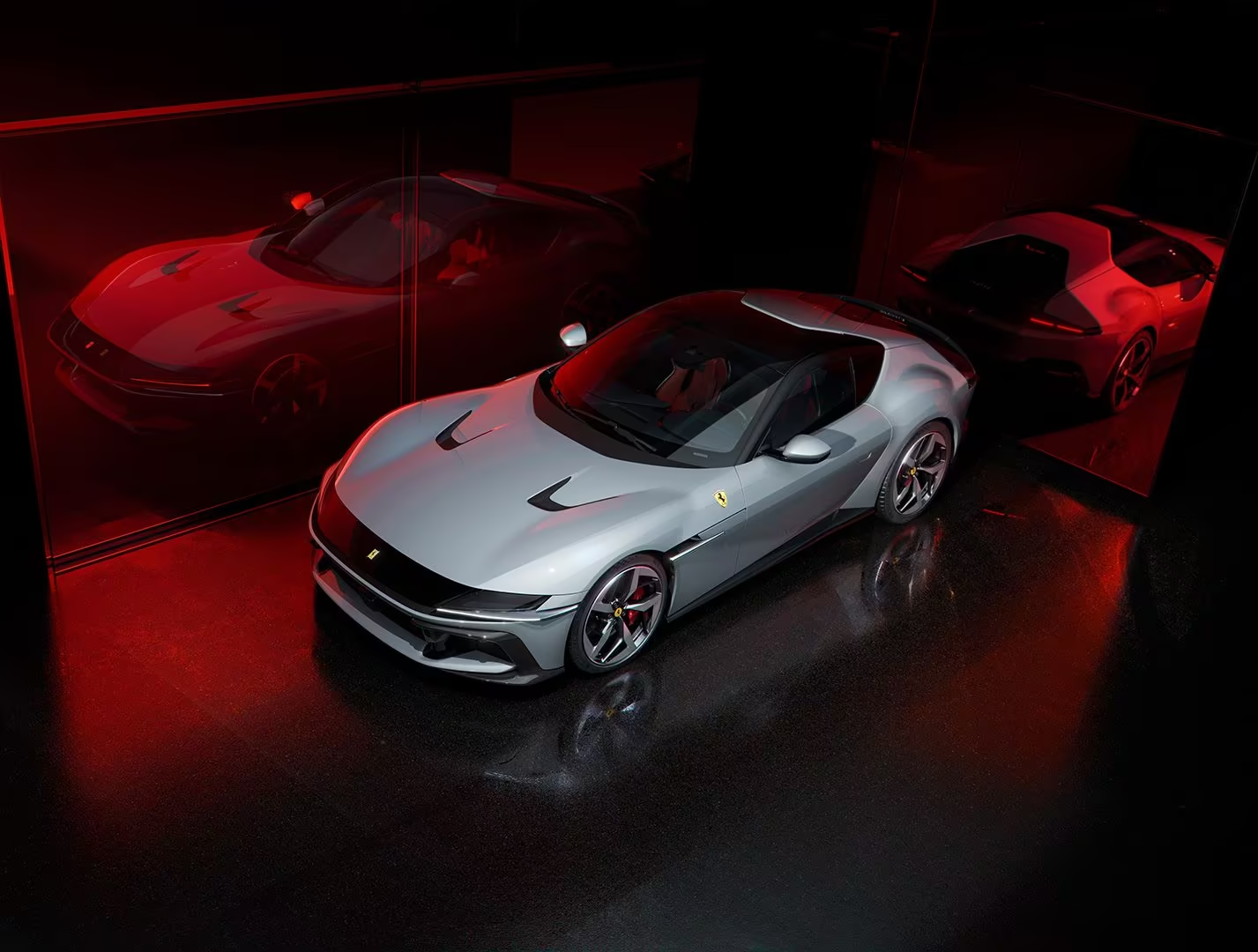
photo: ferrari.com
Tyres engineered for maximum performance
Ferrari offers Michelin Pilot Sport S5 and Goodyear Eagle F1 Supersport tires for the 12Cilindri model. Both options provide excellent grip and stability, which is crucial for a vehicle with such high performance.
In summary, the Ferrari 12Cilindri is above all a combination of a classic V12 engine with modern technologies, together creating a car capable of delivering an unforgettable driving experience.
Behind the wheel: first impressions and reviews
Turning the key in the Ferrari 12Cilindri is undeniably a moment that stays with you for a long time. The sound of the naturally aspirated V12 engine stirs emotions that accompany every press of the accelerator.
First impressions behind the wheel
MotorTrend describes the 12Cilindri as “one of the wildest front-engined Ferrari models in history.” This statement highlights the intense experience this model delivers.
Driving assessments
Reviewers highlight several key aspects of driving the 12Cilindri:
- Ride comfort: “The ride quality is outstanding, even without activating the ‘bumpy road’ mode,” notes Goodwood Road & Racing.
- Steering precision: “The steering system is precise, and the damping is flawless,” emphasizes Goodwood Road & Racing.
- Engine sound: “The naturally aspirated V12 sound gives you goosebumps,” writes Motor1.
Track test results
Ferrari 12Cilindri delivers impressive performance on the track:
- 0-100 km/h acceleration: 2.9 seconds
- Top speed: over 340 km/h
- Braking 100-0 km/h: 31.4 meters
Controversial design
The styling of the 12Cilindri evokes mixed feelings:
“Design is polarizing, even by the standards of today’s automotive world,” notes Top Gear.
“12Cilindri looks fresh; it’s a dramatic, modern take on the iconic GT,” writes MotorTrend.
Pros and cons according to reviewers
Pros Cons – Powerful V12 engine – High price – Precise handling – Controversial design – Ride comfort – Limited luggage space Ferrari 12Cilindri is a car that blends tradition with modernity, delivering an unforgettable driving experience. Its unique character and performance make it a choice for true automotive enthusiasts.
Market, money and prestige: the significance of the 12Cilindri for Ferrari
The Ferrari 12Cilindri, with its limited production and US debut marking the brand’s 70th anniversary, undoubtedly plays a key role in strengthening Ferrari’s financial standing and brand image in the global luxury GT car market.
Limited production strategy and its impact on margins
Ferrari consistently follows a limited production strategy, which naturally increases the exclusivity and collectible value of their vehicles. A prime example is the F80 model, introduced in October 2024, with production capped at 799 units, each starting at $3.9 million. This approach not only boosts profit margins but, above all, reinforces the brand’s prestige.
The significance of the US premiere marking the brand’s 70th anniversary
The launch of the 12Cilindri in the United States, marking the 70th anniversary of Ferrari’s presence in this market, highlights the historical significance of the USA for the brand. In 2024, the USA was Ferrari’s largest market, with 3,262 vehicles sold, accounting for 23.9% of global deliveries.
Comparison of GT Ferrari sales in 2023 and 2024
Ferrari sales in the luxury GT car segment showed growth in 2024. In 2023, Ferrari delivered 13,663 vehicles, while in 2024 this number increased to 13,752, representing a 0.7% rise.
Growing demand in China and the Middle East
Despite a 22% drop in sales in China, Hong Kong, and Taiwan in 2024, Ferrari is seeing growing demand in the Middle East. In 2023, sales in this region increased by 31% compared to 2022.
3 key takeaways for investors
- Exclusivity drives margins: Limited production of models like the F80 allows Ferrari to maintain high profit margins.
- Strong presence in the American market: The USA remains a key market for Ferrari, highlighting the importance of launches and marketing activities in this region.
- Geographical diversification: Despite challenges in China, growing demand in the Middle East points to an effective strategy of diversifying sales markets.
Ferrari 12Cilindri, through its exclusivity and strategic launch in the American market, significantly strengthens Ferrari’s financial standing and brand image in the global luxury GT car market.
And if you’re passionate about automotive topics, be sure to check out this article as well – the most expensive cars in the world
Ecology vs. Emotion: The Debate Over the Future of the V12
In the face of tightening CO₂ emission standards in the European Union and the United States, the future of large combustion engines, such as naturally aspirated V12s, is uncertain. Ferrari, as a manufacturer of luxury cars, faces the challenge of reconciling its tradition with new environmental regulations.
Rising CO₂ emission standards in the EU and USA
The European Union has adopted ambitious CO₂ emission reduction targets for new passenger cars:
- 2025: a 15% reduction compared to 2021 levels.
- 2030: a 55% reduction compared to 2021 levels.
- 2035: complete elimination of CO₂ emissions from new passenger cars, meaning a ban on the sale of vehicles with combustion engines.
Of course, in the United States, stricter emission standards are also being introduced, with plans to achieve carbon neutrality in the transport sector by 2050.
Ferrari’s stance on emission regulations
Despite increasing environmental demands, Ferrari remains committed to its naturally aspirated V12 engines. Emanuele Carando, Ferrari’s global marketing director, emphasized:
“We will keep producing naturally aspirated V12s as long as the law allows us to.”
Ferrari supports its position with three main arguments:
- Technical: Naturally aspirated V12 engines deliver linear power and instant throttle response, which is hard to achieve with turbocharged engines.
- Technical: Adding hybrid components would increase the vehicle’s weight, which would negatively affect performance and handling.
- Emotional: The sound and performance characteristics of the V12 are an integral part of the Ferrari driving experience, highly valued by customers.
CO₂ Emissions Comparison: Ferrari 12Cilindri vs. SF90 Stradale
To illustrate the differences in CO₂ emissions between traditional and hybrid Ferrari models, we present the following table:
Model Powertrain type CO₂ emissions (g/km) Ferrari 12Cilindri Naturally aspirated V12 353 Ferrari SF90 Hybrid V8 154 CO₂ emission data for the Ferrari 12Cilindri sourced from A, for the SF90 Stradale.
Possible scenarios for the future of the V12
To meet future regulations, Ferrari is considering several strategies:
- Mild-hybrid: Integration of a mild hybrid system that minimizes weight gain while reducing emissions.
- E-fuels: The use of synthetic fuels that are CO₂-neutral, allowing continued use of combustion engines.
- Limited production: Reducing the number of V12 models produced, making them more exclusive and compliant with stricter emission standards.
As noted by Julia Poliscanova, Director of Vehicles and Supply Chains at Transport & Environment:
“This is a pivotal moment for the European automotive industry, as global competition in the production of electric cars, batteries, and chargers is immense.”
The future of naturally aspirated V12 engines at Ferrari naturally depends on the company’s ability to innovate and adapt to changing regulations, while preserving the unique character of its vehicles.
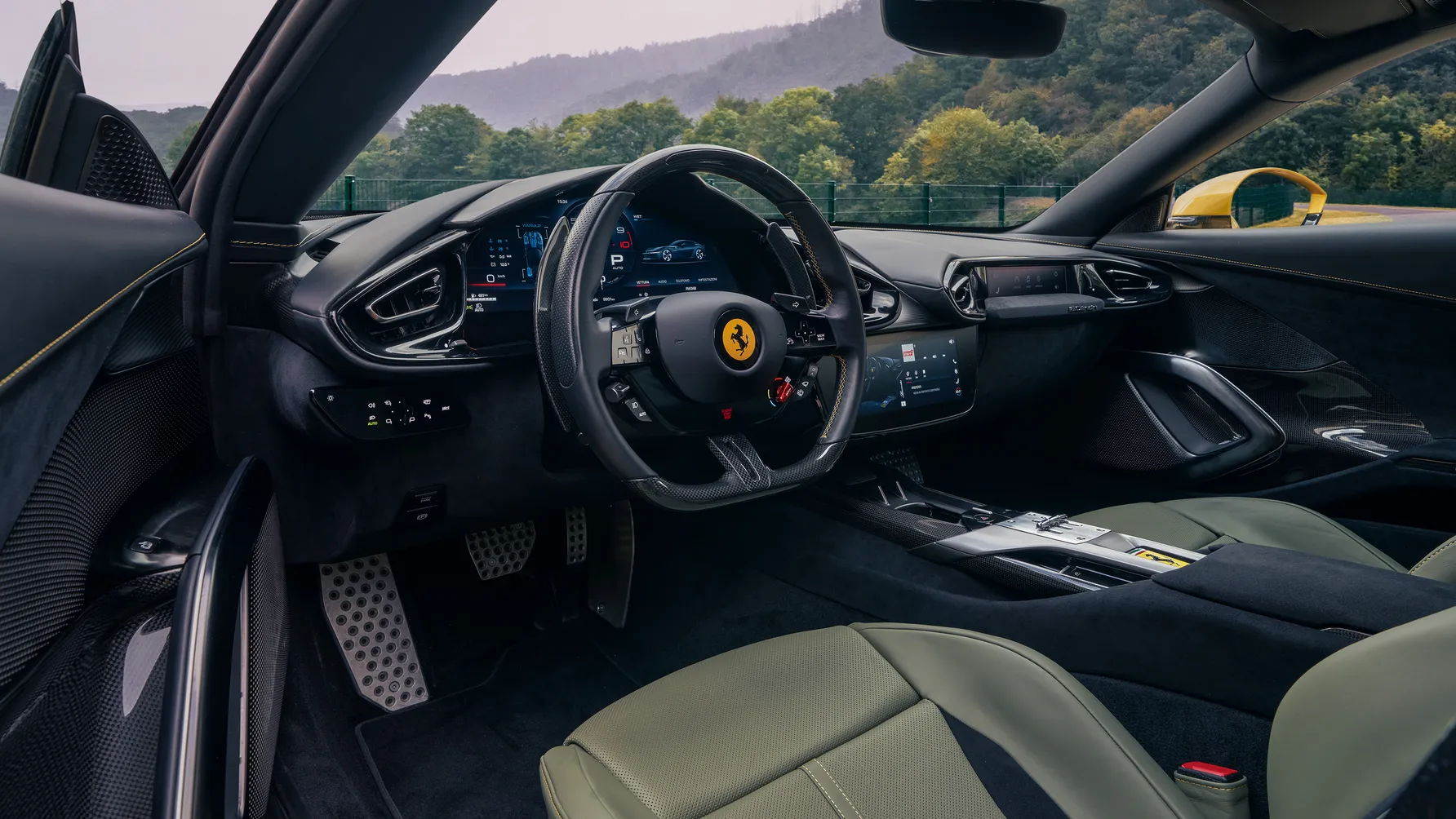
photo: topgear.com
To the Future of the V12: What’s Next for Ferrari and Drivers
Ferrari 12Cilindri is a modern ode to the naturally aspirated V12 engine, blending tradition with innovation. In the face of growing environmental and technological challenges, the future of these legendary power units raises many questions.
Key takeaways from the article
- Ferrari plans to keep its V12 engines for as long as possible, adapting them to meet future emissions standards.
- The introduction of e-fuels could extend the lifespan of combustion engines while offering carbon neutrality.
- Ferrari is investing in electrification, planning to launch its first fully electric model in 2026.
- Hybrid technology plays a key role in the brand’s future, combining traditional engines with modern solutions.
- The future of V12 engines depends on their ability to adapt to evolving environmental regulations and changing consumer preferences.
Practical steps for enthusiasts
- Book a test drive of the Ferrari 12Cilindri to experience the power and character of the V12 engine firsthand.
- Follow car auctions featuring classic Ferrari models with V12 engines, as they can be an attractive investment opportunity.
- Support the development of e-fuels by getting involved in initiatives that promote synthetic fuels as an alternative to traditional fuels.
Technology forecast
By 2030, Ferrari plans to introduce hybrid V12 engines with energy recovery systems. This could result in a reduction of CO₂ emissions by around 20-30% compared to current units.
The future of V12 engines depends on our passion and commitment to their evolution.
And here, see what would make the perfect souvenir for a Ferrari fan






Leave a Comment