

Are copper pots suitable for induction?
Copper has long been synonymous with culinary luxury. These warm, shimmering vessels are not just tools, but symbols. Many people, when purchasing copper accessories, wonder whether copper pots are suitable for induction? The problem is that an induction cooktop works on the principle of a magnetic field, and pure copper … well, it isn’t magnetic. Sounds like the end of the conversation, right? But not necessarily — because there are hybrid solutions that many people are unaware of. For many years at Luxury Products, we have been showcasing unique solutions from Italian brands specializing in premium products.
Are copper pots suitable for induction and how does modernity combine with technology
Because we don’t want to choose between aesthetics and functionality. And that’s good, because we don’t have to. But to make an informed decision, it’s worth first understanding:
- how induction really works (and why pure copper is not suitable)
- which types of pots made of copper actually work
- how to recognize the right pot before buying
- pros and cons of compromise solutions
In the following sections, we will elaborate on each of these topics — from physics to practice.
photo: us.ruffoni.net
How does an induction cooktop work and why is pure copper not enough?
When you look at an induction cooktop, you see a smooth sheet of glass. There’s no flame, no burner. And yet the pot heats up—even faster than on a traditional gas stove. All the magic happens beneath the surface, in the electromagnetic field created by a copper coil hidden under the glass plate. This field generates eddy currents in the bottom of the vessel —but only if the bottom is made of a ferromagnetic material.
What is induction heating really about?
An induction cooktop works thanks to the phenomenon of electromagnetic induction. A coil beneath the surface generates a rapidly changing magnetic field that tries to penetrate anything placed on the cooktop. If it encounters a ferromagnetic material—such as iron or certain types of stainless steel—it creates eddy currents (so-called Foucault currents) within it. These currents cause internal friction in the metal, and that friction turns into heat. And it’s this heat that cooks your meal.
The problem is that copper—despite its spectacular thermal conductivity (401 W/mK), several times higher than aluminum (237 W/mK) or steel (16-50 W/mK)—is a non-ferromagnetic metal. It doesn’t react to the magnetic field in a way that would generate heat. Copper cookware itself is NOT directly suitable for induction, because it simply doesn’t “catch” the field. You can place it on the cooktop and… nothing will happen.
In other words: copper conducts existing heat extremely well, but it can’t generate it on its own under induction.
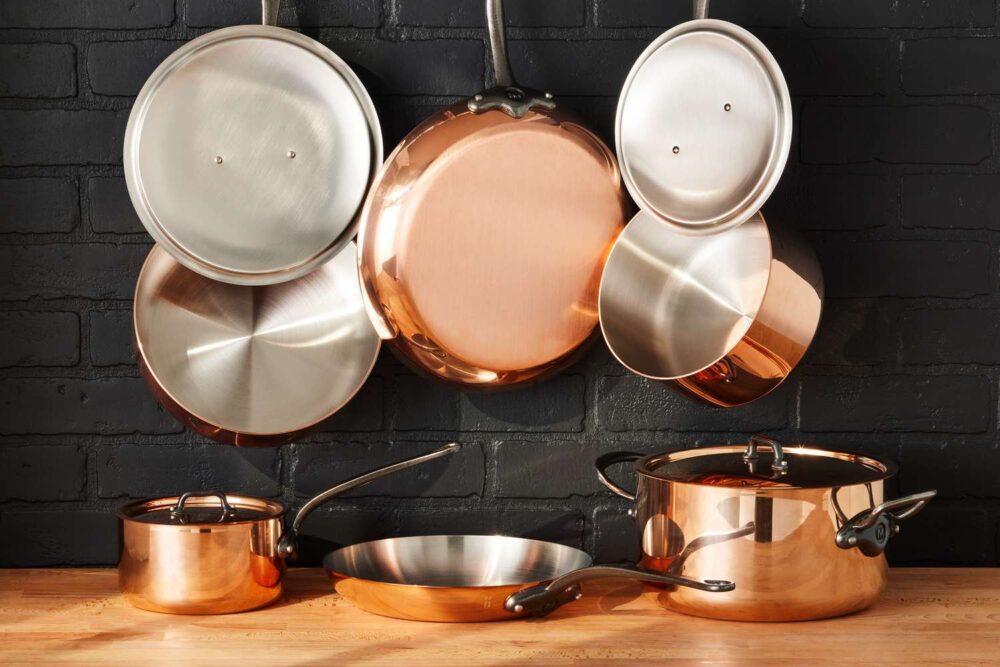
photo: foodandwine.com
Modern copper pots for induction — discover their construction and key features
Manufacturers have solved a problem that is simple in theory but not easy in practice: they added a flat disk of ferromagnetic steel to the copper body. This “sandwich” retains the advantages of copper (rapid heating, even distribution), but responds to the induction field—the cooktop detects the steel and transfers energy to the entire pot. Particularly good brands from the West, such as Ruffoni and Falk Culinair, specialize in this.
Hybrid construction: copper + stainless steel
A typical modern copper pot for induction has walls made of pure copper with a thickness of 1.5-2.5 mm and a special bottom—here the manufacturer embeds or attaches a layer of stainless steel (most often inox 18/10 or 18/8, sometimes AISI 430/304) with a thickness of 1-3 mm. The total bottom thickness is usually 2-5 mm. The market standard has become the ” 90% copper + 10% steel ” configuration—the Affinity series or the “Induction Copper” lines work exactly on this principle.
photo: evasolo.com
What DNA parameters are crucial during induction?
| Parameter | Induction hob requirement | Typical copper pot with disc |
|---|---|---|
| Bottom material | Ferromagnetic steel (magnet sticks) | Inox 18/10, 18/8, AISI 430/304 |
| Bottom diameter | Min. 12 cm (depends on the burner model) | 14-24 cm (most often 20 cm) |
| Flatness | Perfect (no bends > 1 mm) | Tolerance ±0.5 mm, ground bottom |
| Steel layer thickness | Min. 0.8 mm | 1-3 mm |
How to recognize an induction-compatible copper pot and avoid duds?
You bought a beautiful copper pot, brought it home, and the induction hob doesn’t even blink – a classic scenario. It happens more often than you think, and it’s not always the induction’s fault. The problem is that not every pot with a copper exterior actually works on this type of hob. You need to be aware of one fundamental thing: a good manufacturer comes at a price. Let’s not kid ourselves—you won’t buy a set of real copper pots for 100 euros! Definitely not, and that’s a fake!
Magnet test – the fastest verification method
Before you pay, try a simple experiment at home. Stick a neodymium magnet to the bottom—if it sticks firmly, the pot works with induction. No magnet? You can buy one at a household appliances store for a few zlotys. The procedure is as follows:
- Place the magnet on the underside of the pot (exactly in the center of the bottom).
- Check if it holds firmly, as a slight pull is not enough.
- If the magnet falls off or barely sticks, forget about induction.
The bottom material must be ferromagnetic for the coil to generate eddy currents; attractive-looking copper alone is not enough. However, this is just one of the tests we can perform. The key is that the manufacturer provides an original certificate for their products.
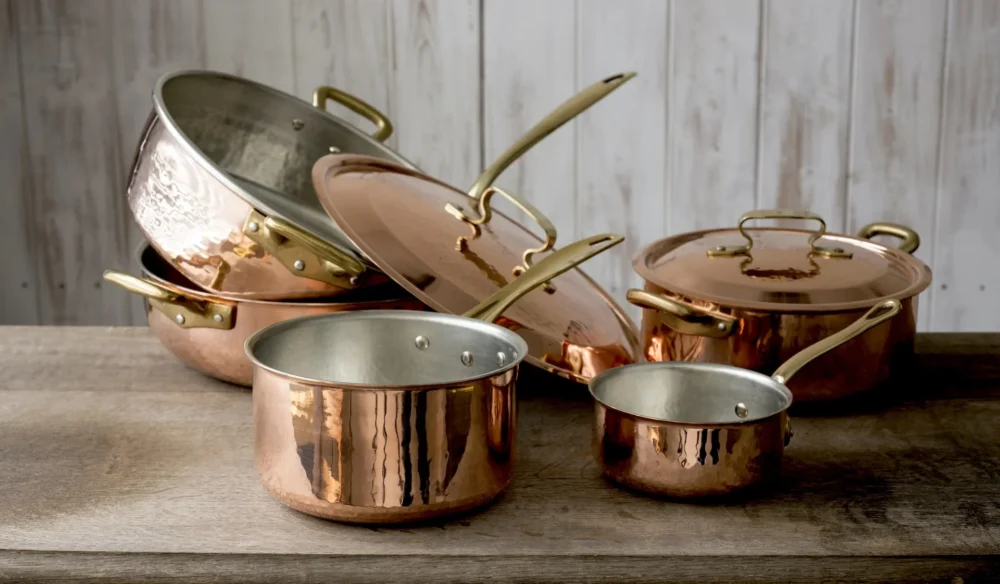
photo: leatelierparis.com
Markings on the bottom of a pot that we need to know
Coil symbol, the word “induction,” cooktop pictograms – manufacturers usually place this on the bottom. The problem? Some cheaper pots are misleading or have no markings at all. Pay attention to:
| What to check | Why it matters |
|---|---|
| Magnet | Confirms a ferromagnetic bottom |
| Markings | Coil symbol = manufacturer’s declaration |
| Weight | Heavy base = steel disc inside |
| Flatness | Flat bottom = better contact with the plate |
Although 95% of new copper pots on the market are not suitable for induction, there is no shortage of duds and counterfeits. Pay attention to very thin, lightweight cookware without a brand mark—they often have a disc so weak that the cooktop doesn’t detect them. A copper pot that is very light is a red flag indicating it’s a cheap imitation.
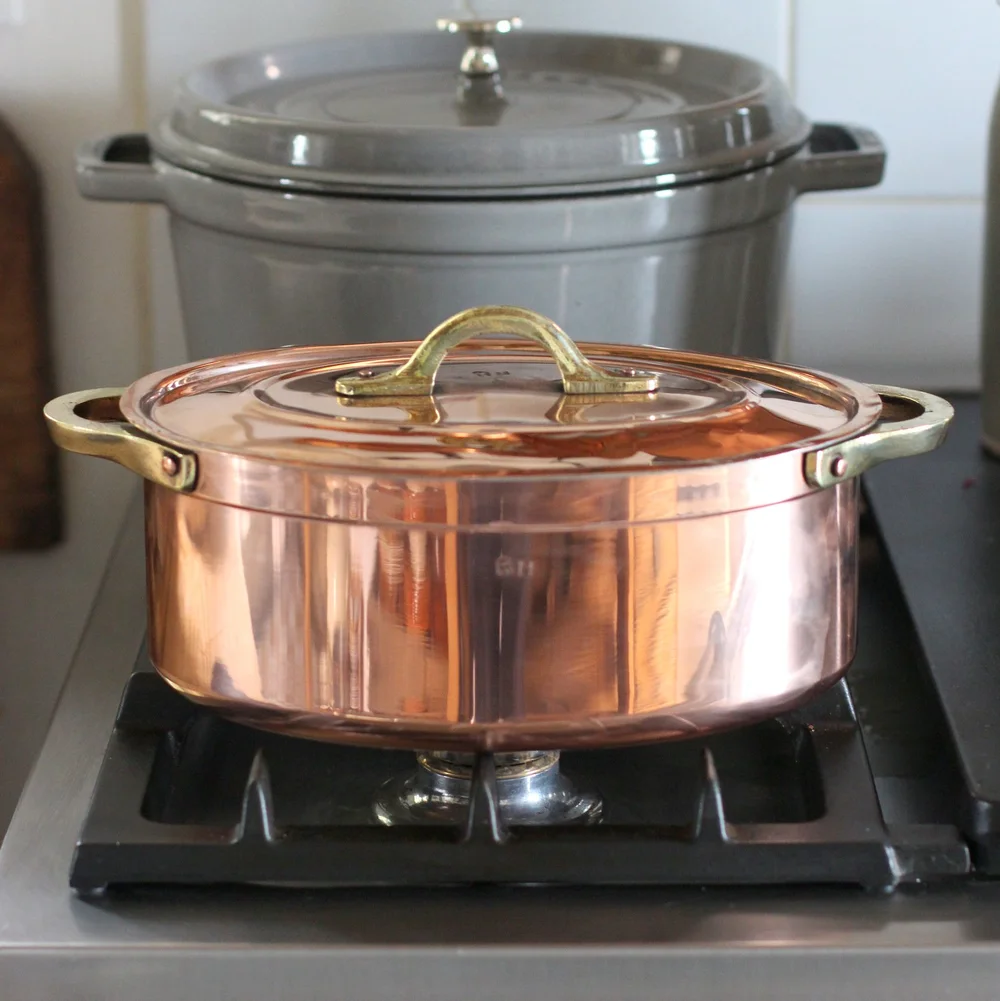
photo: rabbithilllifestyle.com
Advantages and disadvantages of copper pots on an induction hob
A copper pot on induction is a bit like a Ferrari in city traffic—beautiful, expensive, but is it really for everyone? Let’s see what you actually get with copper, and what might surprise you (and not always in a good way).
Why do chefs love copper on induction
High-quality copper pots with a ferromagnetic disc heat up about 30% faster than steel ones. That’s not a myth. And heat distribution? Perfect for sauces, reductions, risotto—anywhere temperature nuances matter. Control is simply better.
And then there’s durability. Copper will easily last 20–50 years, while aluminum usually lasts 5–10. In restaurants they use De Buyer, Falk Culinair, or Ruffoni —and for good reason. It’s an investment for years, not just a season.
Discover the advantages of copper cookware:
- Fast heating (30% advantage over steel)
- Excellent temperature control
- Lifespan 20-50 years
- Antibacterial properties
- And the aesthetics – copper simply looks
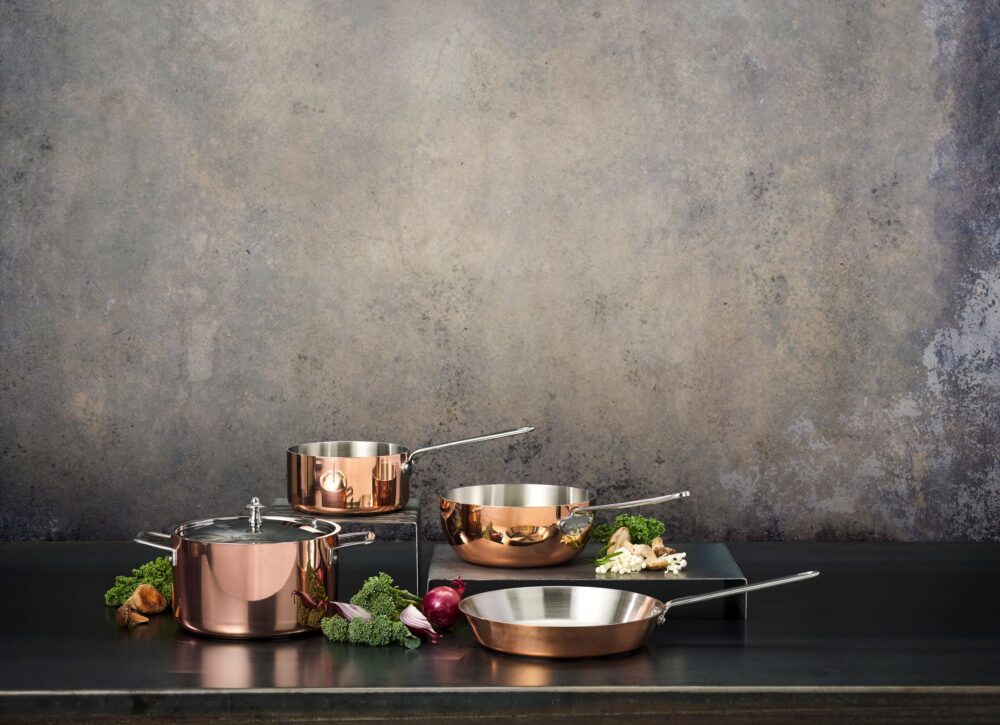
photo: scanpan.eu
High price and weight?
Here comes the reality check. The price? Easily 100 – 200 euros per pot. The weight? 2-5 kg, which can be a real struggle for some. Plus, you have to polish them, because copper oxidizes. And be careful with very acidic dishes if the pot doesn’t have a protective coating. So premium copper cookware has to be heavy and come with a hefty price tag!
Disadvantages:
- A price that puts off most wallets
- Weight (sometimes you need to lift it with both hands)
- Care – hand polishing
- Restrictions with acidic dishes
About 80% of users from rankings and X are satisfied. 70% of posts on X praise induction for its speed and cleanliness, but 20% complain about “incompatible pots” as well as the weight and price of copper. It seems that you either fall in love with the copper beast or consider it an impractical luxury. For us, copper pots and cookware are the best for professional cooking.
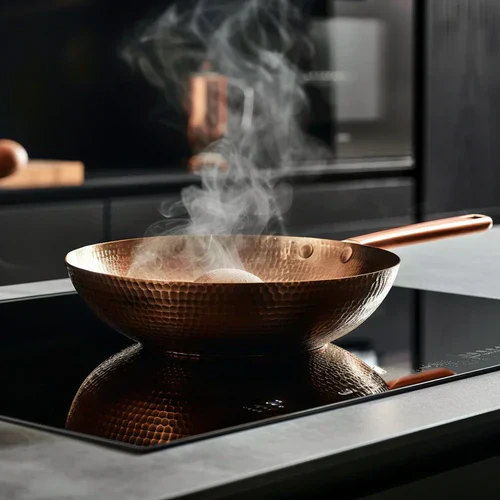
photo: copperkitchenstore.com
When is copper on induction a good investment?
Copper pots with an induction layer are the best choice if you often prepare delicate sauces, reductions, or sweet mixtures, and wherever precision matters. Enthusiasts of cooking who value aesthetics and are willing to pay for durability will find what they’re looking for here. On the other hand, those who mainly cook soups, pasta, and simple dishes won’t notice much difference compared to good stainless steel at a much lower price.
Mariano Italiano
Chef and cooking enthusiast
lifestyle & products editor
Luxury Blog





Leave a Comment