

Which is better, bonding or flow injection?

Social media, selfies, one Zoom meeting after another — our smile is on display almost all the time. In Poland, especially since 2018, the pressure for a “perfect smile” has noticeably increased, particularly among people who work with others. This is where composite restoration methods come in: which is better, bonding or flow injection? Both allow you to improve the shape, color, or minor imperfections of your teeth, usually without enamel grinding and without pain.
Which is better, bonding or flow injection? – a smile without drilling
What do patients expect today? Most often, I hear:
- Quickly – preferably in a single visit
- No drilling and no anesthesia
- Naturally – so that no one can tell that “something’s been done”
- Affordably priced for the middle class
Later in the article, you’ll discover the exact differences between bonding and flow injection, the visual results they offer, how much you can expect to pay, and how to choose the best option for yourself. For now, one thing matters: today you have a choice that simply didn’t exist a few years ago.

photo: 209nycdental.com
Bonding and flow injection in simple terms
Both methods—bonding and flow injection—allow you to enhance your smile without grinding down your teeth, but they work in completely different ways. Bonding gives the dentist more of a “freehand” approach, while flow injection relies on a precise matrix and digital planning. To understand which option is better for you, it’s worth starting with the basics: what exactly each technique involves and where they come from.
What is composite bonding?
Bonding is the direct modeling of a flowable composite on the tooth surface. The dentist applies the material freehand, sculpts the shape, and then cures it with a lamp. This method originated in the 1960s, when Michael Buonocore introduced adhesive bonding—bonding to enamel. Today, bonding refers to so-called direct composite veneers: quick, minimally invasive procedures, but the result depends mainly on the dentist’s skill.
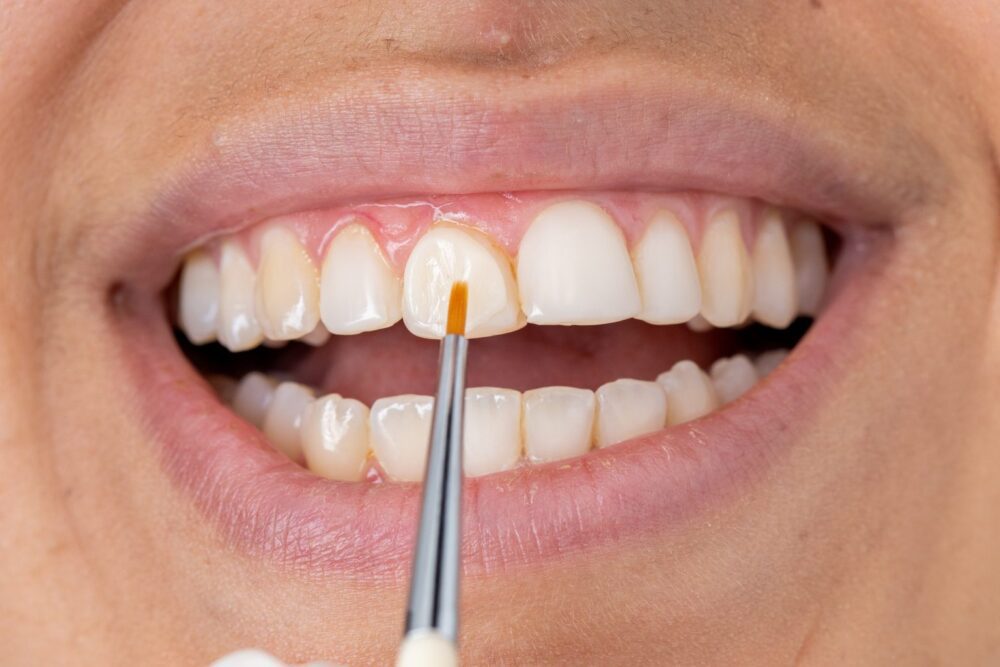
photo: studiosmiles.com.au
What is the flow injection technique (FIT)?
Flow Injection Technique is a more recent option. Instead of sculpting “by eye,” the doctor prepares a custom silicone matrix based on a digital scan (or a wax-up, if needed). Then, a special low-viscosity composite is injected into this matrix, which is placed over the teeth. The matrix ensures consistent shape and symmetry, while the material itself spreads evenly. The technique appeared in Europe around 2018, exploded in Poland between 2021 and 2023, and by 2024-2025 became standard in premium clinics.
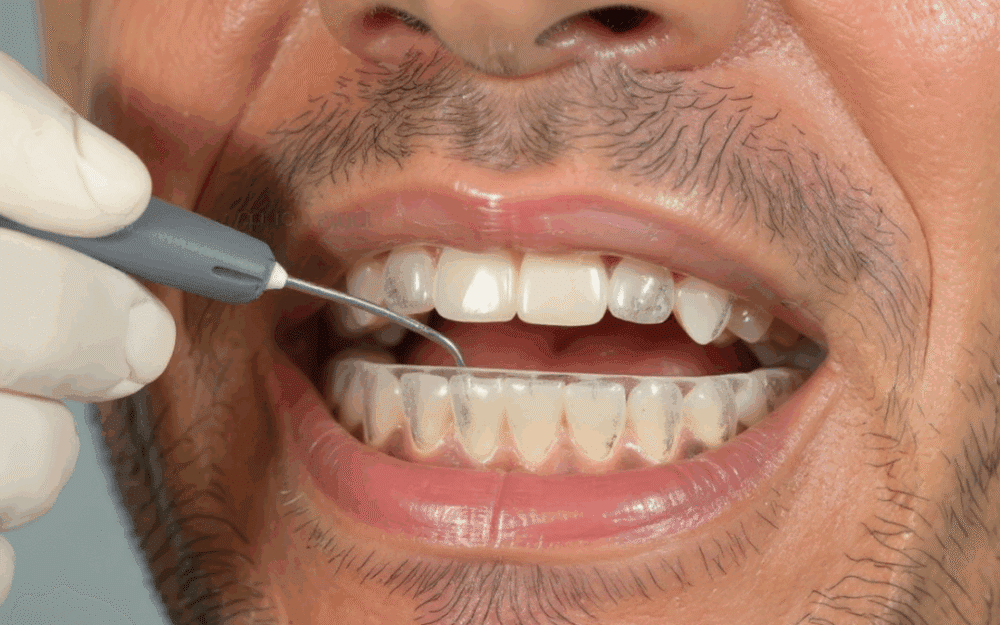
photo: odontoiatry.it
| Aspect | Bonding | Flow injection |
|---|---|---|
| Application method | Doctor’s discretion | Silicone mold |
| Digitization | Minimal | Full (3D scan) |
| Repeatability | It depends on skills | High |
For comparison: porcelain veneers require grinding down 0.3-0.5 mm of enamel, are more durable and more expensive, but this is a completely different category of intervention.
From scan to smile – how both procedures work
What does the bonding process look like step by step?
Bonding is a “live” procedure—the dentist sculpts your smile layer by layer, without a matrix. It looks roughly like this:
- Etching the enamel with 37% phosphoric acid for 15-30 seconds (it looks like a white paste and may cause slight tingling).
- Application of bonding agent – a liquid resin that ensures the composite adheres for years.
- Applying composite in layers of 0.3-1 mm – the dentist shapes it with a spatula, builds up the tooth edge, and rounds the corners.
- Each layer is cured under an LED lamp for about 20 seconds—you feel warmth, but it doesn’t hurt.
- Finishing and polishing – contouring, smoothing with discs, adjusting to the bite.
The entire procedure usually takes 1-2 hours, and you leave the chair with a perfect smile.
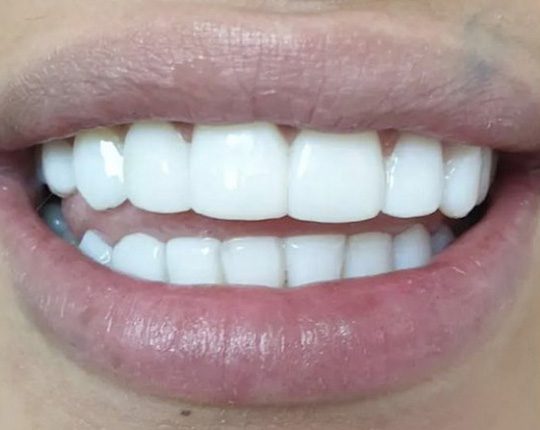
photo: thecliniccanton.com
How does the flow injection (FIT) procedure work?
With flow injection, most of the magic happens outside your mouth—in the digital world and the lab. The procedure has three stages:
Diagnostics: intraoral scan (Trios, iTero), photos, digital wax-up—designing your future smile in Exocad or 3Shape.
Laboratory: based on the scan, a model is printed and a silicone matrix is cast (Elite HD+, PUTTY)—a plastic “shell” that replicates the ideal tooth shape.
Treatment: acid etching, filling the matrix with flowable composite (G-aenial Flow, Filtek Supreme Flow Ultra), pressing it onto the teeth, light-curing through the matrix, removing the silicone, gentle contouring and polishing. It takes 2-3 hours, but covers 6-12 teeth at once.
Both methods are painless and you see the results immediately—the difference lies in how you get there.
Effect, longevity and risk – how both methods really compare
Both methods deliver visible results, but they differ in details that truly matter in the long run. Bonding is a quick fix, while flow injection is more predictable and durable. However, neither matches porcelain veneers when it comes to strength.

photo: cardinal-dental.com
Durability and resistance to discoloration
| Parameter | Bonding | Flow Injection | Porcelain veneers |
|---|---|---|---|
| Durability | 2-4 years | 3-6 years | 10-15 years |
| Stain resistance | average | ok | very good |
| Anatomical precision | 7/10 | 9.5/10 | 10/10 |
| Number of visits | 1 | 1 | 2-3 |
Flow injection wins in most categories—the material is denser, fills micro-irregularities more effectively, and thanks to digital shape control, it’s simply… more predictable.
Patient satisfaction and predictability of results
The statistics speak for themselves: bonding satisfies about 92% of patients, while flow injection—97%. Moreover, 80% of people choose FIT precisely because the final result matches the plan in about 97% of cases. With bonding, this consistency is around 82%, which means more surprises—not always positive ones.
When to be cautious – contraindications and limitations
Bruxism is the main enemy of both methods—risking a reduction in durability by about 50%. Other contraindications:
- active caries (treatment first)
- gum inflammation
- severe bite disorders (TMJ)
- very high aesthetic expectations (in that case, porcelain)
In such cases, you either need to carefully qualify the patient or consider alternative solutions.
The price of a smile – costs, profitability, and patient reviews
A beautiful smile is an investment, but how much does it actually cost? And does a higher price always mean better quality? For many people, budget is the deciding factor when choosing between bonding and flow injection—so let’s take a closer look at the numbers.

photo: yourdowntowndentist.com
How much does bonding cost, and how much does flow injection cost in Poland?
Classic bonding typically costs 800–1,500 PLN per tooth, although in more complex cases (extensive shape reconstruction, multi-shade composite layering) it can reach 1,500–3,000 PLN per tooth. Flow injection is usually priced for the entire dental arch—for the upper “six” (the six front teeth), prices range from 2,500–4,500 PLN, sometimes even 2,000–5,000 PLN, depending on the clinic’s reputation and the complexity of the procedure. For comparison, porcelain veneers cost around 2,500–5,000 PLN per tooth. Composites may seem inexpensive at first, but it’s important to remember they need refreshing every few years. A simple calculation: if bonding lasts 4 years at a cost of 1,200 PLN, that’s 300 PLN per year; flow injection at 3,600 PLN for six teeth (also ~4 years) comes out to 150 PLN per tooth per year.
Real patient stories and their testimonials
A concrete example? Ms. Agnieszka, 32 years old, with a 2 mm diastema between her front teeth, opted for flow injection at Hausclinic, costing around 12,000 PLN for six upper front teeth. After four years, a check-up showed the results were fully maintained: the diastema was closed, and both shape and color were improved. Her opinion: “Expensive for a temporary solution, but I didn’t want to have my teeth ground down for veneers.” Meanwhile, Tomek, in his thirties, chose bonding for 5,000 PLN (four teeth) and said, “It’ll last me a few years, then I’ll see.” Some patients see FIT as a “gateway to porcelain”—less invasive, so psychologically it’s an easier first step. The decision is always a balance between budget and expectations, and of course, how long you want to enjoy the results without touch-ups.
Which method to choose today and what will change tomorrow
There is no single perfect method for everyone—and that’s perfectly fine. Your situation is unique, so instead of searching for an abstract answer to “which is better?”, take a look at a few practical tips.
When to choose bonding and when to opt for flow injection?
Who is bonding best for:
- You’re improving one, at most two teeth
- You care about the lowest possible cost (PLN 400–800/tooth)
- You want a minor correction – a small imperfection, a slight discoloration
- You don’t mind refreshing every 2-3 years
Who is flow injection better for:
- You need to correct more than 6 teeth at once (usually the entire smile zone)
- You want results after just one visit
- You expect maximum precision and natural color transitions
- You have a budget of 10,000–15,000 PLN
Data from Polish clinics is clear: today, around 80% of new aesthetic cases are performed using the flow injection technique, and expert consensus confirms—FIT works better than classic bonding in 85-90% of situations.
photo: apollo247.com
The future of composite aesthetics – what awaits us by 2030?
A revolution awaits us in the coming years:
- AI Smile Design – automatic design of templates based on 3D scans and facial proportion analysis
- “Self-healing” biocomposites – materials capable of self-repairing microcracks
- FIT integration with hybrid orthodontics – combining invisible appliances with composite aesthetics
- 3D printing – matrix and composite application in a single visit
Instead of asking abstractly “which is better?”, schedule a consultation with a doctor experienced in both bonding and flow injection. Together, you’ll choose the best strategy—and consider the option of porcelain veneers in the future if your expectations change. It’s your smile; the decision also shapes its future.
Stan
Lifestyle Editorial Team
Luxury Blog






Leave a Comment