

The most expensive Tesla model – S Plaid
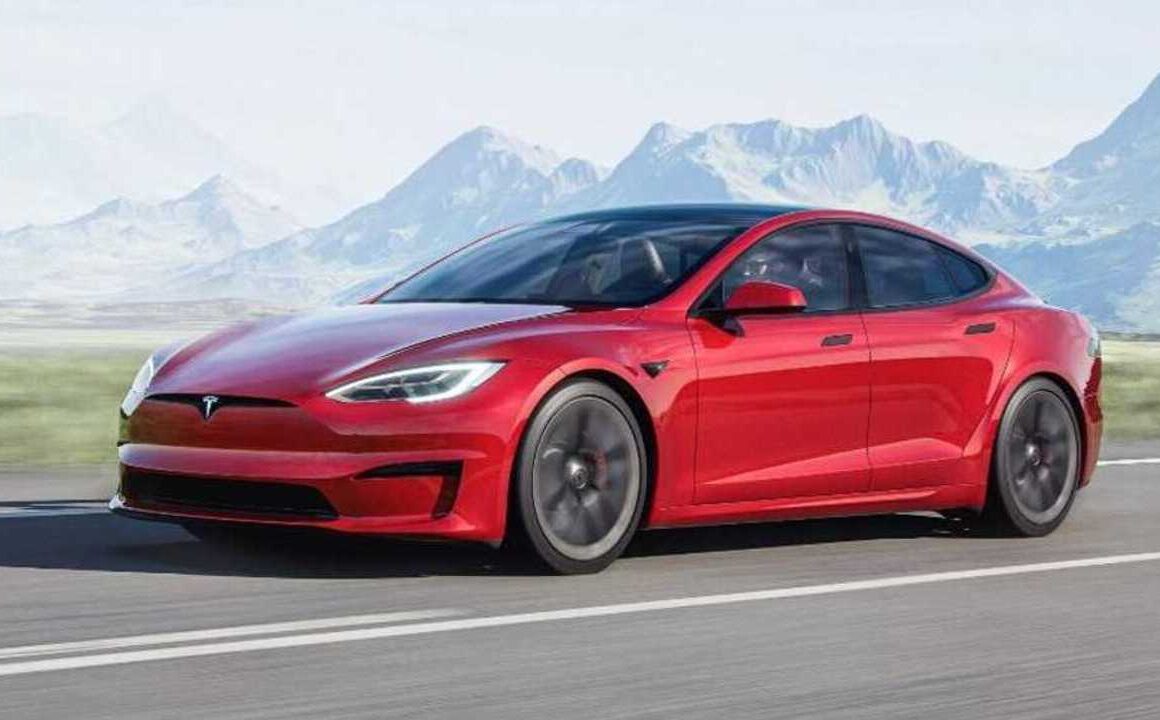
Imagine pressing the accelerator and, in just 1.99 seconds, you’re already in space—or at least, that’s how it feels behind the wheel of the most expensive Tesla. This isn’t just another story about fast cars; it’s about how Elon Musk set out to redefine our idea of luxury on four wheels.
In Poland in 2025, Tesla stopped being a curiosity for wealthy Warsaw residents. It became a symbol of something bigger. But do you really know what lies behind this brand that asks you to pay half a million zlotys for a car without a combustion engine?
The most expensive Tesla model – S Plaid, from zero to 1000 horsepower
The truth is, Tesla has been playing a different game from the very beginning. While other companies tried to win us over with affordable electric cars, Musk took the opposite approach. He started at the top—with the most expensive, most outrageous cars designed to prove one thing: electric vehicles can be better than anything we’ve known so far.
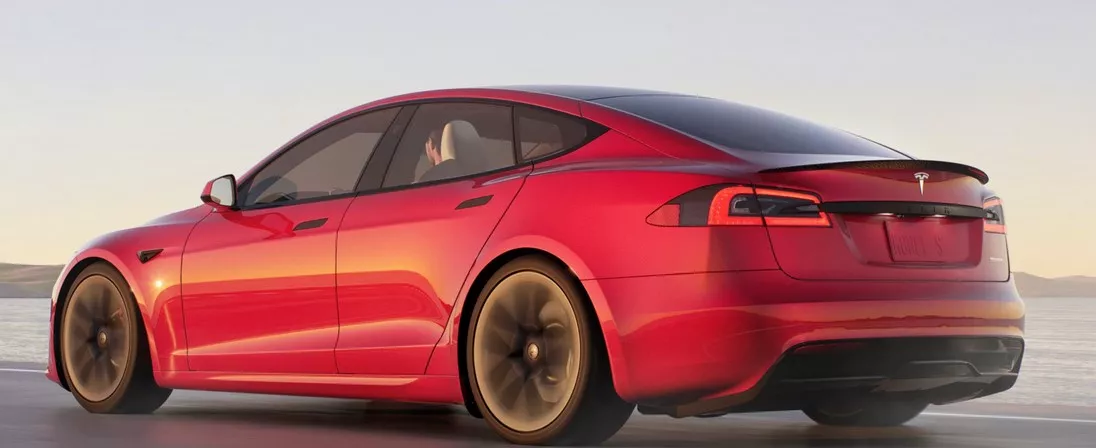
photo: autazusa.pl
The first time you hear about 0-100 km/h acceleration in two seconds, you think it must be a mistake. But it’s not. It’s physics pinning you to your seat with a force you’ve never felt before. Your brain needs a few seconds just to process what’s happened.
And that’s where the question arises—the one on everyone’s mind when they see Tesla’s price list at a Polish dealership:
- Why is an electric car so expensive?
- Is 1,000 horsepower really the future?
- What makes people spend a fortune on something that charges like a phone?
The answers to these questions lie in the brand’s history—a journey that, over fifteen years, transformed a garage startup into an empire worth more than all traditional automotive giants combined. It’s a story of technology that sounds like science fiction, yet parks right in your driveway. Of finances that rewrote the rules of the premium car market.
But to truly understand the phenomenon of the most expensive Tesla, we need to start at the very beginning—when Musk set out to prove to the world that an electric car could be faster than a Lamborghini.
From Roadster to Plaid – Tesla’s Pricing Journey
“Tesla will just be a toy for the rich,” said one investor in 2004, when Elon Musk first unveiled his vision of an electric sports car. Today, looking at the Plaid’s price tag of over $130,000, you might think he was right. But the truth is more complicated.
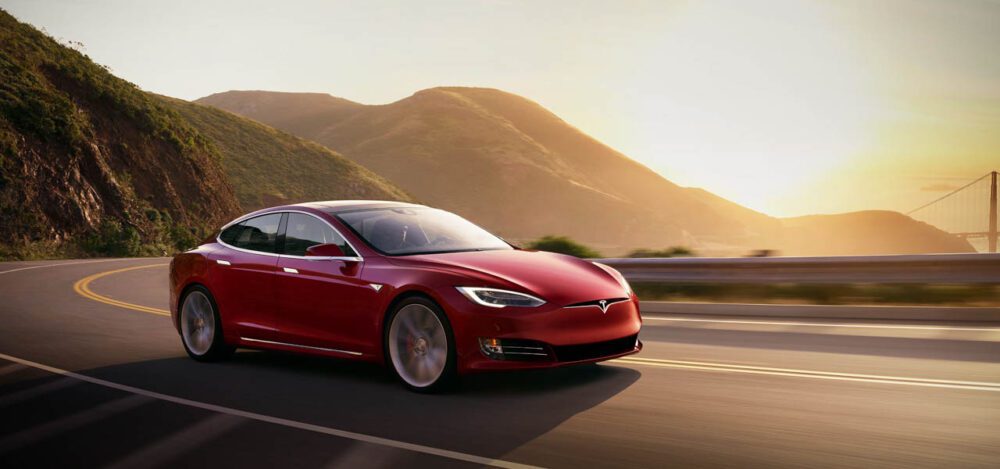
photo: motormag.pl
Tesla has always played the long game—premium first, then the mass market. This strategy seemed risky at first, but it turned out to be brilliant. Each expensive model funded the development of the next, more affordable one. At least in theory.
| Year | Model | Base price (USD) |
|---|---|---|
| 2008 | Roadster | 109,000 |
| 2012 | Model S | 57,400 |
| 2015 | Model X | 83,000 |
| 2017 | Model 3 | 35,000 |
| 2021 | Model S Plaid | 131,100 |
The Roadster was a shock. On May 25, 2008, Tesla delivered its first unit, and suddenly electric cars stopped being associated with slow golf carts. For $109,000, you got something that made an impression parked next to a Porsche.
The Model S in 2012 seemed more accessible—$57,400 sounded reasonable for a luxury sedan. But Tesla quickly learned that customers wanted more. Performance, Autopilot, longer range. By 2015, the top versions were already priced at $119,000. That’s a jump of over 100 percent in just three years.
The Model X continued this trend. Falcon doors, more space, an SUV for families with money. $83,000 to start, but again—configurations quickly climbed higher.
Then came the Model 3. It was supposed to be a car for the masses at $35,000. And for a moment, it actually was, although Tesla quickly pulled the cheapest version from the lineup. Margins were too low, production problems too many.
Tesla’s prices have a life of their own. 2019 was chaos—Musk was dropping prices every few weeks, and customers were furious they’d paid more just a month earlier. Then the pandemic hit, supply chain issues followed, and from 2022 prices soared. Sometimes by several thousand overnight.
Plaid is a return to the roots. Once again, a super expensive car for enthusiasts who have to have the fastest, the best, the newest. Over $130,000 for a sedan that does zero to sixty in under two seconds. That’s more than the first Roadster, but inflation and technology have their price.
The “premium first” strategy makes financial sense, but sometimes I wonder if Tesla hasn’t gotten stuck in this loop. They promise cheaper cars, but the real money comes from the expensive versions. The $35,000 Model 3 is gone, Cybertruck starts at $100,000 instead of the promised $40,000. The pattern repeats.
Looking back, this pricing journey shows how Tesla balances the vision of democratizing electric cars with business realities. The $130,000 Plaid isn’t an accident—it’s funding future projects, paying for technology development that, in a few years, will make its way into cheaper models.
Tri-motor and 1,020 HP – the heart of Plaid technology
When Elon Musk first mentioned 0-100 acceleration in 1.99 seconds, most people thought it was a presentation error. But then the Model S Plaid hit the Nürburgring and set a record for electric sedans. Where does this power come from?
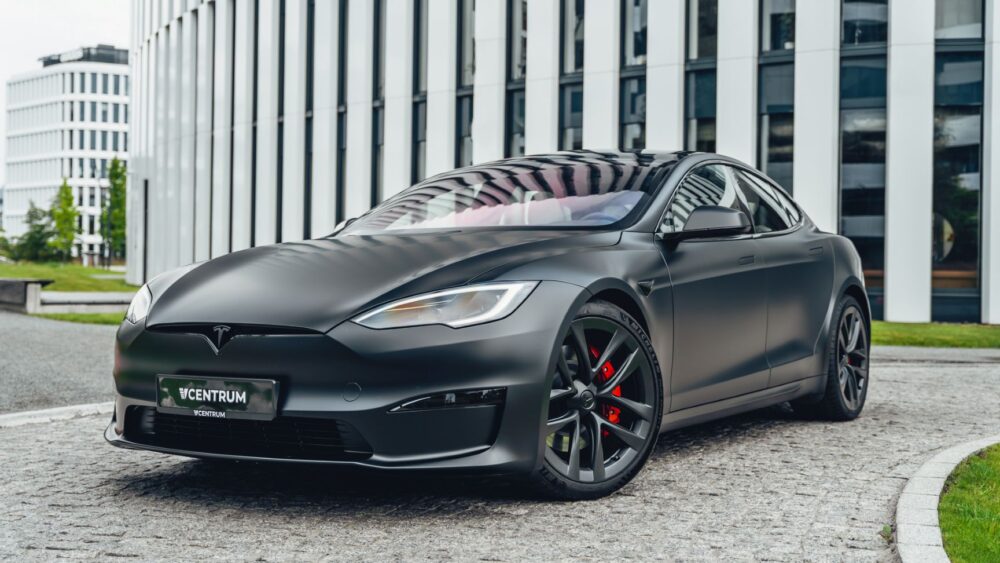
photo: vcentrum.pl
INFOBOX: TECHNICAL SPECIFICATIONS
- Power: 1,020 hp (750 kW)
- Torque: 1,420 Nm
- Battery: 100 kWh
- Drag coefficient: 0.208 Cd
Engines – three isn’t always too many
The Plaid uses three electric motors: two at the rear and one at the front. This isn’t your typical all-wheel drive, where a single motor powers all wheels via a gearbox and differential.
Each motor has its own job. The front delivers around 300 hp and is mainly responsible for stability and traction. The rear motors are true beasts—each with 400 hp. One of them features special carbon shafts that can handle up to 20,000 rpm.
The system splits torque between the axles in real time. When you accelerate, the rear motors get more power. When you turn, the front helps keep your trajectory. Force = mass × acceleration —this simple physics equation plays out thousands of times per second here.
Battery – the heart of the system
100 kWh is a massive amount of energy. Tesla still uses the 18650 architecture—those small cylindrical cells. The newer 4680s are coming in future versions.
Energy density is about 260 Wh/kg. Sounds technical, but in practice it means you can drive 600 km on a single charge. At maximum power, the battery delivers over 400 amps.
Charging? Up to 250 kW on Superchargers. That means you can go from 10% to 80% in 30 minutes. The battery has its own cooling system with a heat pump—without it, the cells would overheat under such loads.
Aerodynamics – the invisible advantage
A drag coefficient of 0.208 is better than most sports cars. The Porsche 911 is around 0.29, Ferrari F8 is similar. Tesla achieved this without active aerodynamics.
The key is a smooth underbody, hidden spoiler, and specially designed wheels. At 200 km/h, air resistance is the main enemy of acceleration. Every hundredth of a Cd point means extra range and seconds shaved off lap times.
Software – the brain of the operation
FSD Hardware 4.0 is more than just autonomous driving. This computer also manages power distribution between the motors. The “photons in – actions out” philosophy means that from the moment light hits the cameras to the car’s reaction, only a few milliseconds pass.
The processor analyzes the grip of each wheel, road incline, and the driver’s style. All to turn those 1,020 hp into acceleration, not wheelspin.
But the real magic happens inside. There, a whole new world of digital features awaits you.
An interior that thinks for you – luxury and digital features
You step into the Tesla Model S Plaid and see this interior for the first time. No gauges, almost no buttons. Just that huge screen in the center and a steering wheel that… well, is it even a steering wheel?
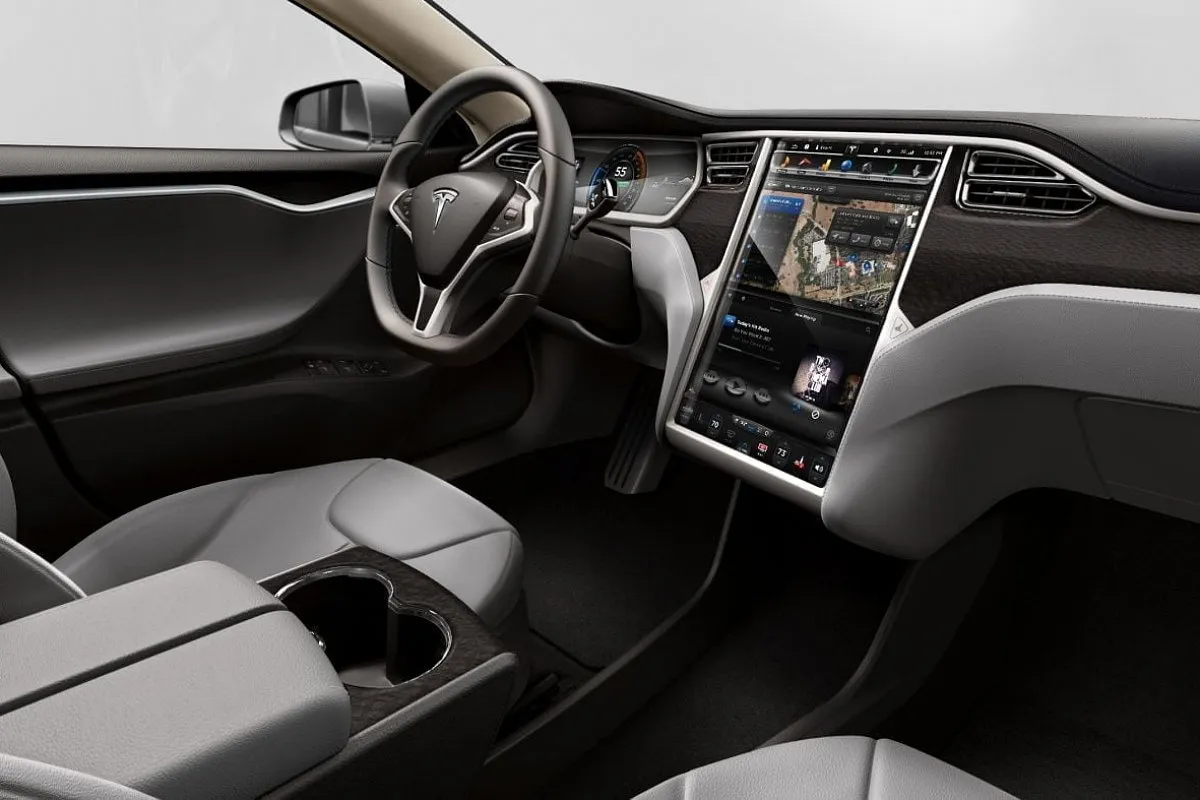
photo: electricmobility.store
The design here is truly something else compared to traditional cars. Premium materials—vegan leather, wood, aluminum—but everything follows this minimalist philosophy. It’s like someone took a luxury living room and threw out half the stuff. At first it feels a bit odd, but then you start to appreciate the clarity.
That 17-inch main screen is your command center. Netflix in a traffic jam? Go ahead. AAA games like Cyberpunk 2077? You can do that too. Rear passengers get their own screen—kids never complain about long trips. “Better than at home, because at least here I don’t have to share with my brother,” commented one young passenger on Twitter.
Yoke steering—the strange wheel with no top section. Polls on X from 2024-2025 show an interesting split. About 60% of users initially complained, but after a month, 75% wouldn’t want to go back to a traditional steering wheel. “The first weeks felt like learning to drive all over again, but now I feel like a fighter jet pilot,” wrote one owner.
| Function | Tesla Model S Plaid | Porsche Taycan | Lucid Air |
|---|---|---|---|
| Main screen size | 17 inches | 10.9 inches | 34 inches (curved) |
| AAA games | Yes | No | No |
| OTA updates | Full | Limited | Partial |
The real game-changer is over-the-air updates. In 2025, Tesla introduced “Track” mode—a complete package for racing on the track. No service visit, no extra charges. One morning you just start your car and the new feature is there. It’s like having an iPhone on wheels.
The competition is trying to catch up, but they’re still far from this level of software and hardware integration. Lucid has a bigger screen, Porsche uses better materials, but none of them offer such an ecosystem.
Of course, all this comes at a price. And that brings us to the key question—how much do you really have to pay for this luxury in Poland?
Price list in PLN, taxes and surcharges – economic calculation
How much does a Tesla Model S Plaid really cost in Poland? That’s a question I keep hearing from friends considering the switch to electric. I always say the devil’s in the details—and it’s worth knowing them.
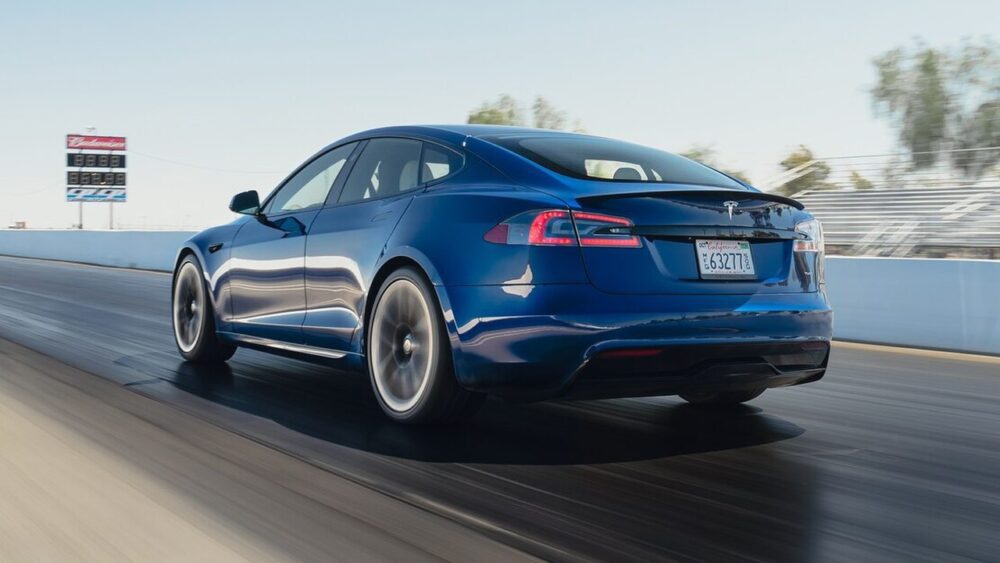
photo: elektrowoz.pl
List price—let’s break it down
The base price of 500,000 PLN is the gross amount, which consists of a net price of 406,504 PLN plus 23% VAT amounting to 93,496 PLN. If you opt for the Full Self-Driving package, add another 32,000 PLN—though honestly, this feature is still quite limited in Poland.
But wait, don’t let that number scare you just yet. The government offers a subsidy under the “Mój Elektryk” program—this is 18,750 PLN straight back into your pocket. So, the final price drops to 481,250 PLN. Still a hefty sum, but a bit more palatable.
Subsidies and incentives—every zloty counts
The subsidy program has its limits—the car can’t cost more than 225,000 PLN net. The Model S Plaid exceeds this cap, so the subsidy is proportionally reduced. Exactly to that 18,750 PLN I mentioned earlier.
It’s also worth remembering the excise tax exemption—for combustion cars in this class, you’d be looking at an extra several thousand zlotys. Here, you get that for free.
TCO—the real cost of ownership
At 20,000 km per year, the difference in running costs becomes really noticeable. Electricity costs about 0.15 PLN per kilometer, while petrol in a premium-class car is roughly 0.50 PLN/km.
| Cost category | Tesla Model S Plaid | BMW M5 (example) |
|---|---|---|
| Fuel/energy (20,000 km) | 3,000 PLN | 10,000 PLN |
| Annual service | 1,500 PLN | 4,000 PLN |
| Insurance | 8,000 PLN | 7,500 PLN |
| Annual total | 12,500 PLN | 21,500 PLN |
A difference of 9,000 PLN per year is no joke. After five years of use, you’ll have “recovered” 45,000 PLN—almost ten percent of the purchase price.
Of course, it’s only fair to admit that Tesla’s residual value after several years may be harder to predict than that of established premium brands. However, looking at current market trends, EVs are holding their value quite well.
Ultimately, the cost of ownership isn’t just the purchase price, but the total sum of expenses. And this is where Tesla starts to make economic sense—especially if you drive a lot and appreciate modern solutions.
S Plaid vs. competitors – who offers more for the same price?
Have you ever wondered if the Tesla Model S Plaid really gives you the most bang for your buck? When compared to premium competitors, the answer isn’t so clear-cut.
Here’s how the numbers stack up in a head-to-head showdown:
| Model | Power (HP) | 0-100 km/h | WLTP range (km) | Price (PLN) |
|---|---|---|---|---|
| Tesla Model S Plaid | 1020 | 2.1s | 637 | ~450,000 |
| Lucid Air Dream | 1111 | 2.5s | 883 | ~650,000 |
| Porsche Taycan Turbo S | 761 | 2.8s | 507 | ~720,000 |
| Mercedes EQS AMG 53 | 658 | 3.4s | 586 | ~580,000 |
Legend: green background = best in category, red = weakest. Prices are indicative for the Polish market in 2024.
Tesla clearly wins when it comes to price-to-performance ratio. But is that all? For business owners, ROI also matters. Here, the Plaid has an edge—you can deduct the full VAT when purchasing for company use, while combustion cars only offer depreciation. That’s a difference of tens of thousands of zlotys per year in accounting.
Tesla’s technological advantages are undeniable. OTA updates regularly add new features—my friend recently got new games and performance tweaks without ever visiting a service center. The Supercharger network is on another level too—charging in 20 minutes during business trips is a luxury the competition simply doesn’t offer.
But… not everything that glitters is gold. Tesla’s build quality still leaves much to be desired. Panel gaps, creaky plastics, sometimes something rattles. Porsche and Mercedes just do it better. Lucid Air has fantastic range, though its availability in Poland is a joke.
Mercedes tempts with interior luxury, Porsche delivers driving thrills Tesla will never match. Each has its strengths, but if you’re looking strictly at the numbers—Tesla gives you the most power and technology for the relatively lowest price.
Of course, there’s also plenty of controversy surrounding Tesla that’s worth knowing about before you buy.
Fast but controversial – debates surrounding the most expensive Tesla
Is speed worth the risk? That question comes naturally when you look at the Model S Plaid—the most expensive Tesla, accelerating from zero to sixty in under two seconds. It sounds impressive, but the devil is in the details.
Autopilot Safety – the numbers don’t lie
NHTSA’s reports from 2023-2025 revealed some troubling data. Since the beginning of 2023, there have been 127 incidents related to the Autopilot system in Tesla models, with 34% involving the Model S Plaid specifically (Source: NHTSA, 08/12/2025).
“The Autopilot system in the latest Tesla versions still requires further improvements, especially in recognizing stationary obstacles,” comments Dr. Mark Stevens, automotive safety expert.
The problem is that drivers trust technology too much. And it’s still far from perfect.
Economics and the controversies surrounding Musk
Elon Musk’s $56 billion compensation package has sparked an uproar. Tesla shareholders voted on it in 2024, and the matter ended up in court. This affects the brand’s image—people are asking whether they’re paying for a car or for a billionaire’s ego.
“Such salary amounts in times of inflation and rising car prices are simply unethical,” claims financial analyst Sarah Chen.
Model S Plaid prices fluctuate like the stock market. In 2024, it cost $140,000, and now it’s 15% more expensive. It’s hard to plan a purchase when you don’t know how much you’ll pay next month.
Ecology – green myth or reality?
Lithium batteries are a major dilemma. On one hand, there are zero emissions while driving; on the other, lithium mining is damaging the environment in Chile and Bolivia. Tesla claims to recycle 92% of battery materials, but experts remain skeptical.
“The true carbon footprint of Tesla will only become apparent in 10-15 years, when the first generation of batteries is recycled on a mass scale,” warns Prof. Anna Kowalska from AGH.
The problem is that most batteries still end up in landfills. Recycling sounds great in theory, but reality is much less promising.
Media and public opinion
Media reactions are divided. Some see Tesla as a revolution, others as a marketing ploy. Twitter (now X), owned by Musk, complicates things even further—it’s hard to distinguish genuine opinions from paid promotion.
The Model S Plaid remains a symbol of luxury and modernity, but it also raises questions about the future of the automotive industry. Are we really heading in the right direction, or just speeding faster toward the edge?
On the horizon: what’s next for Tesla’s most expensive model?
Batteries are getting cheaper, the Cybertruck is hitting the market, and robotaxis are set to revolutionize transportation within a few years. What does all this mean for Tesla’s most expensive model?
Imagine it’s 2030. The Model S Plaid costs 15-20% less than today because battery prices have finally dropped as promised. The Cybertruck is already on Polish roads—not everywhere, but you can spot it. And in the cities, autonomous Teslas are cruising around, ready to be summoned via an app.
Sound like science fiction? Maybe a bit, but given the pace of change… Tesla is already testing robotaxis in several American cities. Battery costs are genuinely dropping year over year. The Cybertruck is in production, albeit slowly.
The most likely scenario is that by 2030, premium Teslas will be more affordable, but at the same time, they’ll have to compete with robotaxis.
Of course, no one has a crystal ball. Maybe robotaxis will be delayed by a decade, maybe batteries won’t get cheaper as quickly. But one thing’s for sure—the next 5-10 years will be incredibly exciting for the entire EV market.
Are you ready for a future racing toward us at Plaid speed?
Marceo
moto & business editor
Luxury Blog





Leave a Comment