

The history of Weimar porcelain – from Blankenhain to the present day
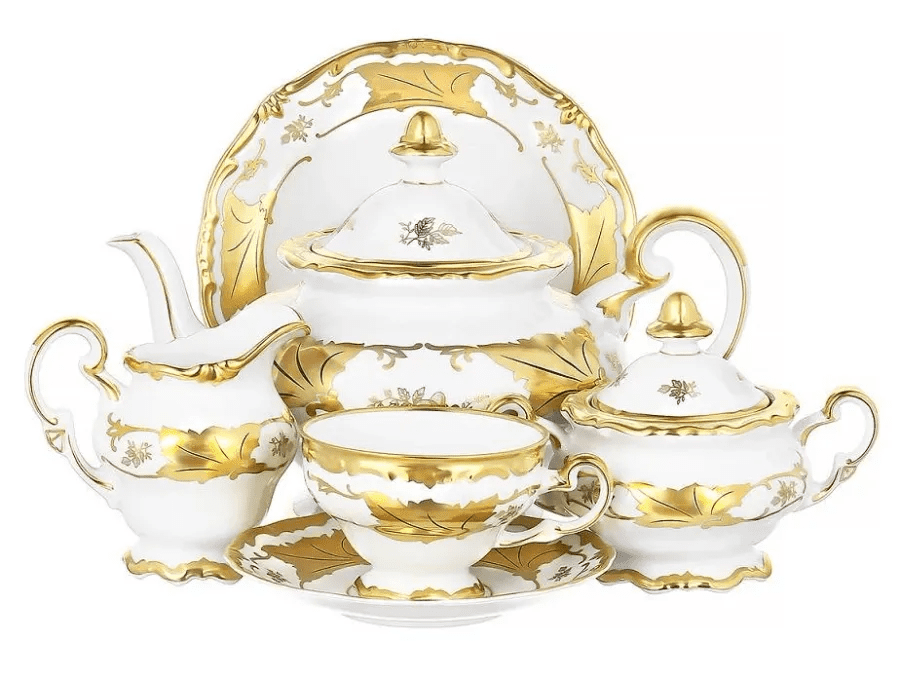
Weimar porcelain was never produced in Weimar. It sounds absurd, but the name ” Weimar Porzellan ” refers to a manufactory in Blankenhain, a small town about 30 km from Weimar itself. In the 18th and 19th centuries, Thuringia was the heart of European “white gold” production, and the prestigious name of the ducal city was meant to attract aristocratic clients. And it did, for over two centuries.
The manufactory was established in 1790. It closed its doors on December 31, 2018. That’s 228 years of uninterrupted hard-paste porcelain production, through all the upheavals of history. Few factories can boast such continuity.
The history of Weimar porcelain, or white gold from Blankenhain
Today, the rights to the Weimar brand belong to the Turkish conglomerate KARACA, and since 2026, production has been carried out outside of Blankenhain. However, Weimar still lives on in collections and on auction sites, because:
- Quality of workmanship: genuine hard porcelain, not bone china or stoneware
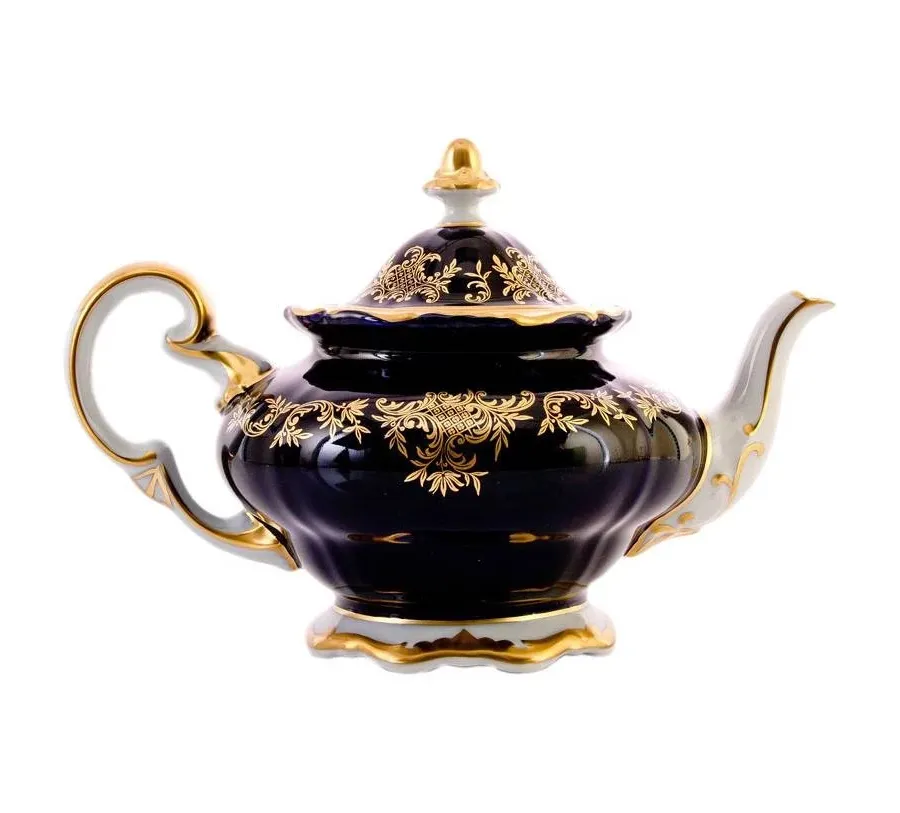
- Cobalt decorations with gilding: recognizable patterns that have endured for decades
- Export success: especially in the GDR and Eastern Bloc countries, hence its availability in Poland
- Collector’s value: sets from the Carstens era (1920s–1930s) or early markings from the 19th century can fetch significant prices
Weimar
In the following sections, we will explore the birth of the manufactory, the modernization during the Art Nouveau period, the golden era of Carstens, the transformations in the GDR, and how to recognize and date old Weimar pieces today.
From Blankenhain to Art Nouveau: Birth and Growth (1790-1917)
Christian Andreas Speck had been sniffing around Blankenhain since about 1780, searching for suitable raw materials for porcelain. Once he found them, he didn’t hesitate: he submitted his application on June 8, 1790, and received approval just a month later, on July 1. The launch took place in a rather unusual location — in the buildings of a former fireproof shooting range and a mill by the Seeteich pond. He marked his first products with a blue “S”, and his debut at the Leipzig Fair in 1797 attracted attention. By 1816, he was already employing 155 workers, which was quite a large enterprise for those times.
However, turmoil followed. A fire on June 26, 1817 destroyed much, although it was quickly rebuilt. The real trouble began after Speck’s death on December 30, 1830: the manufactory passed through the hands of several owners (Gustav Vogt, Gottfried Sorge, Isidor Streithardt, H. Kästner), and with each change came stoppages and uncertainty.
Weimar
Railways, machines, and Art Nouveau
The breakthrough came only in 1847-1848, when the Fasolt family took over the manufactory. From 1856, it operated under the name Porzellanfabrik Fasold & Eichel, expanded with three large kilns, and introduced steam machines. The real game-changer (well, maybe that’s saying too much) was the Weimar-Blankenhain railway line in 1887, which cut transportation costs. In 1898, their own power plant was launched.
That same year, it was taken over by Duxer Porzellanmanufaktur AG, which sparked a wave of Art Nouveau experiments. Alois Hampel designed pieces that won awards: Grand Prix in St. Louis (1904), silver in Milan (1906), gold in Liberec. By the outbreak of World War I in 1917, the manufactory was already standing firmly on its feet.
Cobalt, the crown, and global markets: the Carstens era (1918-1948)
In 1918, the manufactory was taken over by Ernst Carstens, who did something that may sound simple, but changed everything. He renamed the company to Blankenhainer Porzellanfabrik C.&E. Carstens and began building a brand that could break through in foreign markets. Because in Germany, after the war and hyperinflation, no one was interested in luxury porcelain, and the bills still had to be paid.
Weimar
Cobalt and gold: the recipe for recognition
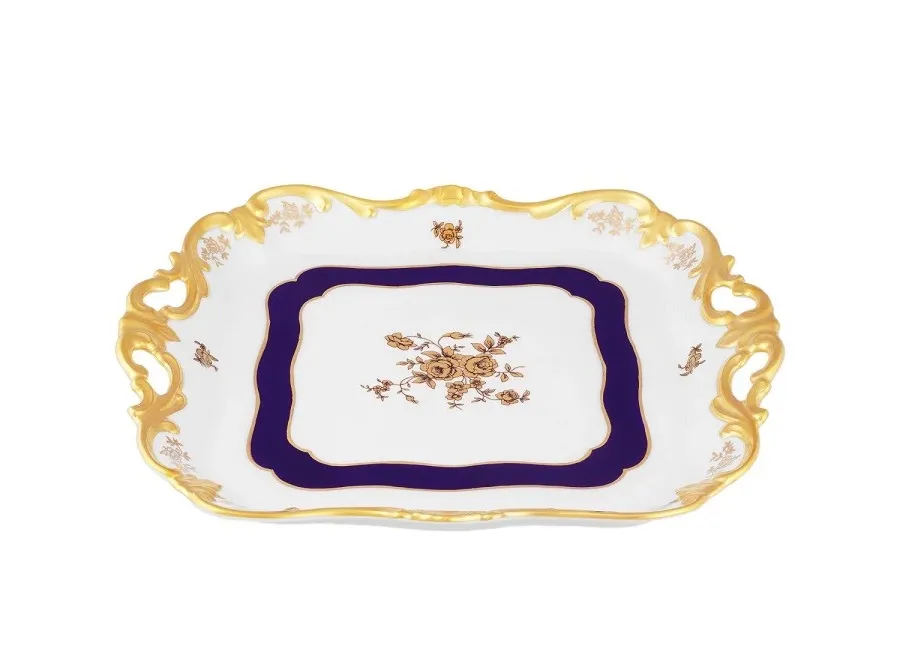
In 1926, Carstens introduced something that became the brand’s hallmark: cobalt porcelain with underglaze decoration and gilding. It was called ” Carstens China “, and it was precisely this cobalt background with white ornaments that set Weimar products apart from the competition. This was no accident—Carstens knew that export required character, something instantly memorable.
At the same time, he was registering trademarks. In 1924, the motif of a crown with a laurel wreath appeared, and in 1928 the company officially secured its rights. It may seem like a small detail, but it allowed protection against cheap counterfeits in Oriental and American markets.
Between exports and strikes
The interwar years were not only a time of success. In 1929, a strike broke out that lasted about three months; employees were fed up with low wages despite rising profits from exports. The tension was real, as the company sold mainly abroad ( Europe, USA, Middle East), while local workers felt exploited.
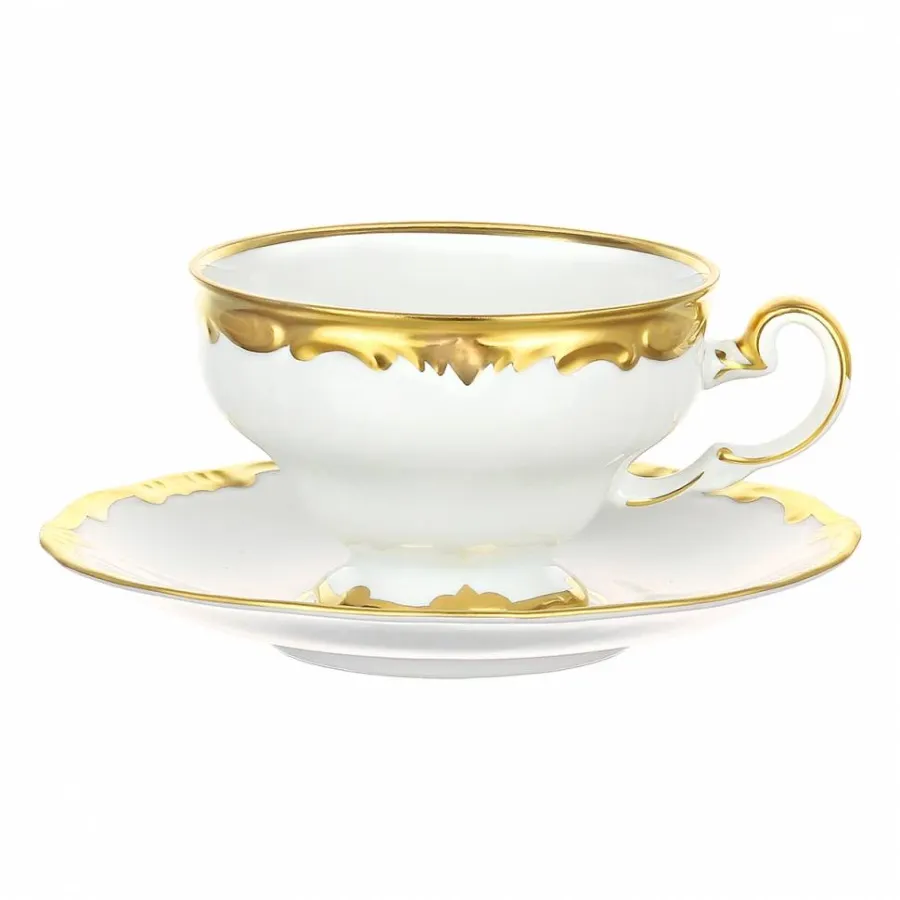
In the 1930s, Eva Zeisel designed at the factory, her modern forms combining functionality with delicate classicism. Carstens struck a balance: traditional gilding met the avant-garde. By 1948, when nationalization and the GDR era arrived, Weimar had already become a globally recognized brand.
Weimar
VEB Weimar Porzellan 1948-1990
On July 18, 1948, the manufactory was nationalized and transformed into VEB Weimar Porzellan. It might have seemed like the end of tradition, but the planned economy brought a wave of investments that the private Carstens could never have afforded. Since 1980, the factory became part of the Feinkeramik Kahla Combine, forming, together with Kahla, Ilmenau, and Lichte, the East German “quartet” of porcelain.
Modernization under control of the plan
The pace of change was truly impressive:
- 1962 – construction of a new production hall
- 1963 – launch of electro-cobalt furnaces for decoration
- 1963-1965 – installation of conveyor belts replacing manual handling
- 1979-1984 – expansion by 6,000 m² of plant area
- 1981 – the large tunnel kiln (75 m!) replaces the old round kilns from the 19th century
Especially this last element changed everything. Round kilns had fired porcelain for several generations, but the tunnel kiln allowed for incomparably greater efficiency.
Weimar
Awards, exports, and gold medals
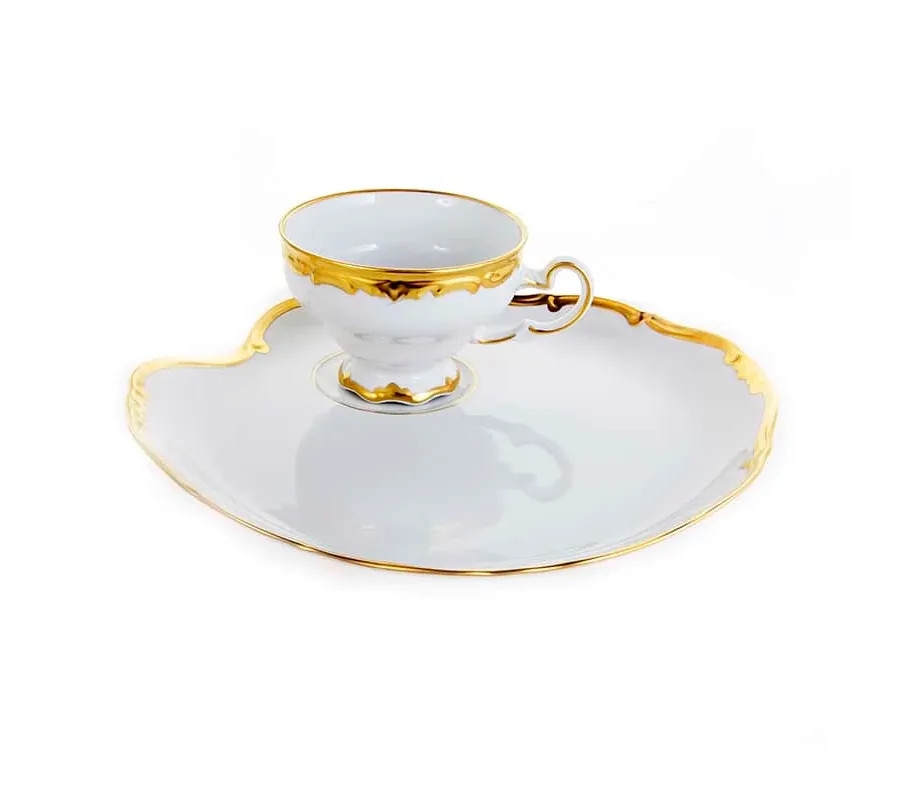
East German design had its own style: geometry, simple floral motifs, plenty of cobalt. And it gained recognition at the Leipzig Fair, which was a mark of prestige for the socialist economy. Gold Medals were awarded to the Exquisit (1965), Saskia (1980), Alt Weimar (1983), and Victoria (1987) series.
Production was mainly destined for the East; Weimar was an important source of foreign currency for East Germany. This was not porcelain for the masses, but rather an export asset for the combine. When the wall fell in 1990, the manufactory faced a question: what next?
Weimar
After unification: privatizations, crises, and brand continuity (1990-2026)
When the Berlin Wall fell, the plant in Blankenhain faced the same question as hundreds of companies in the former GDR: survive or disappear? In 1990, the first privatization took place, and by 1992 Herbert Hillebrand had taken the helm. Unfortunately, by 1995 his company had gone bankrupt. The factory could have shut down for good.
Rescue in 1995 and new furnaces
Then an interesting solution emerged: the municipality of Blankenhain purchased 49% of the shares, while the remaining shares were taken over by the management team together with external investors. More than 3 million euros were allocated for rescue investments, of which around 1.3 million euros went towards new kilns. But (and this shows just how critical the situation was) the factory area shrank from about 30,000 m² to just 9,000 m². This was already a completely different scale of operation.
In 2006, the Geschwister Hillebrand became the owners, and a year later Könitz Porzellan took over the plant. The Turpin Rosenthal family, the sixth generation of porcelain makers, tried to continue the tradition.
Closure 31.12.2018 and brand under KARACA
It didn’t work out. In 2018, when the factory still employed 64 people, insolvency was declared. On December 31, 2018, the plant at Christian-Speck-Straße 5 closed for good. Today, it’s an abandoned site, a so-called lost place.
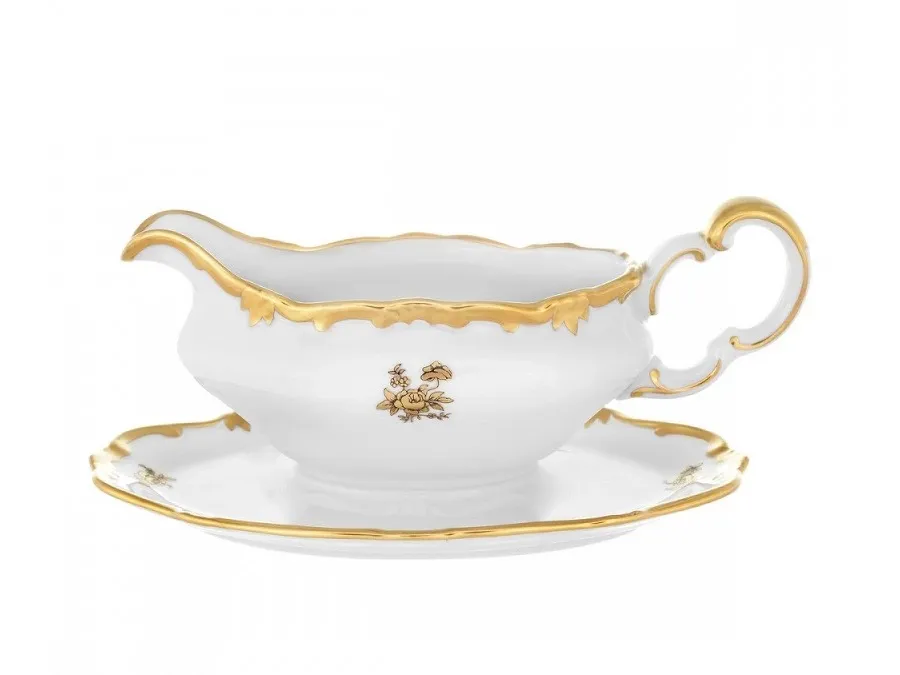
But the brand survived. Around 2020, the rights to the Weimar name were acquired by the Turkish company KARACA. In 2026, porcelain bearing the Weimar logo is still being produced, just no longer in Blankenhain. It’s a continuation of the brand, not the factory.
Weimar
How to recognize and date Weimar?
If you’re holding a plate with a blue decoration and want to know when it was made, start by looking at the bottom. Weimar marks changed like fashion trends. In the beginning, around 1790, you’ll find a simple blue “S” (sometimes with a dot). From 1887, a shield or diamond shape appears, and after 1900, “Germany” was added, as Americans required country of origin labeling. In 1924, the crown with a wreath was introduced, followed by the inscription “Weimar Porzellan” (from 1928). After the war, the GDR introduced its own variants, often with additional information about VEB. After 1990, hybrids with Turkish KARACA appeared.
Weimar
Cobalt, gold, and mass
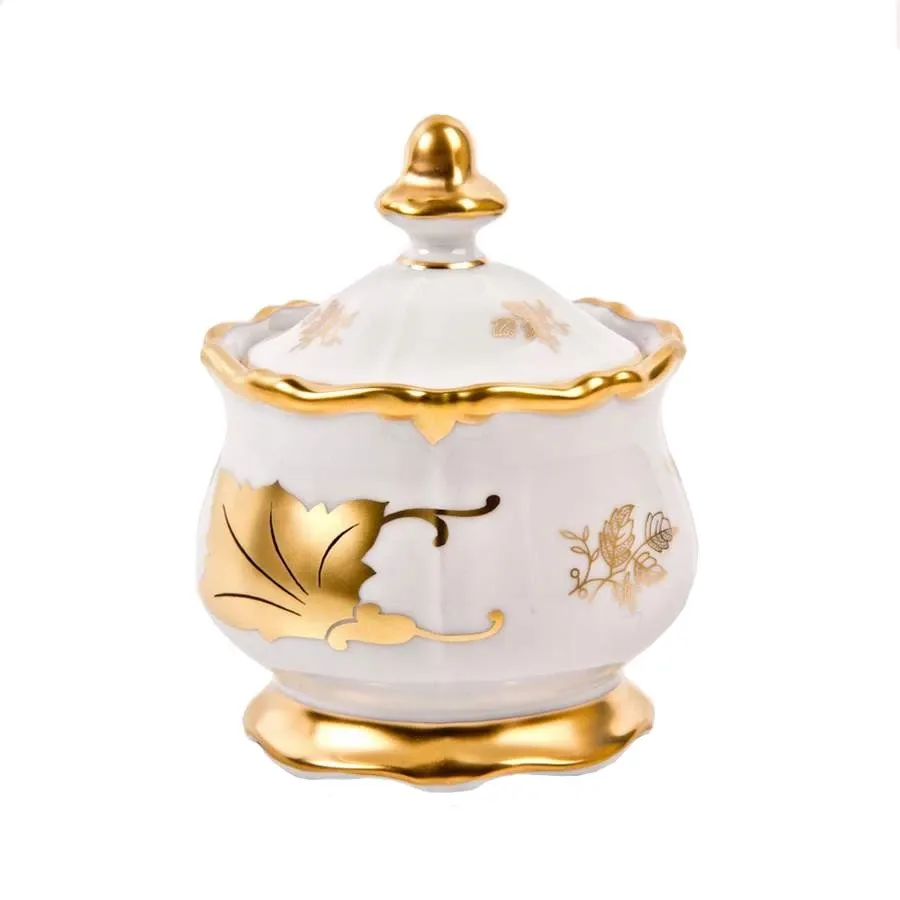
Weimar has been famous for its underglaze cobalt with hand shading since 1926. You can see it with the naked eye—the blue isn’t flat, it has depth. The gilding on the edges should be even, without any rubbing off (unless the set has truly been used). Technologically, you have hard-paste here: about 50% kaolin, 25% feldspar, and 25% quartz, fired at around 1,400°C. Since 1981, the company has switched to a tunnel kiln (75 meters!), which has slightly changed the structure of the material.
When evaluating, check that the mark matches the declared era. The legend about orders for rulers? Be cautious—not all stories are backed by archives. The Katharina, Secunda, and Saskia lines are established names, but in catalogs you’ll also find decorative numbers instead of verbal names.
A legacy that never fades
The history of Weimar porcelain is more than just a sequence of dates and changes in ownership. It’s a story of how traditional craftsmanship survived everything: industrial revolutions, world wars, regime changes. Weimar porcelain has preserved its identity not out of sentiment, but thanks to genuine quality that simply never goes out of style.
Weimar
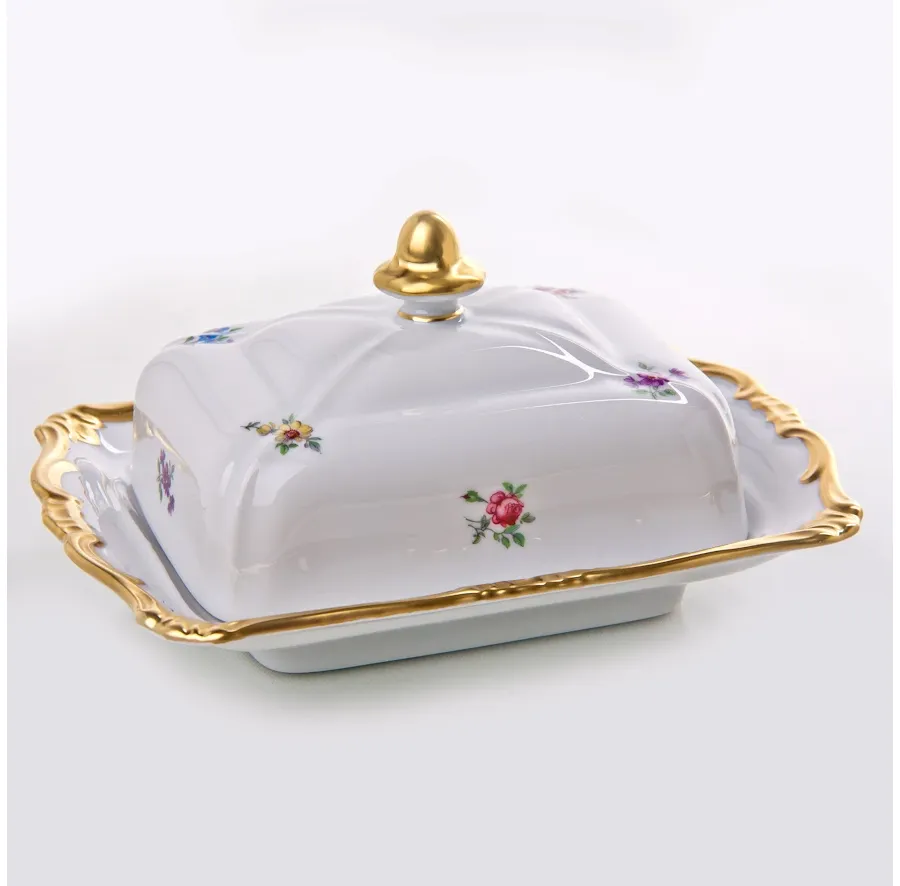
Today, collectors and porcelain enthusiasts seek both pre-war sets from Blankenhain and later productions from the GDR era. Each period has its fans, each carries a different story. Interestingly, modern ceramic workshops in Thuringia often reference those old designs, as if admitting: that was the right direction.
Weimar porcelain has proven that true craftsmanship needs neither marketing nor rebranding. It’s enough to do things well and endure, even when the world around is falling apart.
Today, you can once again purchase new products from this brand at the online store My Luxury Products https://www.myluxuryproducts.com/
Mark
lifestyle editorial team
Luxury Blog



Leave a Comment