

Luxury Men’s Skincare – A Guide to Premium Brands
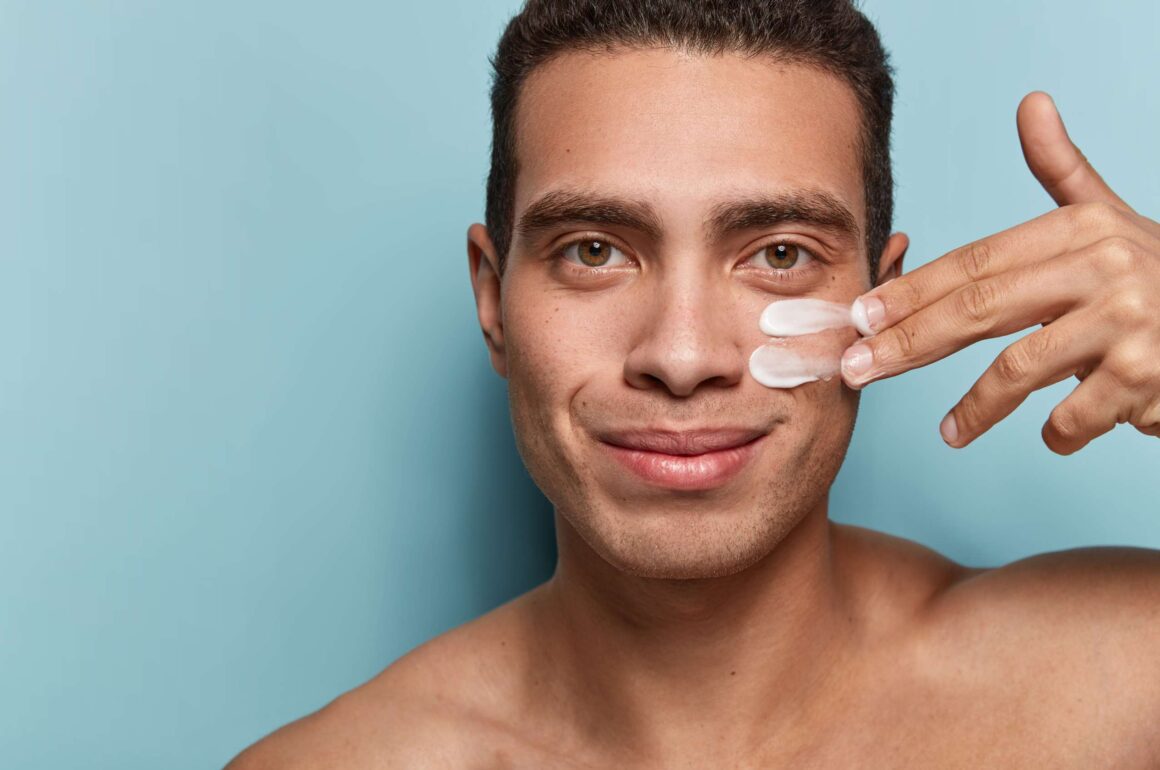
The luxury men’s cosmetics market in Poland is experiencing a real boom—its value has surged by 180% over the past three years, and globally, we’re already talking about 18 billion dollars annually. But what does luxury men’s skincare actually look like?
I sometimes wonder what that moment feels like. A man stands in a perfumery, holding a 400-zloty cream in his hand, thinking, “Does this make sense?” Until now, he’s been buying something for twenty zlotys at Rossmann. Now he’s looking at the elegant packaging and feels like this could be a turning point.
Luxury men’s skincare – what do we know about it?
Let’s be honest—today, men want to look good. It’s no longer just about vanity; it’s a necessity. At work, on dates, on social media. Everywhere, you’re judged at first glance.
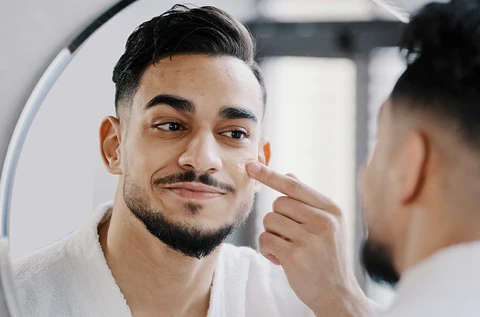
photo: plumgoodness.com
Luxury skincare promises three things that regular cosmetics often can’t deliver:
- Status – you show that you take self-care seriously
- Effectiveness – premium ingredients and advanced technologies
- Pleasure – textures, scents, and rituals that make a difference
I see it among my friends. They used to laugh at “women’s creams,” and now they’re discussing eye serums. The mental shift is huge. Younger guys treat it as normal, while older ones are slowly coming around.
Interestingly, the pandemic only accelerated this trend. Videoconferences showed everyone what they really look like. Suddenly, everyone started paying attention to their complexion, wrinkles, and under-eye bags.
The industry noticed and reacted instantly. Now we have dedicated lines for men from the world’s top brands . These are no longer “unisex” products with a “for men” sticker slapped on at the end.
In the next parts, I’ll talk about how it all started, which ingredients actually work, and whether it’s worth spending a fortune on a single product. But first, it’s worth understanding where this revolution in men’s bathrooms came from.
The origins and evolution of premium men’s grooming
I remember my grandfather telling me that his father used to shave only once a week, using nothing but regular soap. Back then, I found it funny—today, I understand it was simply a different era.
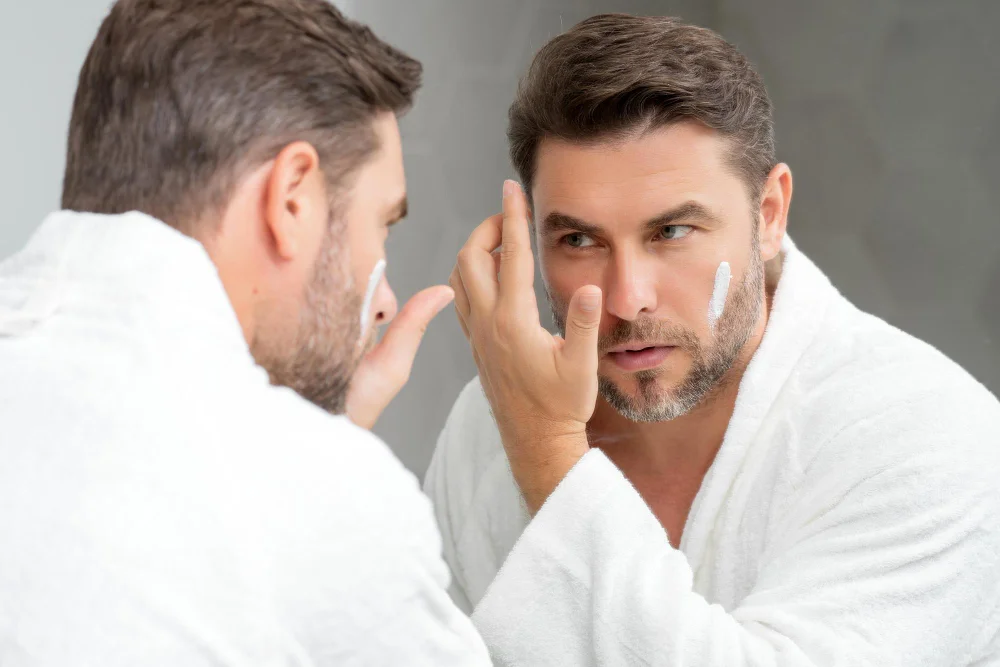
photo: striveskin.com
However, the history of premium men’s grooming goes much further back than we might think. In ancient Egypt, pharaohs used myrrh and frankincense oils not just for religious purposes. These were the first luxury cosmetics for men in human history. It may sound strange, but those rulers understood something about prestige.
| Year | Event |
|---|---|
| Circa 3000 BCE | Egyptian pharaohs use myrrh and frankincense oils |
| 1828 | The founding of Guerlain – the first turning point in luxury unisex skincare |
| 1989 | The founding of Ziaja – opening the Polish market to premium |
| 2021 | Harry Styles’ Pleasing debut – a symbol of new masculinity |
The year 1828 marked a true revolution. Pierre-François Pascal Guerlain founded his brand, and suddenly, perfume was no longer just for women. Men began to see themselves differently. It was the first step toward what we have today.
In Poland, the breakthrough didn’t come until 1989 with the founding of Ziaja. I remember those times—suddenly, products we could only dream of before appeared in stores. It was like opening a window to the world.
But the real change has come only in recent years. Harry Styles and his brand Pleasing in 2021 are not just about cosmetics. It’s a complete redefinition of what it means to be a man. Suddenly, nail polish and eye cream became perfectly normal.
Each of these moments shows just how much our thinking has changed. From pharaohs to French perfume to Polish brands—we see the same thing everywhere. Men have always wanted to look good; it was just society that didn’t allow it.
Today, technology has gone even further, but that’s another story.
Key Ingredients and Technologies in High-End Cosmetics
I often wonder why some creams cost more than my monthly salary. But when I started digging deeper into the ingredients, I discovered things that truly surprised me.
High-concentration retinol is a whole different league compared to those laughable doses from the drugstore. Definition: Retinol 0.5-1% is an active form of vitamin A that accelerates skin cell renewal and stimulates collagen production.
The mechanism is simple—retinol binds to receptors in skin cells and tells them to behave like young ones. It sounds like science fiction, but clinical studies from 2023 showed a 32% reduction in wrinkles after 12 weeks of use. The problem is, most people can’t tolerate such concentrations. The skin peels, turns red, and burns like crazy.
That’s why premium brands have developed slow-release systems. I don’t know exactly how it works, but the effect is that retinol is gradually delivered to the skin throughout the night.
Peptides are another story. In cheap creams, you might find 0.5%, but luxury formulas pack in up to 5%. These are microscopic proteins that trick the skin—convincing it that collagen has been damaged and needs to be replaced.
Definition: Signal peptides at concentrations up to 5% are short chains of amino acids that communicate directly with fibroblasts in the skin.
A study from the university in Barcelona showed a 28% increase in collagen synthesis in women over 40. They tested for 16 weeks, so this isn’t just a placebo effect.
But the real breakthrough is transport nanocapsules. La Mer has been using this technology for years—active ingredients are enclosed in microscopic vesicles that penetrate the skin barrier like butter. Ordinary ingredients stop at the surface, but these reach the dermis.
It’s a bit like comparing walking to flying. Maybe I’m exaggerating with that comparison, but the difference is huge.
| Ingredient | Function | Research results |
|---|---|---|
| Retinol 1% | Cell renewal | 32% wrinkle reduction |
| Peptides 5% | Collagen stimulation | 28% increase in synthesis |
| Nanocapsules | Deep penetration | 3x better absorption |
Chitosan is a newcomer that will be making headlines in 2025. This ingredient is derived from shellfish shells and boasts incredible soothing properties. At a 10% concentration, it can heal second-degree burns within a week. In cosmetics, it works similarly—regenerating damaged skin at the cellular level.
I tested a chitosan cream on my own skin after a chemical peel. Normally, it takes me two weeks to recover, but this time, one week was enough.
Premium brands are investing millions in research on such ingredients. This isn’t marketing—it’s pure science. Every percentage of concentration is precisely calculated, every formula tested for years.
So next time you see the price of a premium cream, remember—you’re paying for years of research and ingredients you won’t find anywhere else.
Profiles of leading premium brands available in Poland
Maybe let’s start with specifics. Recently, I checked what’s actually worth buying in premium stores in Poland. Not everything expensive makes sense.
La Mer is a classic I still don’t fully understand. This famous cream with Miracle Broth costs a fortune—we’re talking 800-1200 PLN per jar. The brand claims it uses some special seaweed extract. Maybe so, but does it really make that much of a difference? I tested it for a month and… well, my skin was moisturized, but for that price you could buy three good creams. This is the ultra-premium segment, so you’re mostly paying for brand prestige.
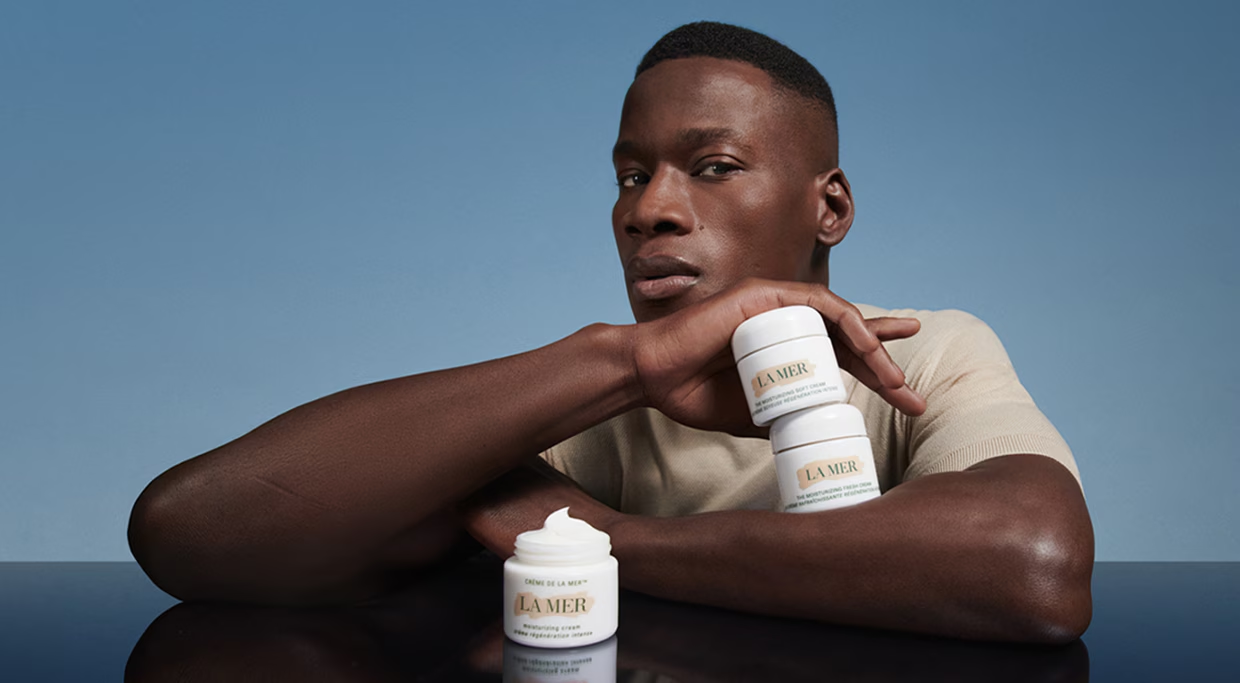
photo: lamer.eu
Tom Ford for Men takes a different approach. Here, it’s all about sensory luxury—every product is meant to be an experience. Their fragrances are intense, sometimes overwhelming. Oud Wood smells like an expensive hotel in Dubai.
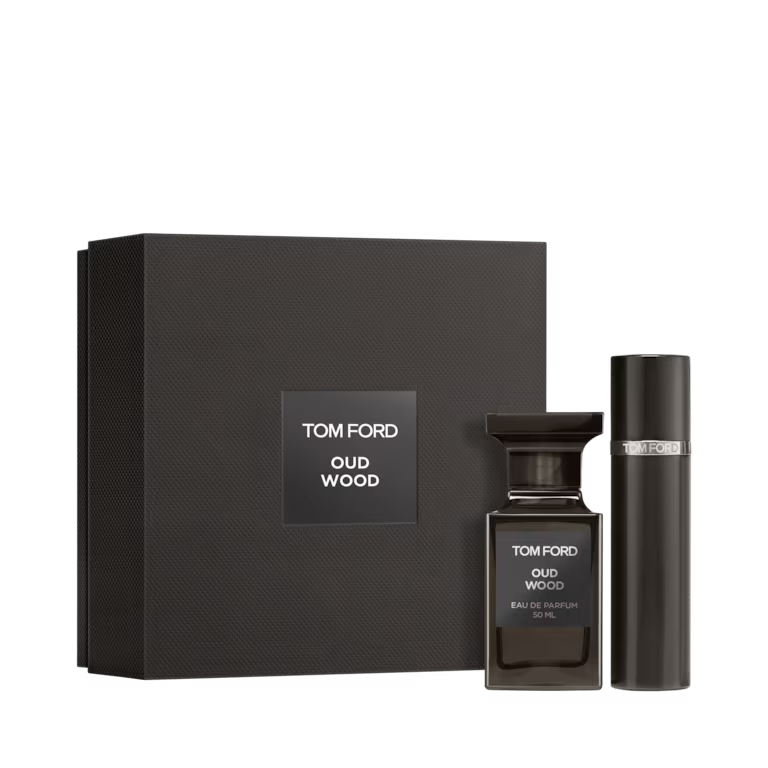
photo: tomfordbeauty.com
The shaving cream has a texture like someone mixed butter with silk. Everything comes in elegant, heavy packaging. This is a brand for the guy who likes everyone to know he uses expensive things.
Bielenda Professional—this one surprised me in a good way. A Polish brand that really delivers advanced formulas. Their vitamin C serum works better than some French equivalents at twice the price. They have labs in Warsaw and work with dermatologists. It’s proof you don’t have to import everything from abroad. Premium, but at a reasonable price—the serum costs about 80 PLN, not 300.
Polish brands are getting better and better in cosmetics. In 2021, Forbes included as many as 13 Polish cosmetic brands in the TOP 200. It shows we’re no longer just following Western trends.
Where to buy all this? Douglas has the widest selection of premium brands. Sephora focuses on trendier names. Gemini pharmacies carry Bielenda Professional. Online prices are often better, but it’s best to test perfumes and creams in person first.
Choosing the right brand is half the battle. The other half is building a smart skincare routine.
Step-by-step grooming ritual for the discerning man
Men’s skincare isn’t a luxury—it’s a necessity. Especially when your skin starts to show you’re no longer in your twenties. I’ve been through the phase of washing my face with soap—now I know that was a mistake.
| **In the morning | Evening | Once a week** |
|---|---|---|
| Cleansing gel (30 sec) | Cleansing gel | 24-carat gold mask |
| Hydrating serum (1 min) | 15% Vitamin C Serum | Enzyme peel |
| SPF 30+ cream (1 min) | Peptide cream | Facial massage |
You can do your morning routine in three minutes. I apply cleansing gel to my damp face, massage it in, and rinse with warm water. Serum—just a few drops on my hands, then I pat it into my skin. Sunscreen is essential, even in winter. I know it sounds like beauty talk, but SPF is the only thing that truly slows down aging.
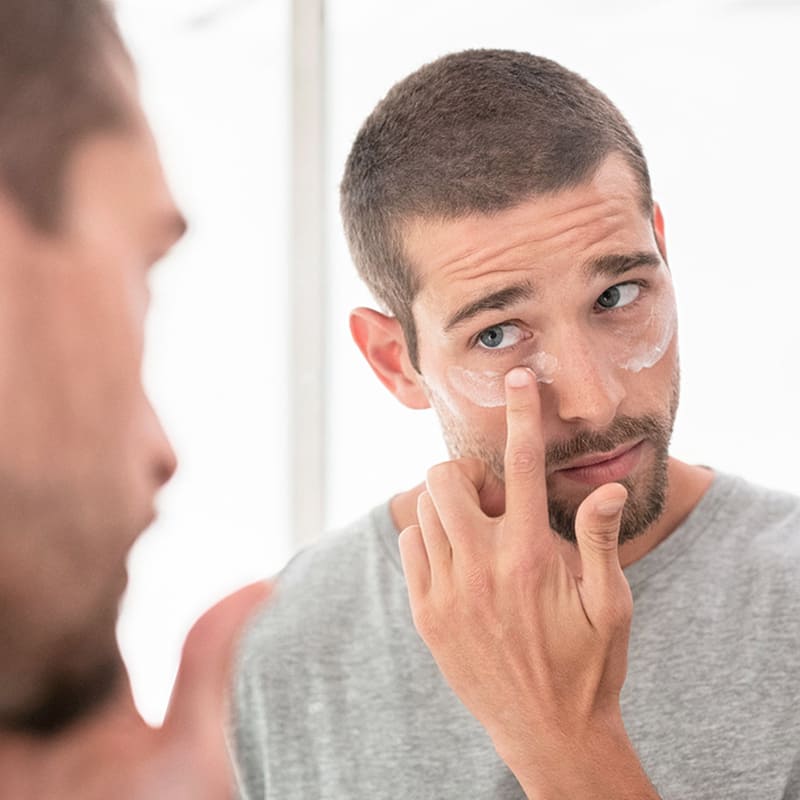
photo: cosmewax.com
Evenings are a bit more complicated. The 15% vitamin C serum is a powerhouse—it can sting at first. I started with 10%, then moved up to something stronger. The key is to apply it to clean skin, then wait a minute before using the peptide cream.
That weekly gold mask… it sounds pretentious, but the results are real. After using it, your skin looks tighter and smoother. That famous “glass skin” isn’t a myth. I do it on Sunday evenings so I look fresh on Monday.
Consistency is everything. It’s better to do less but regularly than to have a spa day once a month.
Costs? The Pleasing serum is about 140 złoty, but it lasts three months. You can put together a whole premium set for 265 złoty. It sounds expensive, but spread over a year, it’s less than a daily coffee from a machine. And you’ll see results after just two weeks.
Sometimes I catch myself checking my skin in the mirror more often than before. But not because of problems—just because I look better than I ever thought possible at my age.
Luxury economics – prices, market, statistics
You know what surprised me when I started digging into all those luxury cosmetics reports? The growth rate—globally, we’re talking about 12% per year according to the latest 2024 Euromonitor data. This is not a slow-moving market.
But let’s start with the hard numbers, because they say it all. A premium face cream ranges from 100 to 1,500 PLN per jar. Limited edition sets? They easily go for several thousand. It sounds abstract, but when you look at the sales statistics, it suddenly makes sense.
Annual growth (in %):
Poland premium cosmetics |████████████████████| 15-20%
Global luxury market |████████████| 12%
Europe online sales |███████████████| 30%
Europe is moving strongly towards online shopping—30% of premium segment sales have already shifted to the internet. But Poland? We do things our own way. Our premium cosmetics market is growing at a rate of 15-20% per year. That means every year, there are more of us choosing higher-end products.
I remember thinking it was all just marketing and a money grab. Maybe that’s partly true, but these numbers tell a different story—people really do notice the difference and are willing to pay for it.
What’s interesting about these statistics is the price structure. There’s no gentle transition here—you either pay 50-100 PLN for a drugstore cream, or you jump straight into the 300-500 PLN segment. There’s practically no middle ground. Marketing calls this “premiumization,” but for the average consumer, it simply means the decision is all or nothing.
Comparing our growth rate to the global one, it’s clear that Poland is catching up with Western markets at lightning speed. 15-20% is almost double the world average. Does that mean we’re more willing to spend on luxury? It’s hard to say for sure.
These figures also reveal one thing—the market is stabilizing around specific price brackets. Producers now know exactly how much we’re willing to pay, and that’s where they aim. And us? Apparently, we’re buying.
Trends and the Future of the Premium Segment
Actually, it’s strange how quickly everything is changing. Just a few years ago, a guy buying face cream was almost an oddity, and now I’m looking at forecasts predicting this market will be worth $15 billion by 2028. Globally, of course.
What about AI?
What fascinates me most is what’s happening with personalization. Apps that scan your skin with your phone and tell you exactly what you need. Sounds like science fiction, but the first solutions are already here. You take a photo, the algorithm analyzes pores, wrinkles, hydration levels, and you get a personalized formula. Not some one-size-fits-all cream.
I used to think it was overkill. Now I see the logic—everyone has different skin, different issues. Why should we all use the same thing?
Will ingredients be lab-made?
Biotech is another revolution. Plant stem cells that regenerate skin at the cellular level. Sounds serious, but they work. There are already brands growing ingredients in labs instead of harvesting them from nature.
And packaging? Zero waste is becoming the standard, not just a hipster fad. Refills instead of new bottles, biodegradable tubes. The industry finally gets that young men won’t buy a product in plastic that takes 200 years to decompose.
And what about here in Poland?
Something interesting is happening in our drugstores. Korean brands that used to make cosmetics for women are now launching lines dedicated to men. I’ve already seen a few in Rossmann and Sephora. These aren’t just adaptations of women’s products—they’re completely new formulas.
Koreans have a different approach to men’s skincare. Less aggressive, more holistic. Not just “wash with soap and that’s it,” but systematic care.
I think in 3-4 years, there’ll be as much choice as in women’s cosmetics. Maybe even more, because the men’s market is growing faster—less saturated, more room for innovation.
All this means one thing—men’s skincare will stop being a niche and become a normal part of life. The only question is, will you be an observer of this change, or a participant?
Invest in your skin – what’s next?
Alright, let’s get down to business. You’ve read about the trends, you know the ingredients, but what now? You’re sitting in front of the mirror and still have no idea where to start. I’ve been there too.
photo: drtorkian.com
First, you need to get your thoughts in order. Here’s a simple checklist I use myself before every purchase:
– Budget – how much can you really spend each month
– Skin needs – dry, oily, sensitive, or maybe combination
– Ingredients – check if you’re allergic to anything specific
– Brand – read reviews, but not just the sponsored ones
– Consistency – be honest, will you actually do this every day
Now, here’s a 30-day plan. No, don’t buy the whole collection right away.
Week 1-2: Just the basics – a cleansing gel and a moisturizer. Watch how your skin reacts.
Week 3: Add a serum with niacinamide or hyaluronic acid. Just one product, nothing more.
Week 4: If all’s well, introduce a day cream with SPF. This really matters.
Then, assess what works and what doesn’t. That’s how I tested things for half a year before I found my routine.
Want to stay up to date? Follow KPMG’s beauty tech reports, Euromonitor shows what’s happening in the market. And if you like quick trends – check out the #glassskinmen hashtag on TikTok. That’s where guys share tried-and-true tips.
Remember one thing – this isn’t a sprint. Your skin needs time to change. Sometimes I think if I’d started earlier, I’d look better now. But better late than never.
Investing in your skin is investing in yourself – start today, and in a month you’ll see the difference.
Norbi +
lifestyle editor
Luxury Blog





Leave a Comment