

How to check a Rolex serial number – a reliable way to verify authenticity
Imagine standing at a Christie’s auction, bidding $150,000 for a 1965 Rolex Submariner—only to discover it’s a fake. That’s why it’s crucial to know how to check a Rolex serial number.
Sounds like every collector’s nightmare. Unfortunately, it’s not just a fantasy. The luxury watch market is experiencing a true epidemic of counterfeits.
“Rolex produces about a million watches a year, but experts estimate that 10-20% of all Rolexes on the secondary market are fakes.”
Those numbers are staggering, aren’t they? But that’s just the beginning. Between 2023 and 2025, there was a real breakthrough in the quality of counterfeits. Chinese factories have mastered the art of creating so-called “superfakes”—replicas that can fool even seasoned dealers. Today’s copies are so flawless that the differences are only visible under a microscope.
photo: theluxuryhut.com
How to check a Rolex serial number? – discover my analysis!
The serial number has become the last line of defense. It’s the only element that counterfeiters still can’t perfectly replicate. Every genuine Rolex features a unique code engraved by Swiss craftsmen. This small string of numbers and letters is like the watch’s DNA—unique and verifiable.
Things are getting more complicated. In 2024, Rolex introduced experimental NFT certificates based on blockchain technology. It sounds futuristic, but these digital “IDs” are meant to complement, not replace, traditional serial number verification. Why? Because blockchain can confirm the authenticity of the certificate, but not the watch itself.
That’s why knowing how to read and verify the serial number remains crucial. It’s the first step that can save you from an expensive mistake. It’s no longer enough to just look at the overall appearance or feel the weight of the watch.
photo: cityam.com
Modern counterfeits can fool the senses. But numbers don’t lie—if you know how to check them. The problem is, most people don’t know where to look for this magic code. And even if they find it, they don’t know how to verify whether it matches the specific model and year of production.
This is where the real art of recognizing an authentic Rolex begins.
Secrets of number location: where and how to read it safely?
The Rolex serial number is like the watch’s genetic code—without it, you can’t verify authenticity. The catch is, the manufacturer has hidden it in a spot that requires a precise procedure to access.
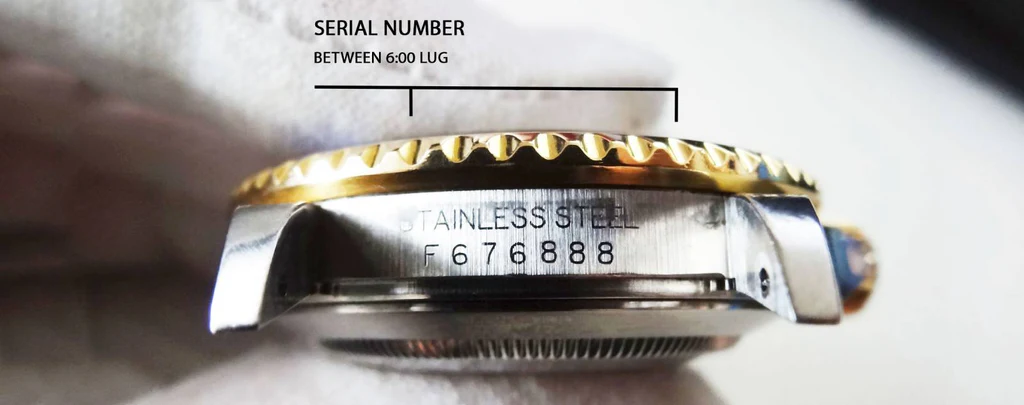
photo: diamondsourcenyc.com
In older models, produced before around 2007, you’ll find the number between the lugs at the 6 o’clock position. Newer pieces have it hidden under the bracelet—for example, a Submariner from 2010 requires you to remove the strap completely, while with a Daytona from 1995, you just need to tilt the watch at the right angle.
The list of essential tools is short, but every item matters:
• A screwdriver with a precise 1.6 mm diameter (other sizes will damage the screws)
• A protective pad made of soft material
• A magnifying glass or a good LED flashlight
• A clean, lint-free cloth
The procedure demands calm and precision. I once saw someone try to force it—the result was disastrous.
- Place the watch face down on the protective pad. Make sure the surface is stable and soft.
- Locate the screws connecting the bracelet to the case. In newer models, they are located on both sides of each lug.
- Unscrew the screws slowly, turning counterclockwise. Each screw requires about 3-4 full turns.
- Remove the bracelet carefully—do not pull on it; simply let it move away from the case freely.
- Look for laser engraving with a precision of 0.05-0.1 mm. The authentic number is clear yet subtle—it never appears mechanically stamped.
The issue format has changed significantly over the years. Here are the key differences:
| Year/period | Number format |
|---|---|
| 1953-1987 | 4-6 digits without prefix |
| 1987-2005 | Letter + 6 digits (e.g. A123456) |
| Since 2005 | “Scrambled” – random letters and numbers |
Differences in length are also significant—the oldest models sometimes have only 4 characters, while contemporary ones can have up to 8. The “scrambled” system introduced after 2005 makes the sequence look chaotic, but this is an intentional security feature.
Reading the number is just the first step. Now it needs to be verified—but that’s a completely different story that requires access to specialized databases.
photo: idwx.co
Digital and expert verifications: from databases to authorized showrooms
Mariusz from Kraków thought he owned a genuine Submariner from 1987. The serial number looked authentic, but when he visited the Rolex Passion Report forum, his world fell apart. It turned out that this particular number had already been reported as a counterfeit.
Once you have the serial number in hand, the real search for the truth begins. The problem is, every method has its pros and cons.
Online databases are the most commonly used because they’re free and fast. Bob’s Watches offers a pretty solid database, but it mainly covers the US market. Rolex Forums are a different story—thousands of enthusiasts share their findings, but… well, they’re just enthusiasts, not experts. Sometimes someone gets the production date wrong or misreads a number.
Authorized boutiques in Poland are a more serious matter. Aurifo or ZegarkiCentrum.pl have direct contact with Rolex, so their verification carries weight. You need to bring the watch, your ID, and some proof of purchase—if you have it. The process takes about a week, as the boutique sends an inquiry to Switzerland.
“Verification at the showroom comes with a fee, but it gives you absolute certainty. It’s the only method recognized by insurance companies,” says Tomasz Kowalski from Aurifo Warszawa.
And now for something completely new – the NFT system that Rolex has been testing since 2024. Some new models feature a microscopic QR code under the case. You scan it with a dedicated Rolex Authenticate app, which connects to the blockchain. It sounds futuristic, but it only works for the latest pieces.
Beware of various “Rolex Serial Checker” apps in app stores. Most of them are outright scams – they collect your data and sell it on. One such app had already reached 50,000 downloads before anyone realized it didn’t actually verify anything.
| Method | Time | Cost | Confidence |
|---|---|---|---|
| Forum/online database | 5 minutes | Free | 60% |
| Authorized dealership | 7 days | 200-500 PLN | 99% |
| NFT system | Instant | Free | 95% |
| Mobile applications | Instant | 10-50 PLN | 10% |
The truth is, no method is perfect. Even boutiques can make mistakes with older models whose documentation has been lost. But once we’ve verified the number, it’s time for what we fear most—looking for signs of a counterfeit.
Red flags and market stories: how a number reveals a fake
Seventy percent of counterfeits have errors in their serial numbers—according to a 2022 study by the University of Geneva. This means that most fakes can be identified if you know what to look for.
But in reality, not everyone has an eye for detail. I know someone who bought a “Rolex” for 2,000 PLN at a flea market, only to find out later that the serial number matched a model from the 1980s, even though the watch was supposed to be from 2015. A bit embarrassing, but these are exactly the kinds of mistakes counterfeiters make most often.
Five main warning signs when checking serial numbers:
- The number is printed instead of engraved
- The digits appear to be at different heights or in different styles
- The same number appears on many items online
- The number does not match the model’s year of production
- The number is missing in places where it should be
In 2023, Polish customs authorities confiscated 500 counterfeit luxury watches with a total estimated value of 1,200,000 PLN. Customs officers from Gdańsk later reported that the key to uncovering the entire batch was the identical serial numbers found on different models. One number, multiple watches—that’s the classic rookie mistake.
Meanwhile, Swiss police in the same year intercepted a shipment from China containing 2,000 counterfeits with serial numbers from the future—the production dates were set for 2025. Apparently, someone made an Excel error while generating the numbers.
Recently, someone on platform X shared that they avoided the “deal of a lifetime” for 2,000 PLN after checking the serial number on a collectors’ forum. It turned out that the same number had already been flagged as suspicious by someone else.
Check before you buy + Verify the number on the manufacturer’s website + Compare with online databases + Check compatibility with the model’s production year + Make sure the number is engraved, not printed
Serial numbers are not just a way to detect counterfeits. They can also reveal much more about the value and potential of a particular piece.
photo: oneluxe.id
Next step: how to use the number to make smart investments in Rolex
Now that you know your Rolex’s serial number, it’s time for the most important part—putting that knowledge into practice. This is where the difference between a collector and a true investor becomes clear.
Rare prefixes are a real goldmine. Watches from the ’60s or ’70s with unusual numbers can appreciate by as much as 40% over the next five years. Why? Because these pieces are getting scarcer, and the market is finally starting to notice.
Action plan after verifying the number
Step one—check the exact production date and compare it with auction prices from the past six months. This will give you a realistic picture of the market.
Step two—document everything. Take photos of the number, keep the certificates, gather all the papers. In 2024, this still makes the difference between a good and a great selling price.
Step three—track trends in your category. A 1965 Submariner is a completely different market than a 1980 GMT. Every model has its ups and downs.
Forecast for 2028 By the end of the decade, half of all verifications will be done online through advanced AI systems. Rolex will likely introduce RFID microchips in new models—it’s no longer science fiction, just a matter of time.
photo: wristler.eu
Blockchain could become the standard for documenting the history of luxury watches. Every part replacement, every service—everything recorded forever.
I’ve been thinking lately about how much the collectors’ market will change. Maybe in ten years, the serial number will be just one of many ways to identify a watch? But today, it’s still king.
A serial number isn’t just digits on a case. It’s a piece of history that connects you to previous owners, to the moment someone first put that watch on their wrist. That emotional value often outweighs pure financial calculations.
A true investor knows that every number tells its own story. Use that knowledge wisely.
Marciano
lifestyle editor
Luxury Blog




Leave a Comment