

Czech table porcelain – top brands, tradition, and quality
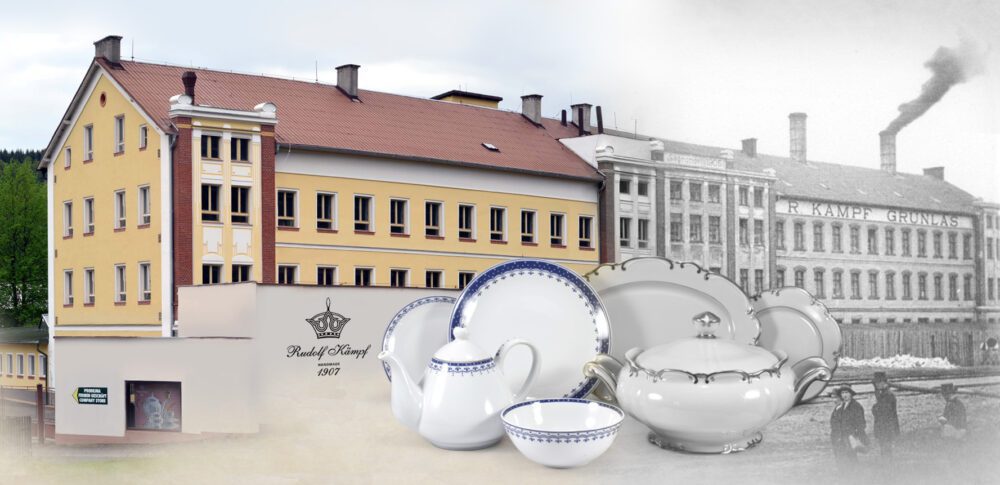
Imagine a material that has withstood 230 years of tradition and firing at 1,405°C. Such durability means that Czech plates and cups can handle anything: from thermal shock in the dishwasher to the daily tapping of a spoon against the rim. That’s precisely why this porcelain is found just as often on home tables as in hotel breakfast rooms or restaurant service.
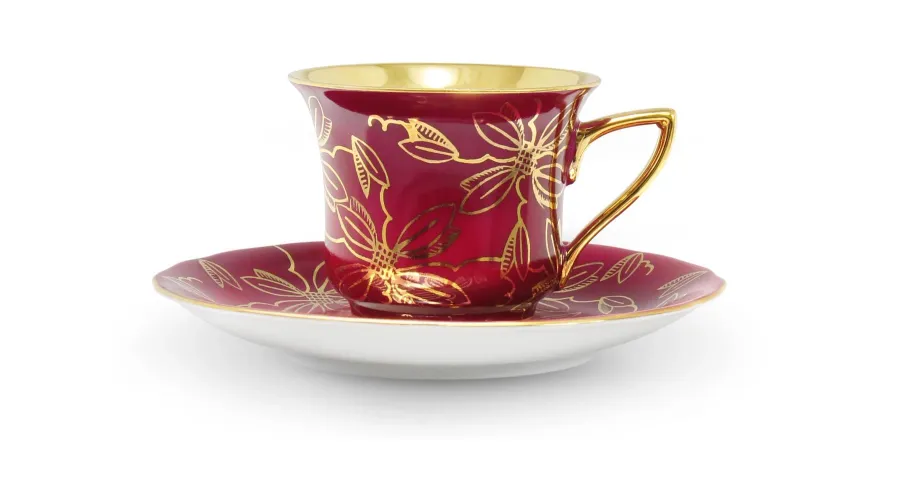
When we say ” Czech table porcelain “, we mean a complete universe: dinner and dessert plates, cups with saucers, bowls, teapots, entire sets for everyday use and elegant gatherings. The range? From minimalist stackable forms for bistros to hand-painted wonders with cibulák patterns, roses, or gilding.
Leander
In this article, we’ll take a closer look at brands worth knowing: Thun 1794, Český Porcelán Dubí (the one famous for cibulák), Rudolf Kämpf, Leander, and G. Benedikt Group. The Czech Republic combines traditional craftsmanship with unexpectedly modern shapes—ergonomic and practical. Here, hand decoration meets smart design that saves space in your cupboard.
Sounds interesting? Before we get into the details, it’s worth going back those 230 years to see how it all began.
Czech table porcelain – history and evolution
Leander
The Czech Republic began its adventure with porcelain relatively late, mainly due to Habsburg preferences for Vienna and Meissen. The first attempts in 1789 in Háje near Horní Slavkov ended in failure, but the breakthrough came in 1792 (Horní Slavkov) and in 1794, when Thun’sche Porcellanfabrik with the TK mark started operating in Klášterec nad Ohří. From that moment, the industry gained momentum.
Milestones 1792-2026
What happened over the next two centuries demonstrates the scale of change:
- 1792 – Horní Slavkov, the first successful manufactory
- 1794 – Klášterec nad Ohří (Thun), TK mark
- 1803 – Březová/Kysibl
- 1810 – Chodov, known for its pink porcelain
- 1818 – Loket
- 1820 – Staré Role
- 1864 – Dubí
- 1882 – G. Benedikt in Dvory (Karlovy Vary)
- 1885 – the first Czech production of cibulák (pattern inspired by Meissen)
- 1888 – Lesov
- 1907 – Loučky, Rudolf Kämpf
- 1921 – Nová Role
- 1945+ – nationalization of the entire industry
- 1989 – privatization after the political transformation
- 2009 – Thun acquires Lesov and Nová Role
- 2021 – opening of the Thun Visitor Center
- 2023 – end of production in Klášterec, relocation to Nová Role and Lesov
- 2026 – Porcelain Festivals in Karlovy Vary (May 8-10 and September 4-6)
Leander
Czech porcelain has drawn inspiration from China and Japan from the very beginning, but it was cibulák (since 1885) that became the hallmark of the region. Thuringian design also played a formative stylistic role. After the war, everything ended up in the hands of the state, and the breakthrough of ’89 paved the way for the modern formula: gastro export plus craftsmanship in tandem with automation.
Top brands worth knowing
Czechia may be small on the map, but it’s a giant when it comes to porcelain. Several manufactories are still operating at full capacity, each with its own niche and scale. It’s worth knowing who stands behind what.
Leander
Thun 1794, or an industrial giant
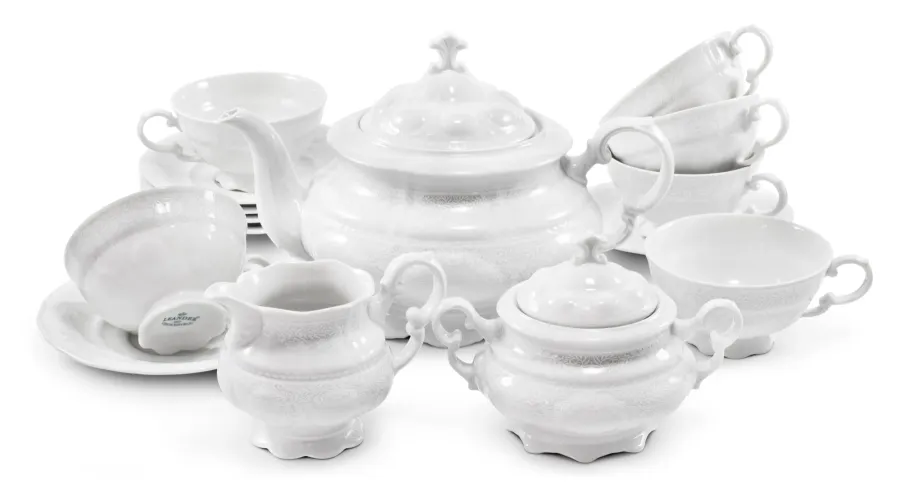
The largest manufacturer, headquartered in Nová Role. Over 230 years of tradition, but this isn’t sentimental craftsmanship—it’s scale: 3,500–4,000 tons of porcelain annually. Hard porcelain, fired up to 1,405°C. About 70% of production is tableware, the rest are figurines and accessories. They specialize in customizations for retail chains (you’ve seen their logo on saucers in malls, I guarantee it). In 2023, they closed the plant in Klášterec and concentrated production in Nová Role and Lesov. They even have a Visitor Center. The company describes itself as: “High quality, unique design based on 230-year tradition.” It sounds like advertising, but the numbers back it up.
Český Porcelán Dubí, master of cibulák
Since 1885, they have specialized in one pattern (cibulák, that blue onion design), but in over 850 shapes and 660 variations. An obsession with detail. 70% is exported to 90+ countries, and they have received the “Rodinné stříbro” (national brand) award multiple times. Dubí is essentially a factory of a single motif, but since it has lasted 140 years, it works.
Leander/Rudolf Kämpf, premium handmade
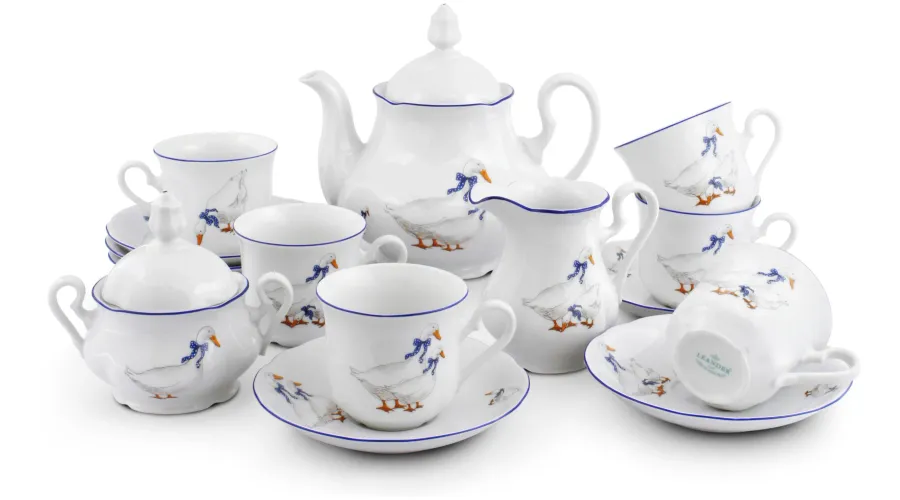
Loučky, since 1907. This is more of a boutique than a factory: handcrafted production + modern designs. A premium brand, present at Ambiente 2026 in Frankfurt. Part of the G. Benedikt group, so they have strong backing, but maintain an artisanal character.
Leander
G. Benedikt Group, the standard for gastronomy
Dvory near Karlovy Vary, since 1882. Specialization: hotel and gastronomy porcelain. They cooperate with Lilien Austria and Suisse Langenthal, produce approx. 1.78 million pieces annually, and distribute to 48 countries. If you’ve eaten at a decent restaurant in Central Europe, you’ve probably used their plates.
These four brands share one thing: durability that is no coincidence.
Technology and quality of Czech porcelain
An interesting thing: people ask why Czech porcelain lasts for decades, and the answer lies in specific parameters, not magic. Temperature, kaolin, the method of applying the pattern—all of these determine whether a plate will survive 500 dishwasher cycles or give up after twenty.
Leander
The foundation of durability
Most Czech products are made of hard kaolin porcelain, fired at temperatures up to 1,405°C. This is a hotel standard that ensures resistance to thermal shock (pouring hot soup into a cold plate), impacts, and aggressive detergents. The products are generally dishwasher and microwave safe, although gilding and plating require caution. An alternative is bone china, which is lighter and contains bone ash, but this is a niche; the core of production is hard porcelain.
Aesthetics that work
Underglaze patterns ( like the iconic cibulák) applied before glazing are virtually resistant to abrasion. Other techniques include:
- hand painting (squirrel hair brushes, now rare)
- spray and stamp
- screen printing – In 2015, Thun was producing 25 million pieces annually using this method, so we are talking about an industrial scale
Shapes? Classic ones, like Opal or Tom, still work. Modern stackable designs (Reset Dubí) save space in the cupboard, while ergonomic ones ( Lea by Thun) fit better in the hand during service. This isn’t a whim, but functionality tested in professional kitchens.
The result? Porcelain that handles everyday use without excuses.
Choice, authenticity, and care
A good porcelain set should, above all, suit the way you intend to use it. The difference between a set for home and a gastro line is not just the price, but a completely different design philosophy.
Leander
For home or for gastronomy?
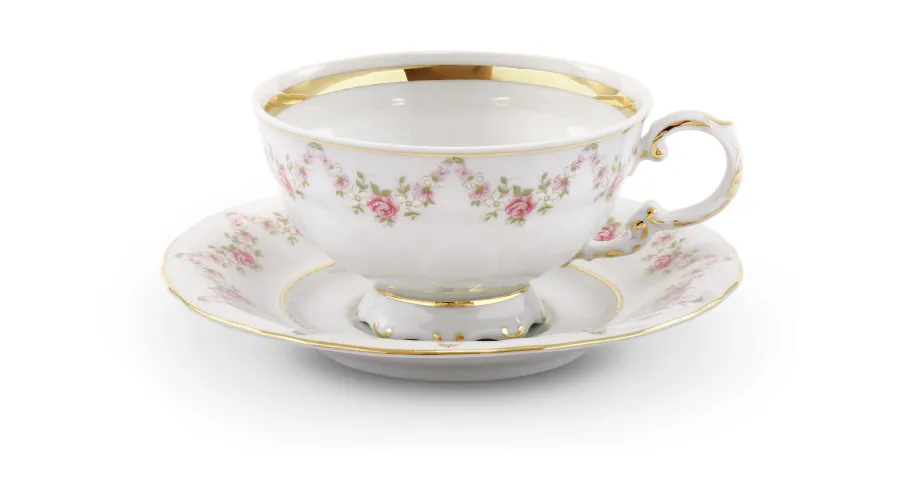
If you’re choosing for a hotel or restaurant, opt for the gastro lines. G. Benedikt offers the Princip and Praha series, which are stackable (saving space in the dishwasher!) and withstand intensive use. For home? Classic styles work better. T hun Bernadotte with roses and gilding is a proven choice for festive occasions, with sets for 6 or 12 people. And if you need something for everyday use, modern ergonomic designs like Lea from Thun are truly comfortable to use.
How to recognize an original?
Pay attention to the manufacturer’s mark, such as the historic TK at Thun or the Dubí logo. Check if the decoration is consistent and the glaze is even. Watch out for counterfeits with the overused word “Bohemia” without a specific brand. It’s best to buy from official e-shops of the manufacturers ( Thun, Dubí, Leander, G. Benedikt) or from trusted distributors. In Dubí, the House of Porcelain operates, where it’s easier to verify the origin. Moreover, Czech exports reach over 90 countries, so you can also find authentic products locally.
It’s worth knowing that the Porcelain Festivals in Karlovy Vary will take place on 8-10.05.2026 and 4-6.09.2026. Brands present their new products there, and at Ambiente 2026 in Frankfurt, you’ll see market trends.
Usage and care
Most sets are dishwasher and microwave safe. But be careful with gold or platinum decorations—these require hand washing. Underglaze patterns, like cibulák, are highly resistant to abrasion and are virtually indestructible. Simple rules will save you stress.
Porcelain that combines tradition with everyday life
Czech porcelain is more than just tableware for special occasions or a decoration in a display cabinet. These are items you can truly use, and that’s where their strength lies. Traditional patterns and hand-painted details don’t mean a plate has to sit on a shelf. For years, these manufacturers have been making porcelain you can put in the dishwasher after Sunday lunch, and nothing will happen to it.
Interestingly, it’s this ease of everyday use that keeps the tradition alive. When a beautiful set serves the family at every meal, not just on special occasions, it becomes part of life. You’re passing on not just an object, but a custom.
Leander
It may sound simple, but porcelain you’re not afraid to use is the only porcelain that will survive for generations. Because when it’s used and appreciated every day, it truly has a chance to become a legacy.
Mariano EFF
lifestyle & brands editorial team




Leave a Comment